Articles

How to Learn Forex Trading (Without Wasting Years on the Wrong Things)

Most people who set out to learn forex trading start in the wrong place. They open a demo account, download three indicators, watch a handful of YouTube videos, and start clicking buy and sell on whatever pair looks interesting that day. A year later they’re in the same spot, just with more screen time and less money.

I’ve been trading price action for years, and I’ve mentored enough people through this process to know exactly where it goes wrong. Learning forex trading isn’t about accumulating information. It’s about acquiring one specific thing: a genuine, professional-level understanding of why market participants behave the way they do. Almost nobody manages to build that understanding from public sources, and honestly, most paid courses don’t get you there either. That’s not because the skill itself is rare or unteachable. It’s because very few people teaching it actually have it, and even fewer are willing to teach it directly instead of selling you a simplified version.

This article lays out what that understanding actually is, why it’s so hard to find, and why – contrary to what most of the industry implies – it doesn’t have to take years to acquire if you’re learning from the right person.

Why Most People Learn Forex Trading Backwards

The typical entry point into forex is a search for “the best strategy” or “the best indicator combination.” That instinct is understandable, but it’s also the reason so many traders stay stuck indefinitely. A strategy is a fixed set of rules applied to a market that doesn’t hold still. The market changes character depending on who’s active, what’s been triggered, and where the pressure is building. A rule that worked last Tuesday can fail today for reasons that have nothing to do with the rule itself.

I wrote about this in more depth in my piece on trading forex for beginners, where I go through the difference between retail illusions – pattern memorisation, indicator stacking, chasing the “holy grail” setup – and what professional traders actually spend their time learning: participant behaviour and context. If you haven’t read that one yet, it’s a good companion to this article because it explains the why behind everything below.

The short version is this: learning forex trading is not about learning to recognise shapes on a chart. It’s about learning to read what other participants in the market are likely doing, and why. That’s the professional understanding I keep coming back to, and it’s worth being precise about what it actually is, because the term gets diluted constantly.

What “Professional Understanding” Actually Means

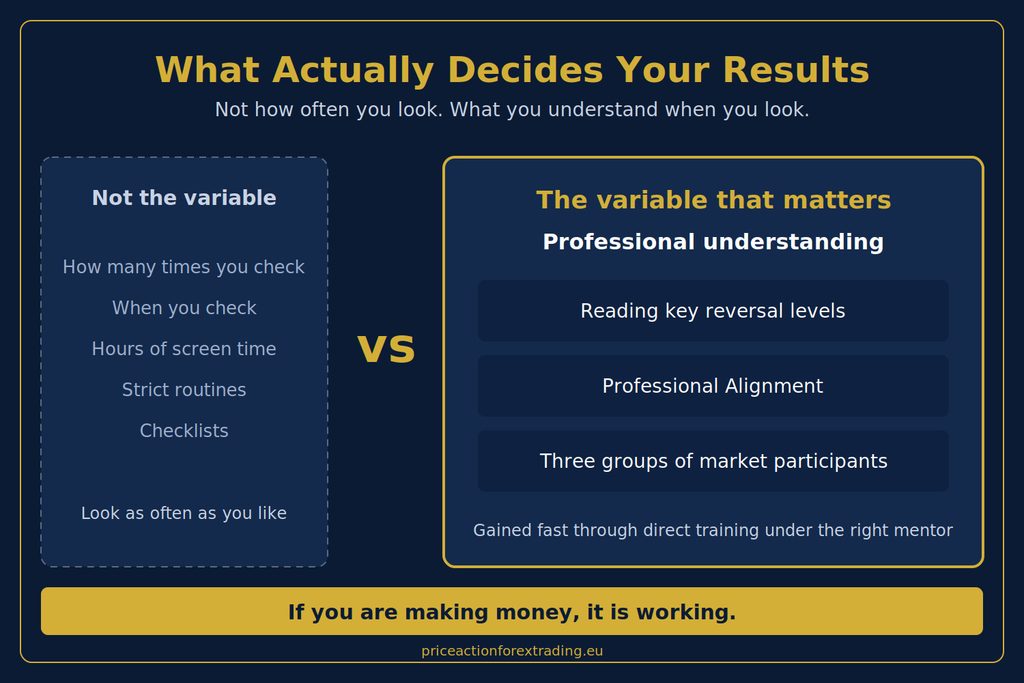
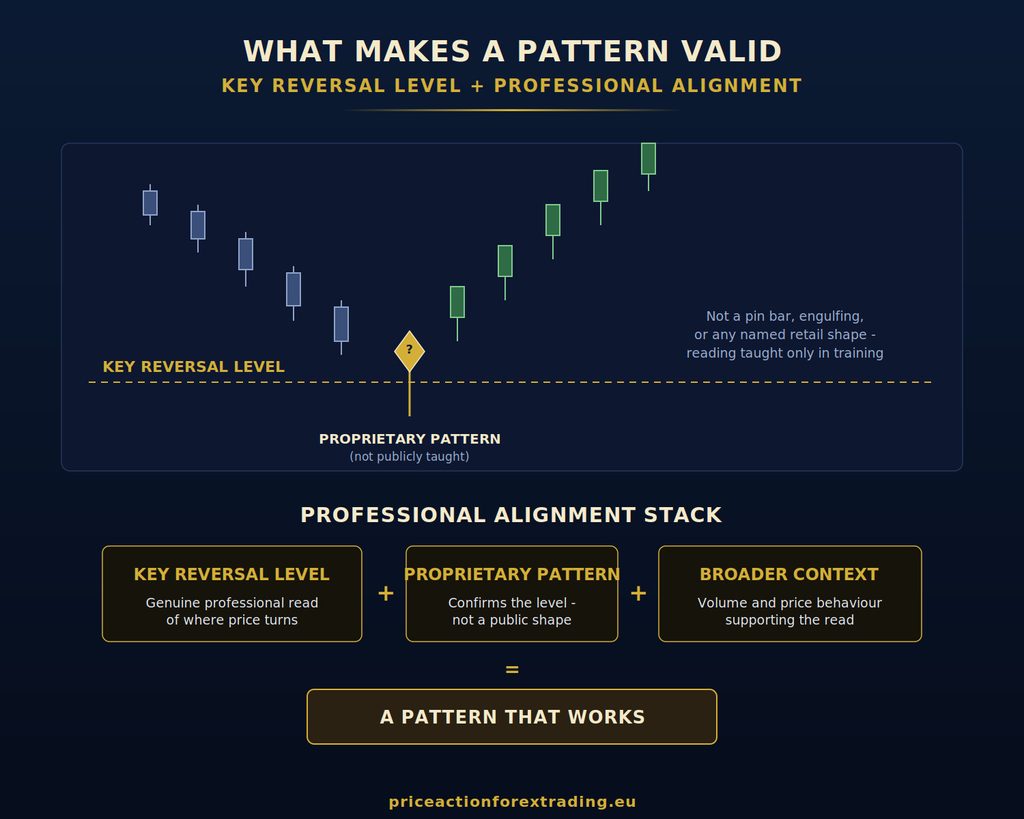
Professional understanding isn’t a bigger pile of information. It’s a different kind of information entirely. Retail education, free or paid, tends to teach you what to look for: a shape, an indicator crossing a line, a level being touched. Professional understanding teaches you why price is likely to behave a certain way at that level, based on who is positioned there, who’s trapped, who’s still got orders resting, and what happens when that pressure gets released.

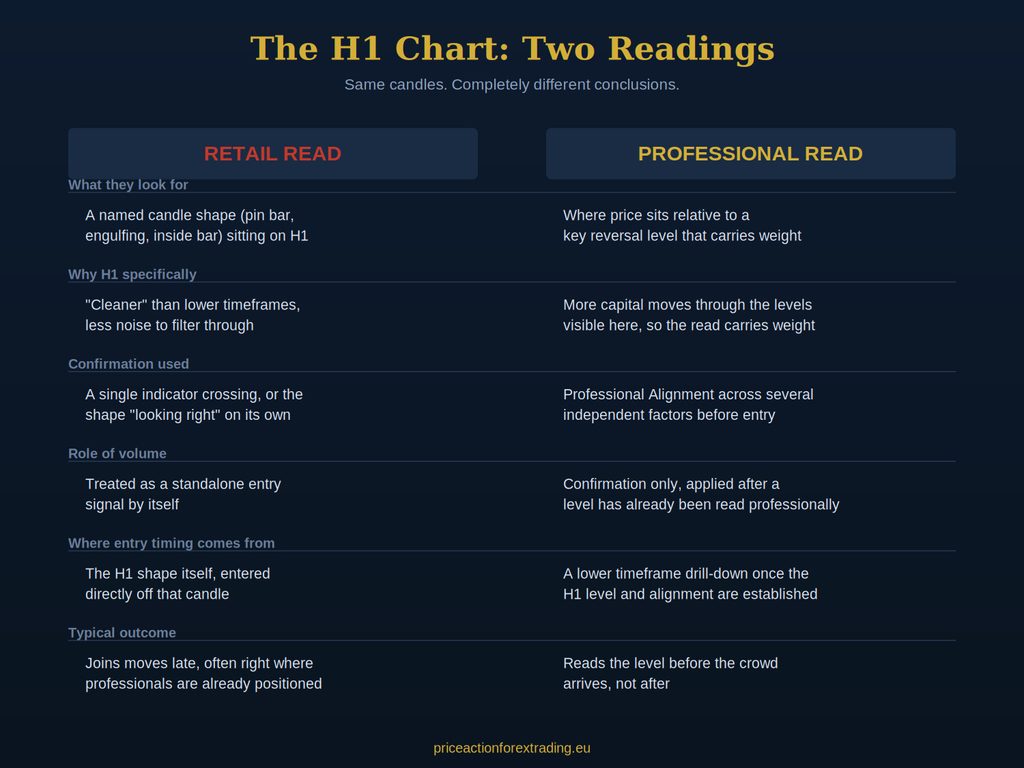
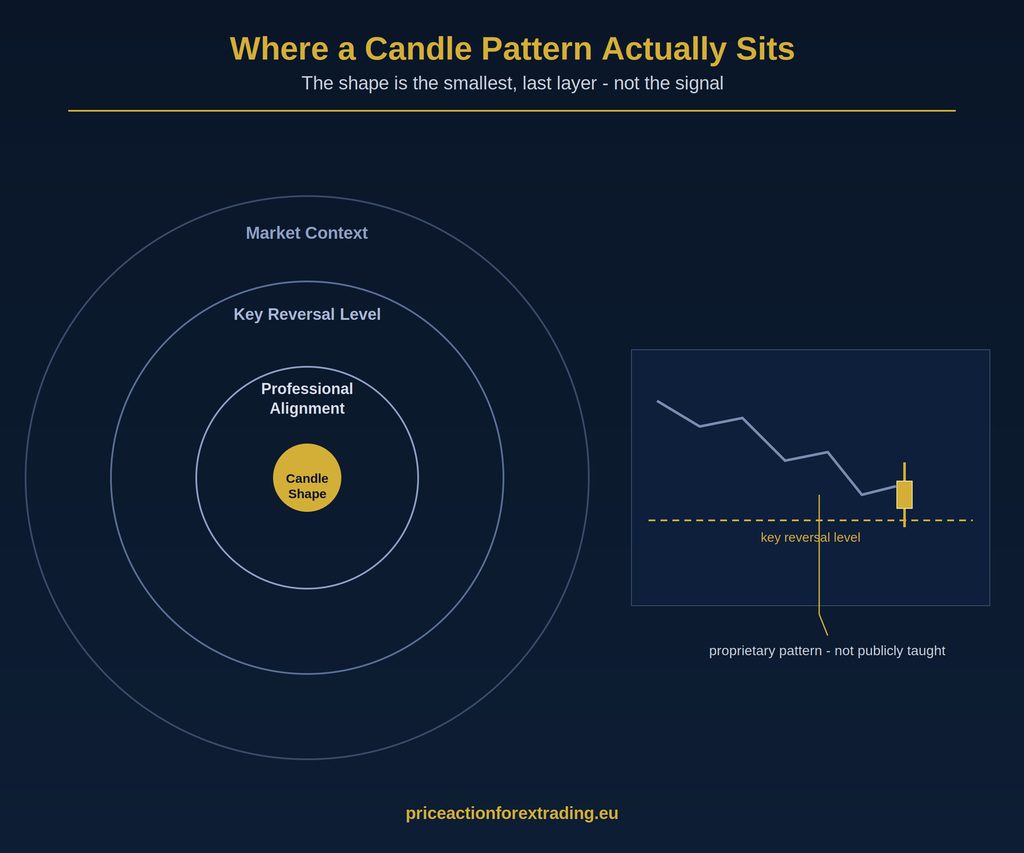
That distinction sounds subtle until you watch it play out. Two traders can look at the exact same chart. One sees “a pin bar at resistance,” applies the rule they were taught, and takes the trade. The other sees the same candle but reads it in the context of the session, the recent positioning, and the likely behaviour of the participants who got caught on the wrong side of the last move – and that reading tells them something completely different about what’s likely to happen next. The first trader is applying a pattern. The second is reading behaviour. Only one of those skills survives contact with a market that doesn’t behave the same way twice.

Forex isn’t a single, centralised market either, which matters for this same reason. It’s a decentralised network of brokers, banks, liquidity providers, and retail platforms, and depending on where you’re trading from, you may only ever be trading against your own broker rather than the wider interbank flow. I broke this down in detail in my article on the illusion of forex market turnover, because the “$9.6 trillion a day” statistic gets thrown around constantly and it misleads new traders about what they’re actually participating in. Understanding that structure is part of professional understanding too – you’re not reading a single global market, you’re reading the specific sandbox of participants you’re actually exposed to.

Why You Won’t Find This in Public Sources

This is the part that frustrates me most about the state of forex education. Free content – YouTube, forums, blog posts – almost never goes beyond the surface, and there’s a simple reason for it: teaching genuine participant behaviour takes direct explanation in live markets, usually sitting one-on-one with a real professional trader. It doesn’t compress into a ten-minute video or a forum post with a screenshot and three bullet points. So what gets produced instead is content about indicators, chart patterns, and generic “rules,” because that’s what’s actually possible to package and distribute at scale for free.

What surprises a lot of people is that this problem doesn’t fully go away once money enters the picture. A large share of paid forex courses are simply a better-organised version of the same surface-level material – fixed setups, presented as universal rules, taught by people whose main trading activity is selling the course rather than trading live, funded accounts themselves. Paying for a course doesn’t automatically buy you professional understanding. It buys you organisation, at best. The understanding itself only gets transferred when the person teaching it actually has it, and is willing to explain the reasoning behind it rather than just handing you a rulebook.

The Four Stages Everyone Goes Through

Every trader I’ve worked with, myself included, goes through the same rough sequence. Where people get stuck longest is usually the same point too, and it’s worth naming clearly so you can recognise it if it’s happening to you right now.

Stage one is mechanics. Learning what a pip is, how leverage works, how to place and manage an order. This is necessary, but it teaches you nothing about how to actually trade. It’s plumbing, not skill.

Stage two is pattern chasing. This is where most retail traders get stuck, sometimes for years. Indicators, candlestick names, chart patterns, “setups” copied from a course or a forum. Confidence goes up because everything feels like it has a name and a rule. Results stay random because the rules don’t account for context.

Stage three is the wall. The setups that seemed to work stop working. Doubt creeps in. This is where most traders quit, or start hopping from system to system, never realising the problem isn’t the system – it’s that they’re still operating on patterns instead of understanding.

Stage four is professional understanding. Context replaces patterns. You start reading who’s trapped, who’s committed, and why price is likely to move the way it’s about to move. This is the stage that separates people who trade for a living from people who trade as an expensive hobby, and it’s the stage most retail traders never reach on their own, simply because nobody ever showed them what it actually looks like.

Here’s the part worth emphasising: stage four doesn’t have to take years. It takes years for people trying to reach it through trial and error, or by piecing it together from public sources and generic courses, because nobody is correcting their reasoning along the way. With direct, experienced mentorship, that same understanding can be transferred far faster. The bottleneck was never intelligence or time served at the charts. It’s whether someone who genuinely has the understanding is willing to explain it to you directly.

Structured, Mentored Learning Changes the Timeline

You can, in theory, get from stage one to stage four entirely on your own. Some people do, eventually. But self-teaching means you’re both the student and the only source of feedback, and when you’re new, you don’t yet know what good feedback even looks like. Every mistake gets discovered late, often after it’s already cost you.

A structured, mentored path compresses that timeline considerably – not because it’s magic, but because it removes the guesswork about sequencing and replaces trial and error with direct correction. You’re not trying to figure out what to learn next; someone who already has professional understanding is transferring it to you directly, and correcting your reasoning while it’s still forming rather than after it’s already cost you a string of losing trades.

This is the whole idea behind my forex training course. It’s built to teach genuine, professional-level market understanding, and it suits new traders and experienced traders alike – the material isn’t gated behind years of prior screen time. What matters isn’t how long you’ve been trading before you start; it’s that you’re being taught to read participant behaviour directly rather than left to reconstruct it from patterns over the coming years.

The Learn to Trade in 5 Days Programme

I also run a Learn to Trade in 5 Days programme, and I want to be clear about what it actually is, because it’s often assumed to be a stripped-down taster meant to funnel people into buying more. It isn’t. It teaches the same professional, participant-behaviour-based understanding as everything else I teach – just built around one specific strategy rather than the broader curriculum. It’s a complete, standalone programme, and traders have built real profitability from this course alone, with nothing else required afterward.

The five days isn’t a compressed crash course in the sense of “here are the basics, upgrade later for the real material.” It’s five days because that’s what it takes to transfer professional understanding of one strategy properly, when it’s being taught directly rather than left for you to piece together yourself.

Mentorship vs. Self-Teaching

There’s a difference between having a mentor and having bought a course, and it’s worth being clear-eyed about which one you actually have. A course gives you material. A mentor gives you correction – someone looking at your specific reasoning and telling you what you’re missing, in real time, rather than you discovering it three months later through a losing streak.

I wrote about this distinction at length in my article on finding a forex mentor, including how to tell a genuine mentor apart from someone who’s just selling a course or a signal service under a different label. It’s worth reading before you commit money to anyone claiming to teach you this, mentorship included.

The value of a real mentor isn’t the information they hand you. It’s that they shorten the distance between not understanding and understanding, because they’re correcting the specific gaps in your reasoning rather than delivering generic material to everyone at once.

Common Mistakes That Keep People Stuck

A few habits show up again and again in traders who’ve been “learning” forex for years without actually progressing. Recognising them in your own routine is worth more than any new piece of information you could add on top.

Switching strategies after a handful of losses. Two or three losing trades tell you almost nothing about whether an approach works. Abandoning it that quickly means you never gather enough data to know if the problem was the method or the execution.

Treating every loss as a mistake to fix. Losses are a normal part of a probability-based activity. Trying to eliminate them entirely leads traders toward over-optimised systems that fall apart the moment conditions shift slightly.

Learning in isolation from context. Studying a setup without understanding the conditions it depends on – session, volatility, where the broader positioning sits – means you’re memorising a shape rather than understanding a mechanism.

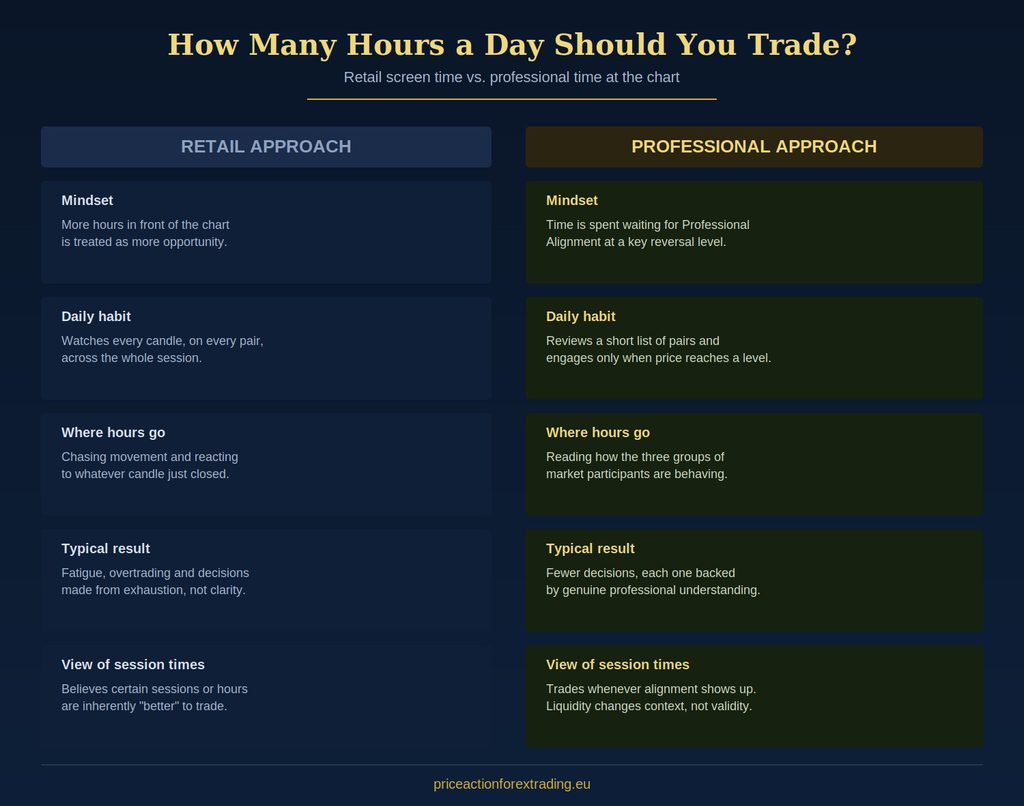
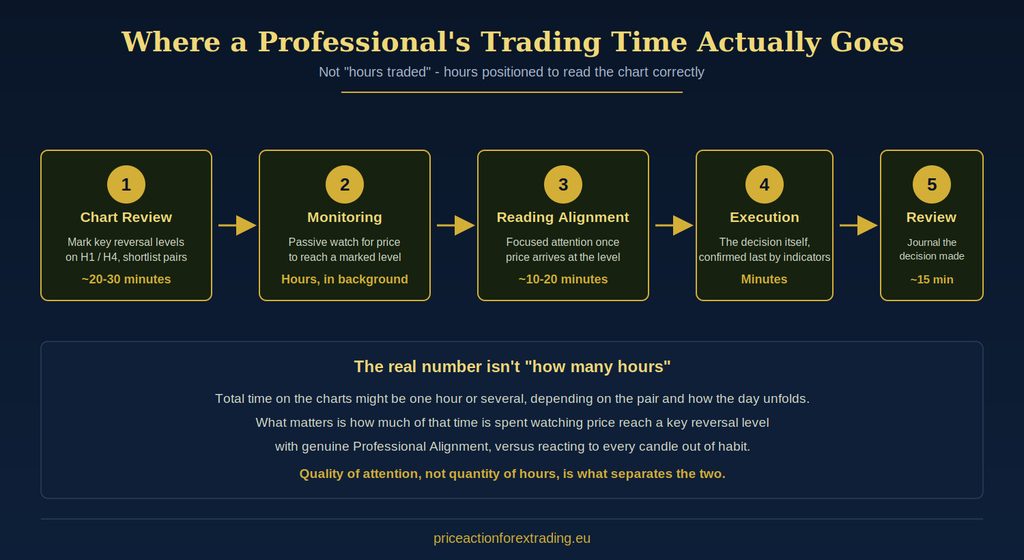
Assuming more screen time equals more learning. Watching the charts for eight hours a day doesn’t teach you anything if nobody is correcting your reasoning afterward. Direct, corrected feedback on a small number of trades will teach you more than passive watching ever will.

Learning exclusively from people who’ve never traded live, funded accounts. A lot of forex education online, free and paid, is produced by people whose primary income is the education itself, not the trading. That doesn’t automatically make the content wrong (in most cases it does), but it’s worth knowing whether the person teaching you has actually built the understanding they’re describing.

What Realistic Progress Looks Like

I’m not going to tell you to be patient and content with plateaus and losing streaks – that’s the same line every guru uses to excuse mediocre teaching, and it’s not true if the teaching is actually good. Under the right mentor, corrections happen fast. A flawed piece of reasoning gets caught and fixed the same day it happens, not three months later after it’s cost you a string of losing trades. Put in real effort under direct, competent correction and the results show up quickly, both in how you think about trades and in your account balance.

What separates fast progress from slow progress isn’t mindset or patience. It’s whether someone with genuine understanding is watching your reasoning closely enough to correct it immediately. Self-taught traders stay stuck for years because nothing ever interrupts a bad habit until it’s already expensive. With the right mentor, that loop gets closed almost immediately – which is exactly why effort under proper guidance pays off far sooner than the industry likes to admit.

Final Thought

Learning forex trading properly comes down to acquiring one thing that’s genuinely hard to find: professional-level understanding of why participants in this market behave the way they do. Public sources rarely go deep enough to teach it. Most paid courses don’t either. And the years it supposedly takes to acquire aren’t really about the market being that hard to understand – they’re about how long it takes to reach that understanding through trial and error, without anyone correcting your reasoning along the way.

With the right mentor, that timeline changes considerably. My forex training course is built for new and experienced traders alike around exactly this kind of direct teaching, and my Learn to Trade in 5 Days programme delivers that same understanding as a complete, standalone course built around a single strategy – not a teaser for something bigger.

What Is a Managed Forex Account? How It Actually Works

A managed forex account is an arrangement where a professional trader makes trading decisions on your behalf, inside an account that stays in your own name at your own broker. That’s the whole concept. Everything else, the different account structures, the fee models, the ways this gets abused, is detail worth understanding before you commit any capital to one.

This article covers how managed accounts are actually structured, where they differ from copy trading and signal services, how guaranteed-return products actually work versus performance-fee managed accounts, and what to check before you sign anything.

The Core Mechanism: Limited Power of Attorney

A managed account works through a Limited Power of Attorney (LPOA), sometimes called trading authority. This is a legal document granting a named third party permission to open and close trades on it. It does not grant permission to withdraw funds. Withdrawal rights stay with the account owner (you) – unless you separately and explicitly authorize otherwise, which you shouldn’t.

This distinction is the entire basis of a legitimate managed account. The moment money leaves your own named account at a regulated broker and moves into someone else’s wallet, company account, or an unregulated pooled structure, you’re no longer dealing with LPOA-based management.

PAMM, MAM, and Privately Managed Accounts: The Real Differences

These three terms get used interchangeably in marketing material, and that’s part of the problem, because they carry meaningfully different risk profiles.

PAMM (Percentage Allocation Management Module) pools investor capital into a single master account. Your deposit becomes a percentage share of that pool, and trades are executed once at the master level, then allocated proportionally across every investor. You don’t own individual positions; you own a fractional claim on the pool’s overall equity. This is efficient for the manager and the broker, but it means your outcome is tied to everyone else’s capital movements in and out of the same pool, not just to the trading itself.

MAM (Multi-Account Manager) is closer in spirit to individual account management than it is to PAMM, despite the similar name. A manager trades from a master interface, but each investor’s account remains separately held, with its own lot sizing, its own leverage, and often its own risk multiplier relative to the master strategy. You can typically see your own account’s individual trade history, not just a pooled statement. It’s a middle ground: more operationally efficient for a manager running many clients, while keeping your capital and your trade record separated from other investors’.

Privately managed accounts go furthest in the other direction. The manager trades your account directly, one account at a time, under LPOA. There’s no pooling and no master allocation logic sitting between the decision and your account. It’s the most transparent structure, and also the least scalable for a manager, which is worth knowing, because it shapes how many clients a manager can realistically take on without their attention getting diluted.

None of the three is automatically dishonest. But if a manager can’t clearly explain which structure you’d be in and why, that’s worth pausing on before you go further.

Managed Accounts vs. Learning to Trade Yourself

These solve different problems. A managed account gives you market exposure without you having to develop the skill yourself. Learning to trade gives you the skill itself, at the cost of the time it takes to build it properly.

If the goal is capability you own indefinitely, that only comes from structured, deliberate practice, not from watching someone else’s results. My Forex Training Course exists for people taking that route.

If the goal is simply return on capital without becoming a trader, a properly structured managed account is a more direct answer than either of those courses, and you should evaluate it on its own terms rather than as a substitute for learning.

Managed Accounts vs. Copy Trading: The Real Problem

Copy trading platforms let you automatically mirror another trader’s positions into your own account. The pitch is simple: find a trader with good results, connect your account, and their trades replicate into yours in real time.

Trading without a fixed stop-loss order isn’t inherently reckless. Plenty of experienced traders run strategies without one, managing risk instead through position sizing, exposure limits, or structural invalidation levels that don’t sit as a mechanical order on the platform. That’s a legitimate professional approach, and it looks nothing like what usually dominates copy trading leaderboards.

The actual problem on most copy platforms is what sits behind the missing stop, not the absence of the stop itself. The traders who climb highest on public leaderboards typically get there by taking oversized positions relative to their account size, often adding to losing trades (martingale or grid-style) without any coherent framework for how much exposure that can absorb before it becomes unrecoverable. There’s no professional risk management happening, and no stop, because there’s no plan for what happens if the trade keeps moving the wrong way. It just keeps getting bigger until the account can’t hold it.

That combination produces a smooth, high-win-rate equity curve for months or even years, because almost every trade eventually turns around given enough added size and enough time. It looks exceptional on a leaderboard sorted by return. It isn’t. It’s an account carrying steadily increasing, undefined risk, and undefined risk doesn’t fail gradually. It fails once, entirely, when a large enough adverse move arrives (a surprise rate decision, a geopolitical shock, a broker gap over a weekend) that the position size can no longer absorb. The curve that looked flawless for eighteen months can be wiped out in a single session.

This is a structural feature of that specific style of copy-trade leaderboard trading, not just bad luck. The longer it runs without failing, the more followers it attracts, and the larger the eventual damage when it does. If you’re evaluating a trader to copy, the relevant question isn’t simply “do they use a stop.” It’s whether their position sizing has a defined ceiling regardless of how a losing trade develops, and whether they can explain that ceiling in specific terms rather than pointing at a smooth equity curve as proof enough.

Guaranteed Returns vs. Performance-Fee Managed Accounts

Guaranteed returns aren’t automatically a scam, but they’re a completely different product from a standard managed account, and the two get confused constantly.

A legitimate guaranteed-return product works because the provider, not the investor, is absorbing the downside risk. In exchange for that certainty, the return offered is deliberately conservative, well below what the actual trading typically produces, because the investor is paying a premium for security rather than for maximum upside. This is closer to a fixed-income or structured product than to a typical trading arrangement. I offer this myself as one option, alongside my managed account service: a lower, fixed rate, because I’m the one carrying the risk if trading conditions turn against the position.

A standard managed account works on the opposite principle. There’s no guarantee, because the risk is shared between you and the manager rather than carried entirely by one side. If the account draws down, you feel that directly, not the manager. In exchange, the upside is shared too, and the manager is typically compensated only through a performance fee on profit generated, meaning they earn nothing if you don’t. That alignment, only getting paid when you get paid, is the actual safeguard in this structure, not a promised number.

What separates a real guaranteed product from a Ponzi structure isn’t the presence of a guarantee. It’s whether the provider can explain, specifically, how the guarantee is backed: what capital reserve, hedge, or conservative allocation makes it possible for them to absorb a loss and still pay you the promised return. If a guarantee is offered with no explanation of what stands behind it, and the return is high rather than conservative, that combination is the actual warning sign, because the only way to fund a high fixed return without a real backing structure is to pay it from new investor deposits. That’s a Ponzi mechanic regardless of how it’s marketed.

Fees: What You’re Actually Paying For

Managed account fee structures generally combine two components: a management fee, a flat percentage charged on the capital under management regardless of performance, and a performance fee, a share of the profits generated, usually calculated against a high-water mark so the manager only gets paid on new profit, not on regaining ground after a loss.

Watch for structures that skip the high-water mark. Without one, a manager can lose money one month, recover part of it the next, and still collect a performance fee on that partial recovery, effectively getting paid twice for the same ground. Ask directly how the performance fee is calculated and whether losses carry forward before new profit is counted.

Fund Custody and Regulation

Before anything else, confirm where your money actually sits. In a properly structured managed account, funds remain with a regulated broker, in an account opened in your own name, using your own identification documents. You should retain full login access to that account independently of the manager’s LPOA access at all times.

Look up the broker’s regulatory status yourself rather than taking a manager’s word for it. Regulation doesn’t guarantee the manager is competent, that’s a separate question entirely, but it does mean client funds are legally required to be held separately from the broker’s own operating capital, and there’s a recognized authority to escalate to if something goes wrong. If a manager insists you open your account exclusively through their own referral link and discourages you from verifying the broker independently, that’s reason enough to slow down.

Keep in mind that I often direct clients to offshore entities of worldwide-known brokers for higher flexibility. However, I only do it with brokers who have multiple licences in Tier 1 countries (e.g. EU, UK, Australia) and who have good reputation. I don’t deal with brokers who are licensed only in offshore jurisdictions as it means they are not well capitalised and there’s too much financial incentive for them to simply run away with your capital.

A Managed Forex Account Option

I run a Managed Forex Trading service structured as an individual account under LPOA, compensated on a performance-fee basis, for people who’ve weighed this against the alternatives above and decided it fits what they’re looking for. The page covers the structure and terms directly.

Frequently Asked Questions

Is a managed forex account safe? No form of market exposure is risk-free. What a properly structured managed account gets right is custody: your funds stay in your own name, at your own regulated broker, and the manager never holds withdrawal rights.

What’s the difference between PAMM, MAM, and a privately managed account? PAMM pools your capital with other investors’ into a single fund and allocates trades proportionally. MAM keeps your account operationally separate with its own lot sizing while trading from a shared master strategy. A privately managed account has a manager trading your account directly, with no pooling or shared allocation involved.

Can I lose money in a managed forex account? Yes. Any process exposed to market movement can produce losses. The relevant question isn’t whether losses are possible, they always are, but how positions are sized and what’s the underlying logic behind the trading decisions.

What’s the difference between a managed account and a hedge fund? A managed forex account usually keeps your capital in an individually held broker account under LPOA. A hedge fund pools investor capital into a single legal fund structure, typically with less visibility into individual trade decisions and a different regulatory framework.

Can I withdraw my money whenever I want? In an individual managed account, yes, because the account is opened in your name and you retain independent access to it. If withdrawals require the manager’s sign-off or route through a portal separate from your own broker login, clarify that before depositing anything.

Can a managed forex account offer guaranteed returns? A standard performance-fee managed account, no, because risk is shared between you and the manager rather than carried by one side. Guaranteed-return products exist as a separate offering, where the provider absorbs the downside risk directly and prices that certainty into a deliberately conservative, fixed rate.

Final Thoughts

A managed forex account is a straightforward arrangement in principle: your money, your named account, someone else making the trading decisions under a legal authority that stops well short of letting them touch your funds. Where it goes wrong is almost always in the gap between that principle and the structure actually being used, whether that’s a pooled account presented as individual, a copy-trade leaderboard built on undisciplined position sizing, or a guaranteed return with no explanation of what’s actually backing it.

Check the structure, check custody, check how position sizing, fees, and any guarantee are actually backed, and treat any of those questions being dodged as your answer.

Trading Forex for Beginners: What I Wish Someone Had Told Me on Day One

When I placed my first forex trade, I had no idea what I was actually doing. I’d watched a few YouTube videos, went to a 5 day broker-organised seminar, opened an account, and convinced myself that if I could just find the right indicator combination, the money would follow. It didn’t. What followed instead was months of blown demo accounts, a live account that bled slowly, and a growing suspicion that everyone selling “guaranteed” forex strategies online had never actually traded a real account under real pressure.

If you’re just starting out, I want to save you some of that time. This isn’t a hype piece about how forex will make you rich by next month. It’s the beginner’s guide I wish someone had handed me before I ever got myself into this game.

Why Forex Attracts So Many Beginners

Forex is the largest financial market in the world, with trillions of dollars changing hands every single day (although not exactly in the way you’d imagine). It’s open nearly 24 hours a day during the week, it doesn’t require huge starting capital, and you can open a demo account in minutes. All of that makes it incredibly accessible – which is both a blessing and a trap.

The blessing is that anyone with a laptop and an internet connection can learn to read a chart and place a trade. The trap is that this same accessibility is exactly why so many beginners jump in without understanding the basics, lose money quickly, and walk away believing forex trading “doesn’t work.” It works. But not the way most people are taught to approach it.

What Is Forex Trading, Really?

At its core, forex (foreign exchange) trading is the buying of one currency while simultaneously selling another. You’re not buying a stock or a company – you’re speculating on the relative value of two currencies against each other. If you believe the euro will strengthen against the US dollar, you buy EUR/USD. If you’re right and the euro rises, you profit. If you’re wrong, you lose.

That simplicity is deceptive. The mechanics are easy to explain in a paragraph. Doing it consistently, with discipline, over hundreds of trades, is a completely different skill – one that takes real study, not a weekend.

How the Market Actually Works: Pairs, Pips, Lots and Leverage

Before you place a single trade, there are four concepts you need to understand cold. I still remember how foreign this vocabulary felt in my first weeks, so let’s break it down simply.

A currency pair like EUR/USD tells you the exchange rate between two currencies – the base currency (EUR) and the quote currency (USD). A pip is the smallest standard unit of price movement, usually the fourth decimal place. A lot is the size of your position – a standard lot is 100,000 units of currency, and most beginners start with mini or micro lots to keep risk manageable. Leverage allows you to control a larger position than your account balance would normally allow, which means both your profits and your losses are magnified.

Leverage is the piece that gets new traders into trouble fastest. Used carefully, it’s a tool. Used carelessly, it’s how a small, manageable loss turns into an account-wiping one. Get comfortable with these four concepts before you risk a single euro – they’re the price of entry, but not the skill itself.

The Beginner Trap: Why Most New Traders Lose Money

Almost every beginner loses money in their first year. That’s not pessimism, it’s just what happens when you combine inexperience with real capital and real emotions. A few patterns show up again and again.

New traders over-leverage, risking far more of their account on a single trade than they should. They trade without a plan, entering positions because a chart “looks like” it might move rather than because a defined setup occurred. They chase losses, doubling position size after a loss to “win it back” instead of stepping away. They skip education entirely, jumping straight from a YouTube video to a funded live account. Or, what’s even worse, they respect education and they do buy a nice looking trading course, only to be fed worthless retail bullshit – in other words, paying to be taught how to lose.

I made every one of these mistakes myself. What changed things for me wasn’t a new indicator – it was finding a proper mentor who’d actually traded professionally and could show me, in real time, why my process was broken. If you’re evaluating who to learn from, it’s worth understanding the real difference between a genuine mentor and someone simply selling a course or signals, because that distinction shapes everything about how quickly – and how safely – you progress.

Building Your Foundation: Why I Trade Price Action

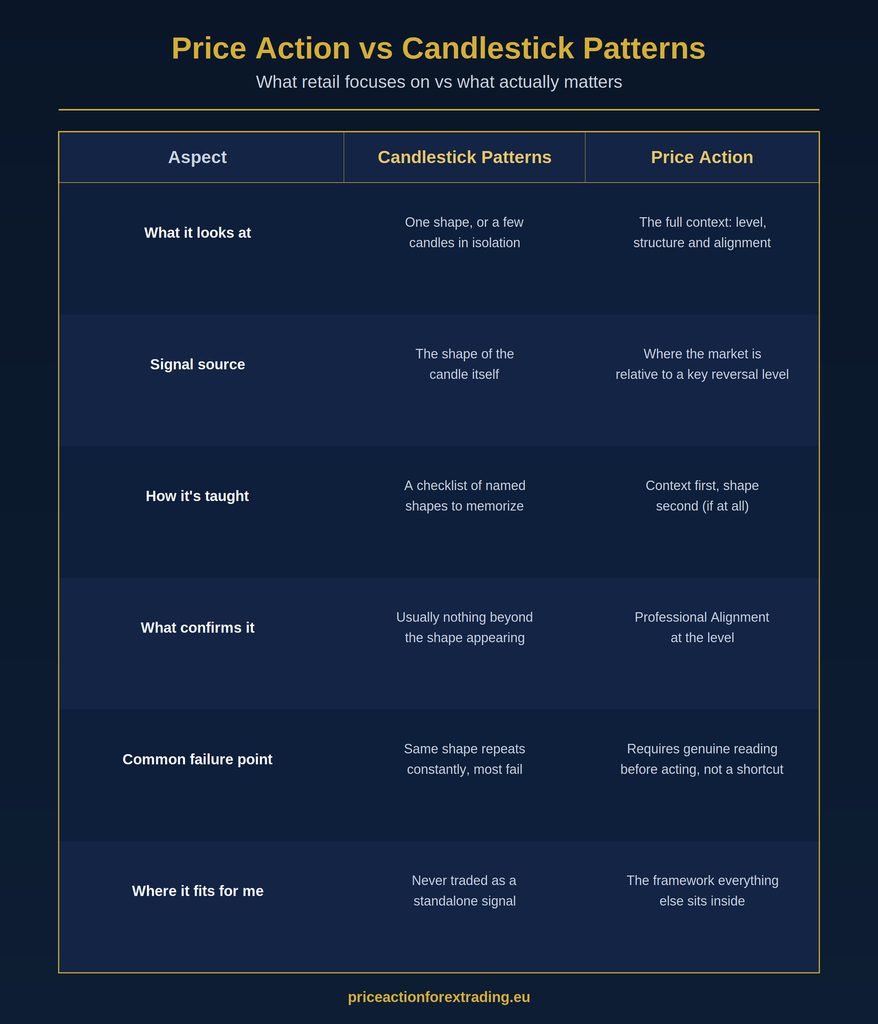
There’s no shortage of indicators promising to simplify forex trading – moving averages, oscillators, custom scripts stacked five deep on a single chart. I tried most of them early on. What actually turned things around for me was stripping all of that away and learning to read price action itself: the raw behaviour of candles, how and why the market actually moves.

Price action doesn’t lag behind the market the way indicators do, because it is the market. It also forces you to actually understand what’s happening on the chart rather than outsourcing that judgment to a formula. That’s not to say indicators are useless – some traders blend both effectively – but for a beginner, I’d rather you understand the “why” behind a move before you start layering on tools that can mask that understanding.

This is the approach my entire teaching method is built around. Once you’ve got the basics down, the real work is turning price action reading into a repeatable, profitable process – which is exactly what I focus on with students inside my Forex Training Course. It’s not just a beginner primer; it’s built to take both new and experienced traders and develop them into consistent, professional traders. And for the record, I do use indicators in my trading to avoid having to be glued to charts all day, but I use those indicators differently compared to the retail crowd.

Professional Understanding vs. the Retail Illusion of Knowledge

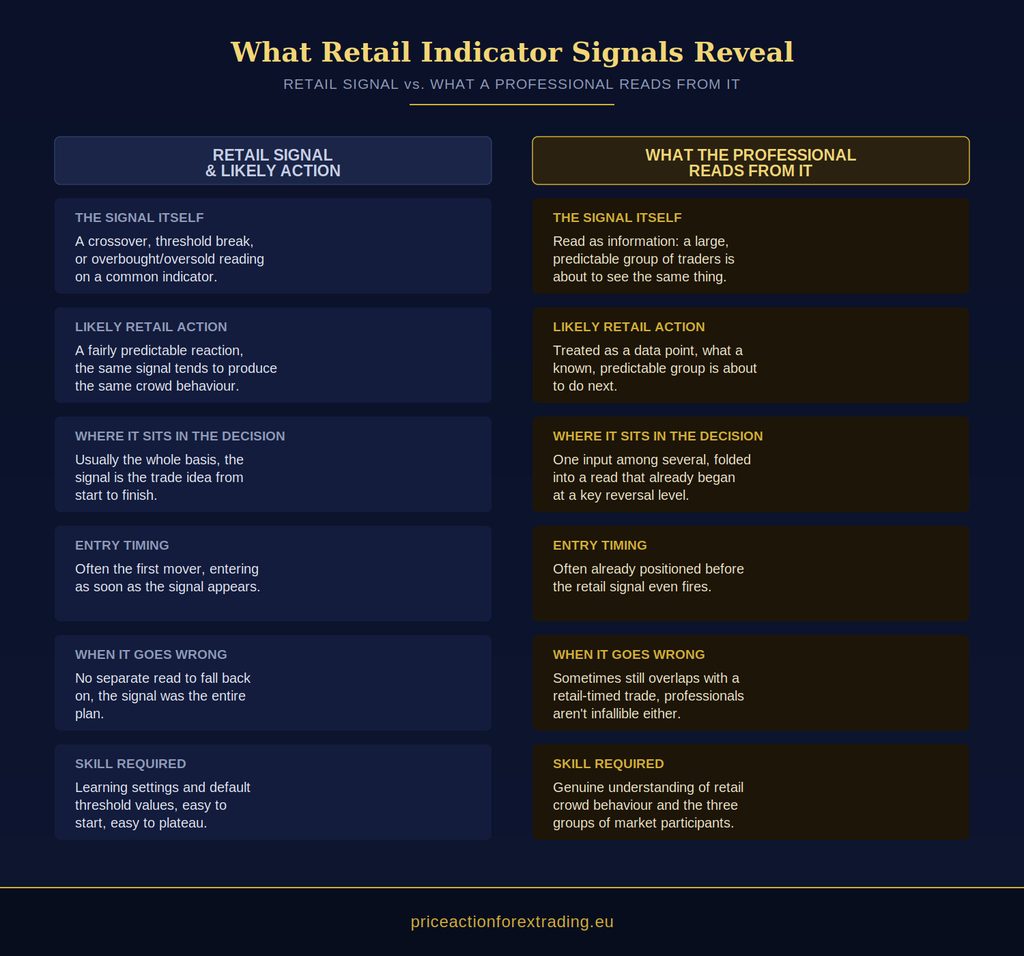
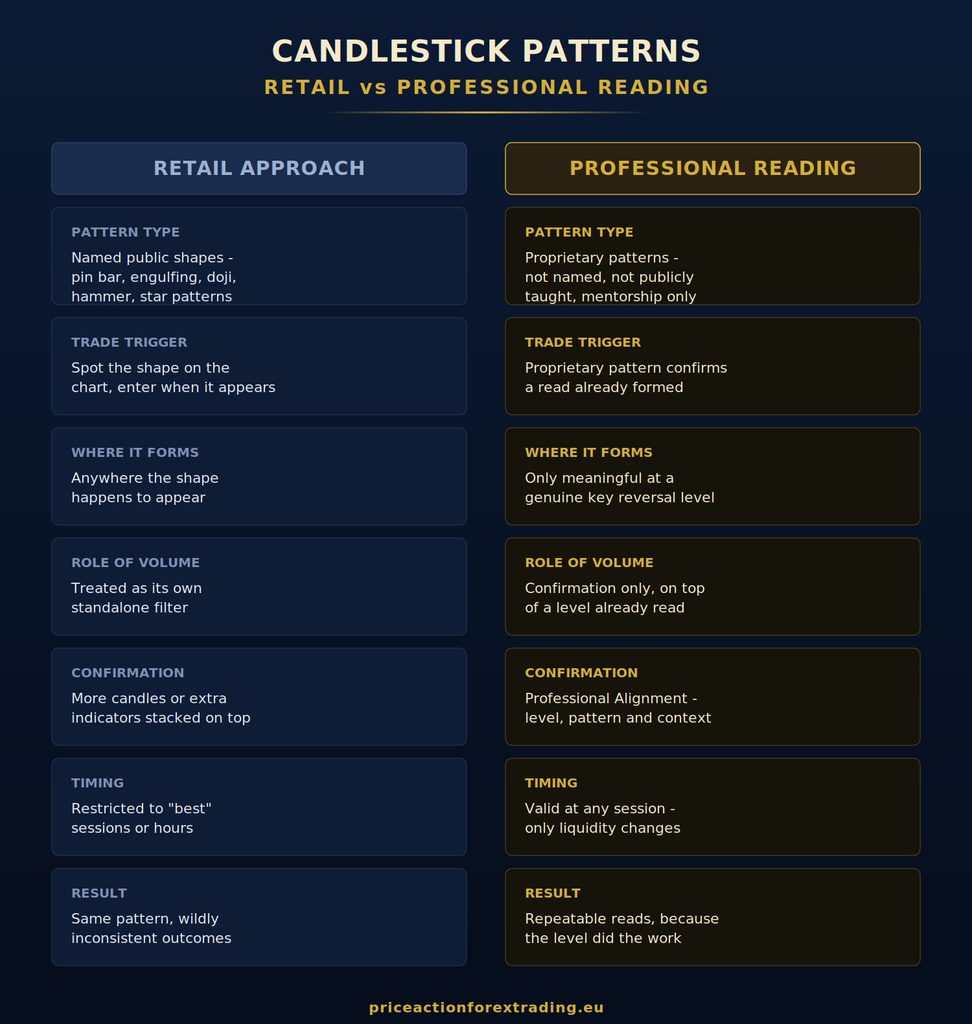
Here’s something nobody told me early on: knowing what a pin bar is, or being able to name five chart patterns, is not the same as understanding the market. Most retail traders mistake vocabulary for knowledge. They can label a “double top” or an “engulfing candle,” and that labelling gives them a false sense of competence – right up until the market does something their pattern book never covered.

Real, professional understanding of the market comes from studying participant behaviour, not memorising shapes on a chart. Why did price accelerate through that level instead of respecting it? Who was trapped on the wrong side of that move, and what does their forced exit do to the next hour of price action? That’s a completely different question from “does this candle match a picture in a course PDF,” and it’s the question that actually separates traders who survive from traders who are still guessing after five years.

This gap is exactly why so many retail traders plateau. They accumulate more indicators, more patterns, more “confirmations” – and none of it closes the gap, because the gap was never about tools in the first place. It’s about understanding the market as a market: a place where real participants with real motivations are moving real size, not a static image waiting to be pattern-matched. Ask most of the retail traders “who are the participants of the market YOU’re trading in”, and most of them will have no clue or they’ll think they know the answer when in fact they don’t.

I built these habits the hard way, through years of studying that participant behaviour rather than chasing new indicators. It’s a lot cheaper to learn to see the market this way from someone who’s already done that work than to stumble onto it yourself after a decade of trial and error.

Demo Trading: Useful, But Don’t Stay There Forever

A demo account is genuinely useful for beginners – it lets you get comfortable with a trading platform, practice reading charts, and test a strategy without financial risk. I use demo accounts myself too – when I want to test a new idea on how to improve my trading. But it has a ceiling. Because there’s no real money on the line, demo trading doesn’t teach you the psychological side of this business: the fear of pulling the trigger, the urge to move your stop, the temptation to revenge-trade after a loss, the destructive obsession with outcomes over process. Those only show up once real money is involved.

My advice: use a demo account to confirm your process is sound and your platform mechanics are second nature, but don’t spend a year there under the illusion that you’re “practicing trading.” At some point you need small, controlled real-money exposure to build the actual skill that matters – emotional control under pressure. And also, keep in mind that sometimes the size of your live account will be too small instead of being too large. If you find yourself repeatedly making some weird mistakes on a live account, increasing your trading capital might actually help. There are cases when you’re simply not taking yourself seriously enough when your account size is too small. But I know it’s a very fine balance line in between. I don’t want to say “start big and risk blowing it all”. You do need to find the balance yourself.

Setting Realistic Expectations

I want to be direct about something most beginner guides gloss over: forex trading is not a fast path to income. It can absolutely become a serious, profitable skill – I’ve built my career around it – but it takes months to years of deliberate practice, not days. Anyone promising you consistent five-figure months within weeks of starting is selling you a story, not a skill.

A more realistic first-year goal looks like this: learn the mechanics properly, develop and stick to a defined trading plan, keep a detailed journal of every trade you take, and aim for consistency rather than home-run wins. If you can finish your first year with your account intact and a clear understanding of your own strengths and weaknesses as a trader, that’s a genuine win – even if the profit and loss statement isn’t dramatic yet. The traders who last are the ones who protected their capital long enough to get good, not the ones who tried to get rich in month one.

It also helps to track your progress honestly. Reviewing real trading statements (or even publishing them to a blog) – wins and losses both – keeps you accountable in a way that cherry-picked screenshots never will. That habit alone will teach you more about your own trading than most courses do.

Picking a Broker and Account Type

Your broker is the platform through which every trade you place is executed, so this isn’t a decision to rush. Look for regulation from a recognised financial authority in your region, transparent spreads and commissions, and a platform you actually find intuitive to use. I still use MetaTrader 4 and found it to be much better than cTrader or TradingView. Most people would probably disagree with me, as the MT4 feels old and clumsy, but not everything that shines nicely is actually the best.

Beginners are often tempted by brokers advertising extremely high leverage, sometimes 1:500 or more. Leverage offered is neither good nor bad. When you gain professional understanding, you’ll understand where to use more or less of it. That 500:1 represents the maximum you can use on your account, but the ultimate decision maker is you. I usually choose the highest available (usually 500:1) but on any given trade I use just a small fraction of that. However, by choosing the largest max leverage option I feel safer because it protects me from certain tricks the brokers can use against me, but these are advanced topics that I cover in my training course.

Choosing How You Want to Learn to Trade

Not every beginner wants the same path, and that’s fine. Some people want to become independent, confident traders who understand every decision they make. Others want to move faster with a highly structured, short-term programme. And some simply don’t have the time to learn to trade themselves and would rather have it managed professionally. All three are legitimate, provided you’re honest with yourself about which one you actually are.

If you want a genuine grounding in how I trade, from the fundamentals through to a complete price action method, that’s what the Forex Training Course is built for. If you’d rather get hands-on fast and see how the process works in a condensed format, my Learn to Trade in 5 Days programme is designed exactly for that. Traders who are specifically drawn to shorter-term, faster-paced setups often prefer Learn to Scalp in 5 Days, which focuses on that style specifically. And if, after all this, you decide trading isn’t something you want to do hands-on yourself, my Managed Forex Trading service is worth a look.

There’s no single “correct” route into this market. There is, however, a wrong way to start – which is jumping into a live account with real money before you understand any of what we’ve covered above.

Final Thoughts

Forex trading rewards patience, discipline and a willingness to actually learn the mechanics before risking your capital – and it punishes shortcuts ruthlessly. I say that as someone who took most of the shortcuts myself before figuring out the long way was actually the fast way. Learn the vocabulary. Understand risk before you understand reward. Find a real education source, not just a signal feed or an AI-written PDF/video course. And give yourself permission to become a real professional trader instead of safely calling yourself a “beginner” for a decade.

If you’ve made it this far, you’re already ahead of most people who jump straight to trading without reading anything first. That’s a good sign. Take the next step deliberately.

Thanks for stopping by and wish you all the best.

The Illusion of Forex Market Turnover

Brokers love to tell you a nice, soothing story about the forex market. They’ll say its daily turnover is $9.6 trillion. They’ll let that number sit in your mind until it starts to feel like an ocean of untouched treasure – money and businesses quietly swapping currencies all day long, with no idea that traders like you could dip in and scoop some of it out.

Then comes the pitch: “Imagine if you could extract just 0.000001% of that turnover. That’s $96,000 in a single day. Anyone can do it, right?”

Wrong. And once you understand why, you’ll see the forex market in a completely different light – which is exactly what this article is here to do.

Where the $9.6 Trillion Number Actually Comes From

Before we go further, you need to separate two things that brokers love to blur together: what happens in your trading account, and what happens “out there” in the real world of foreign exchange. They are not the same thing, and they barely touch each other.

Let’s look at two everyday examples of real foreign exchange happening.

Example one. A tourist from Europe lands at an airport in Australia. He walks up to the currency exchange booth, hands over 500 euros, and receives 820 Australian dollars in return.

Example two. A company in the United States receives an invoice from a European supplier for 1,000,000 euros. Someone in the finance department logs into the company’s bank account and sends an international transfer. The bank deducts 1,090,000 US dollars to cover it.

Both of these are genuine foreign exchange transactions. Both get counted inside that famous $9.6 trillion daily figure. Multiply these two simple examples by millions of similar transactions happening every day – tourists, importers, exporters, central banks, pension funds – and you arrive at the total turnover number brokers love to quote.

Now ask yourself an honest question: what makes anyone think that clicking “buy” or “sell” on a trading platform somehow lets them dip into those transactions? Even if it were possible, it would be theft. Picture that European supplier receiving only 900,000 euros instead of the agreed 1,000,000, for no explainable reason – say, because your trade somehow “took a cut” from their transfer. That kind of shortfall would never go unnoticed. Banks reconcile these amounts to the cent. The deal would break, lawyers would get involved, and someone would go to prison.

Here’s the part that should stop you cold: none of those transactions ever pass through your broker. So how exactly is your broker supposed to pay you out of a $9.6 trillion pool it was never connected to in the first place? It can’t. Something doesn’t add up – and that’s because the whole premise is built on a myth.

There’s No Such Thing as “The” Forex Market

The truth is simpler and, frankly, a little less exciting than the brochure version: there is no single, centralised forex market that your trades plug into. The $9.6 trillion figure is nothing more than a sum – a statistical total of countless individual, unrelated transactions. It is not a market’s turnover in the sense of one shared pot of liquidity that participants draw from.

Every one of those FX transactions happens inside its own closed environment. Think of them as separate sandboxes. You’ve probably heard forex described as a “decentralised, over-the-counter market” – this is exactly what that phrase means. There is no exchange floor, no single order book, no central authority matching every buyer with every seller the way a stock exchange does.

The tourist exchanging euros for Australian dollars is transacting inside the sandbox of that particular exchange booth. The money he hands over doesn’t get released into some mythical global market – it stays with the booth. And critically, it’s the booth that decides what exchange rate to offer him, not “the market.”

The same logic applies to the company paying its European supplier. That transaction happens entirely inside the sandbox of their bank. The bank sets its own quote for the euro-to-dollar conversion, and the transaction is settled within the bank’s own books.

Your trades work exactly the same way. Whatever you buy or sell at your broker stays inside the sandbox of that broker. Your broker is the one quoting you prices. Which means the uncomfortable truth is this: you can only ever make as much money as your broker is willing to pay you. You are not siphoning value out of some bottomless global reserve – you’re negotiating, trade by trade, with one specific counterparty.

What You’re Really Buying When You Click “Buy”

There’s another layer to this that most retail traders never stop to think about. When you click “buy” on your trading platform, you are almost never buying an actual currency. In the vast majority of retail setups, you’re buying a CFD – a contract for difference.

A CFD is an agreement between you and your broker about the price movement of an asset. No physical or even electronic transfer of currency takes place between you and “the market.” Your trade doesn’t get bundled into that $9.6 trillion global turnover figure at all – unless your broker decides it needs to hedge its own exposure to you by going out and buying the real currency in the wholesale market. That only tends to happen once a trader becomes large enough, or consistently profitable enough, that the broker doesn’t want to carry the risk of paying you out of pocket.

For the overwhelming majority of retail accounts, none of that happens. Your profit or loss is simply a number that moves between your account and your broker’s balance sheet. That’s the entire transaction. There’s no invisible thread connecting your MT4 terminal to a European invoice or an airport currency booth.

Sandboxes Aren’t Completely Isolated – But There’s Still No Central Pool

None of this means every sandbox is a sealed island with zero connection to the rest of the world. Banks talk to other banks. Large institutions hedge with each other across borders. Liquidity providers connect brokers to bigger liquidity pools upstream. These connections are real, and they’re what makes forex a genuinely global, interconnected system rather than a collection of totally isolated shops.

But interconnected is not the same as centralised. There is still no single marketplace where all $9.6 trillion physically flows through one pipe that you, as a retail trader, are plugged into. Your broker sits at the end of a long chain of sandboxes, and what happens upstream of that chain has very little to do with whether your account grows or shrinks today.

Why This Matters for How You Actually Trade

Understanding this changes the entire way you should think about “making money in forex.” You’re not competing against a $9.6 trillion ocean. You’re not trying to grab an invisible sliver of somebody else’s international wire transfer. You are trying to consistently win against a very specific, very real counterparty: your broker, and the other traders inside that same sandbox.

That reframing matters because it kills two dangerous myths at once.

Myth one: the market is so big that anyone can profit from it effortlessly. Size has nothing to do with whether you personally make money. A trillion-dollar backdrop doesn’t make a losing strategy profitable, any more than a huge stock market makes every stock picker rich. If you don’t understand price action – the actual mechanics of why price moves where it moves – the size of the number on a brochure is irrelevant to your account balance. I wrote about this exact misunderstanding in why news announcements don’t move the market the way the textbooks claim – the forex market runs on real cause and effect, not on the comforting stories retail traders are told to keep them clicking buttons.

Myth two: retail education that ignores this structure is harmless. It isn’t. Most retail content treats forex as if it were one giant casino floor where the house edge barely matters because the pot is infinite. That framing keeps people trading recklessly, chasing signals, and blaming “the market” instead of learning how price actually behaves inside their own broker’s environment. Once you understand you’re trading inside a sandbox with a real, finite counterparty, you start taking your edge far more seriously – because now you know exactly who you’re up against.

What Actually Determines Whether You Get Paid

If size and access to some mythical global pool aren’t what decide your results, what does? Three things, and none of them are exotic:

  1. Whether you genuinely understand price behaviour inside the environment you’re trading, rather than relying on lagging indicators or recycled “strategies” copied from forums.
  2. Whether your risk management is strict enough that a string of losing trades doesn’t wipe you out before your edge has a chance to play out.
  3. Whether you can execute your plan without emotional interference – because your broker doesn’t care how you feel about a trade, only what you actually clicked.

None of these three things has anything to do with the size of the daily FX turnover figure. You could trade in a market with $96 billion of daily turnover or $96 trillion, and it wouldn’t change a single one of these requirements. This is precisely why proper training matters so much more than the marketing brochures suggest – you’re not trying to out-muscle a giant market, you’re trying to out-think one specific counterparty using skills that can genuinely be learned. That’s the whole premise behind my forex training and mentoring course – teaching you to read price the way it actually behaves, not the way brokers pretend it behaves.

If You Want to See This in Practice Quickly

If you’d rather see the mechanics for yourself before committing to a longer course, I run a condensed programme called Learn to Trade in 5 Days, where I walk you through exactly how price moves inside your broker’s sandbox and how to read it without relying on lagging indicators or recycled retail strategies.

For traders who are drawn to fast, short-term setups rather than swing positions, Learn to Scalp in 5 Days covers the same core principles applied to a much tighter timeframe – useful once you understand that you’re trading against a specific counterparty and need precision, not just volume of trades.

And if trading isn’t something you want to do yourself but you still want exposure to the market, my managed forex trading service lets you put your capital to work while I handle the execution, using the same understanding of market structure covered in this article.

The Bottom Line

The $9.6 trillion figure is real, but it’s not what brokers imply it is. It’s a sum of finished transactions, not a shared pool waiting for you to dip into. Every foreign exchange transaction – from an airport currency booth to a multinational wire transfer to your own CFD trade – happens inside its own closed sandbox, with its own quotes, set by whoever runs that sandbox.

Your broker is your counterparty. Your results depend on what happens between you and them, trade by trade, not on the size of some imaginary global reservoir. Once that illusion falls away, you stop chasing the fantasy of an infinite market and start focusing on the only thing that was ever actually going to make you money: understanding how price genuinely behaves, and trading that understanding with discipline.

That shift in perspective alone puts you ahead of most of the retail crowd, who are still out there believing they’re one lucky trade away from scooping up a slice of $9.6 trillion that was never theirs to take.

Forex Mentor: How to Find One Worth Learning From (And Why Most Traders Never Do)

Every losing trader I’ve ever talked to has one thing in common: they tried to figure out the forex market entirely on their own. They read a few blogs, watched a hundred YouTube videos, bought an indicator or two, and then wondered why none of it held together once real money was on the line.

A good forex mentor is the single biggest shortcut in this business. Not because they hand you a magic strategy, but because they show you how a profitable trader actually thinks – something no course, no PDF and no indicator can teach you on its own.

Think about how every other serious skill is learned. Surgeons don’t become surgeons by watching recorded lectures alone – they operate under supervision for years. Professional athletes don’t get good by reading about technique – they train under a coach who corrects their form in real time. Trading is no different, yet it’s one of the only high-stakes skills where people routinely expect to become world-class entirely by themselves, from free YouTube content and a demo account. It rarely works, and it’s not because they weren’t smart or disciplined enough. It’s because self-study has a ceiling that is very hard to break through without direct mentorship from a real professional trader.

I know this first-hand. Everything I know about trading professionally, I learned from one man: my own mentor, Robert Taylor. Without him, I’d probably still be blowing small accounts and blaming the market for it. In this article I want to walk you through what a real mentor actually does, how to tell one apart from someone just selling you a dream, and what mentorship should look like if you’re serious about becoming a professional trader.

What a Forex Mentor Actually Does

There’s a lot of confusion around the word “mentor” in this industry, mostly because it gets slapped onto anything with a price tag. So let’s be precise about it.

A mentor is not someone who sells you a course and disappears into their inbox. Also, a mentor is not someone who pushed 50 videos of “comprehensive content” to YouTube and you watched them all and now you call that person “your mentor”. A real mentor is someone who:

  • Watches you trade and tells you exactly where your thinking broke down
  • Explains the reasoning behind a decision, not just the decision itself
  • Has been through enough market cycles to recognise patterns you can’t yet see
  • Corrects your psychology as much as your technical execution
  • Is invested in your long-term independence, not your monthly subscription

That last point is the one people miss the most. A real mentor’s job is to make themselves unnecessary. If someone’s business model depends on you never becoming self-sufficient, they were never mentoring you – they were renting you their opinion.

When I talk about how I trade in detail – for example in my article on how I actually manage a live trade – I’m doing exactly what Rob did with me for years: showing the decision-making process in real time, not just the entry and exit. That’s the part retail education almost always skips.

Mentor, Course Seller, or Signal Provider? Know the Difference

The forex education space blends three very different roles together, and most beginners can’t tell them apart until they’ve already paid for the wrong one.

A course seller gives you information. A signal provider gives you trades. A mentor gives you understanding and judgement. Only one of these three actually builds a skill you can keep for the rest of your life.

Signals can be a useful supplement – I occasionally share free trading signals myself, purely to demonstrate what’s possible and build credibility. But copying someone else’s entries will never make you a trader. The moment the signals stop, so does your ability to make money. A mentor, on the other hand, transfers the underlying skill, so you’re still profitable long after the relationship ends. But in our case, the relationship doesn’t really end because I offer a free “earn while you learn” option to everybody who completes my full training course. In that private group I post upcoming trades not just as signals like “buy there, exit there” but with reasons of why there’s a setup, the logic beyond the target and full explanation of how that trade fits into our professional framework.

Courses fall somewhere in between. They can be genuinely useful as a foundation, but a pre-recorded video can’t watch your live trade and tell you why you hesitated for three extra seconds and missed your entry. Only a mentor can do that.

The Red Flags (And Green Flags) of Real Mentorship

The forex industry is full of people calling themselves mentors who’ve never actually proven anything. Here’s how to separate the two.

Red flags to watch for:

  • Screenshots of profit instead of full, verifiable statements
  • Guaranteed or fixed monthly returns
  • A trading history shorter than a few years
  • Constant upsells, urgency, and “limited spots” pressure
  • Pushing you straight into a prop firm challenge (often because they earn a kickback from it)

Green flags worth paying attention to:

  • Full, transparent trading statements, not cherry-picked wins
  • Willingness to review your actual trades, not just talk theory
  • An explanation of market logic rather than a “secret indicator”
  • Years of experience across different market conditions
  • A genuine interest in making you independent, not dependent

If you want a sense of what transparency should actually look like, I regularly publish my own trading statements on this blog, including the losing trades, not just the highlight reel.

Also, by verifiable statements I don’t mean asking for a MyFxBook link. The problem with those external services is that they’re often funded by the brokers and everything that you see there can still be faked, either on the platform or on the broker side (e.g. marketing accounts). So if someone sends you a MyFxBook link, it doesn’t have more credibility than a simple screenshot.

What I mean by verifiable is that you need to do your own due diligence: ask very specific questions about certain trades of interest that you found in the statement of your potential mentor and listen how they respond. You need to make sure that these are the trades they actually took and they have a very clear understanding of why they took those trades.

What I Learned From My Own Forex Mentor

I didn’t start out as a professional trader. I spent over a decade as a web developer before trading became my full-time career, and the transition nearly broke me before it worked. I was overconfident, over-engineered my strategies, and made every classic mistake a technically-minded person makes when they assume trading skills can be reverse-engineered like code (I wrote a longer breakdown of this in Making Forex Work For Web Developers & Software Engineers, if that sounds familiar).

What actually turned things around wasn’t just another course or another indicator. It was being mentored, one-on-one, by someone who had already spent 20 years in the market and had nothing left to prove. Rob didn’t sell me a dream. He corrected my thinking, week after week, trade after trade, until I stopped needing him to. He showed me, time and time again, how a real professional trader approaches the forex market, how he investigates and predicts the movements of the market with a high degree of probability using his professional understanding of the market and also how he applies his professional trading strategy when a good opportunity arrives.

That’s the part people underestimate about mentorship – it’s not a one-time transfer of information, it’s a slow rebuilding of how you see the market. You can read about technical analysis in a hundred articles, but until someone watches you apply it badly and tells you exactly why, none of it really sticks.

Some of the results I’ve shared on this blog, like my 21% month trading the London open or growing a small account by 56% in a single month, aren’t the product of a lucky strategy I stumbled onto. They’re the product of years of correction, repetition and feedback that started with Rob and that I’ve continued to refine ever since. Mentorship compounds. The lessons you absorb in year one keep paying off in year five, in ways a single course or ebook simply can’t replicate.

How Long Should Mentorship Actually Take?

This is a fair question, and the honest answer is: longer than most people want to hear. Nobody becomes a consistently profitable trader in a weekend, and any mentor promising otherwise is selling you a fantasy (for the record, I do have a short 5 hour course, but I recommend taking it over 5 weeks instead of a single weekend). What a structured mentorship can do is compress years of trial-and-error into months, by making sure you’re not repeating the same mistakes over and over without realising it.

In my own experience, the first phase of mentorship is about unlearning bad retail habits – the overconfidence, the over-engineering, the impatience and the illusion of knowledge I described from my own transition out of a tech career. The second phase is about building real pattern recognition through repetition, with correction along the way. The third phase, the one most self-taught traders never reach, is trading with genuine independence and confidence, because you’ve internalised why a trade works, not just memorised a rule.

Why Mentorship Beats Self-Study (And Backtesting)

A lot of self-taught traders lean heavily on backtesting, convinced that if they study enough historical charts, the pattern will eventually reveal itself. I’ve written before about why you can’t backtest your way to success – the short version is that backtesting keeps you trapped in the past, while real trading only ever happens in the present moment, under real emotional pressure, interpreting the market in real time and dealing with real uncertainty.

A mentor short-circuits this entire trap. Instead of spending years building a probabilistic model from old candles, you get direct, live feedback on decisions you’re making right now. You learn to evaluate the current situation from multiple angles, define your probabilities, and act – the way professionals actually operate, rather than the way retail traders are taught to.

This is also why so much “textbook” trading advice falls apart in live markets. Even something as widely misunderstood as news trading – which I cover in News Announcements: Real or Fake? – only starts making sense once someone with real market experience walks you through what’s actually happening behind the price action, rather than what a textbook claims should happen.

Questions to Ask Before Choosing a Forex Mentor

Before you commit your time and money to anyone claiming to be a forex mentor, ask them directly:

  1. Why are you a profitable trader? (I know it’s a tricky question and you may need to rephrase it depending on the person, but it can reveal you a lot about who they actually are)
  2. How long have you been trading profitably?
  3. Will you review my actual trades, or just teach a fixed curriculum?
  4. What happens after the initial training ends – do you leave me alone or do you make yourself available for continous mentorship?
  5. Were you mentored yourself, or were you entirely self-taught?
  6. What is the difference between the professional and retail sides of the forex market?

A mentor who’s confident in what they do will answer all six without hesitation. Someone who gets defensive, vague, or redirects you to “success stories” instead of actual facts is telling you everything you need to know.

What a Real Mentorship Should Look Like

If you’re serious about learning this properly, mentorship should be structured, hands-on, and built around your actual trades – not a library of generic videos you’ll watch once and forget.

That’s exactly how I built my own Forex Training Course. It’s not a course in the traditional sense – it’s a direct continuation of the way Rob trained me, adapted for a new generation of traders who deserve the same level of honesty and attention I received.

If you want a faster, more condensed introduction, my Learn to Trade in 5 Days program is built for traders who want to get a professional foundation quickly, without wasting years on trial and error. And if scalping fits your lifestyle or schedule better, Learn to Scalp in 5 Days applies the same mentorship-driven approach to shorter-term trading.

When You Don’t Want to Trade Yourself

Not everyone wants to become the one clicking buy and sell. Some people would rather have their capital professionally managed by someone who’s already been through the mentorship process and has years of real world results to show for it. If that sounds more like you, my Managed Forex Trading service exists for exactly that reason – you don’t need to become a trader to benefit from professional trading.

Final Thoughts

The forex industry is full of noise: indicators promising certainty, signal groups promising ease, and courses promising shortcuts. None of them come close to what a real mentor provides, because none of them can watch you make a decision in real time and tell you exactly why it was wrong – or right.

I was lucky enough to have that from Rob for years, and it changed everything about how I trade. If you’re tired of guessing your way through the market alone, that’s precisely the gap a real forex mentor is meant to close.

Whichever path fits you – hands-on mentorship, a condensed 5-day program, or having your capital managed professionally – the underlying principle stays the same: don’t try to build a professional skill in isolation. Find someone with a real forex market understanding, get close enough to their process to actually learn it, and give yourself the time that skill deserves.

Thanks for reading, and have a beautiful day.