
Search this question and you get the same answer everywhere. One to three pairs. Master them. Ignore the rest.
My answer is different, and it comes from how I actually trade.
Some days I trade one pair. Some days four. Some days I am working across all 28 majors and crosses. It changes constantly, and it depends on many variables.
That is not indecision. It is what happens when the number of pairs stops being the thing you worry about.
So let me give you a proper answer. Not a rule, but a way to think about it.
The Standard Advice (and Why It Exists)
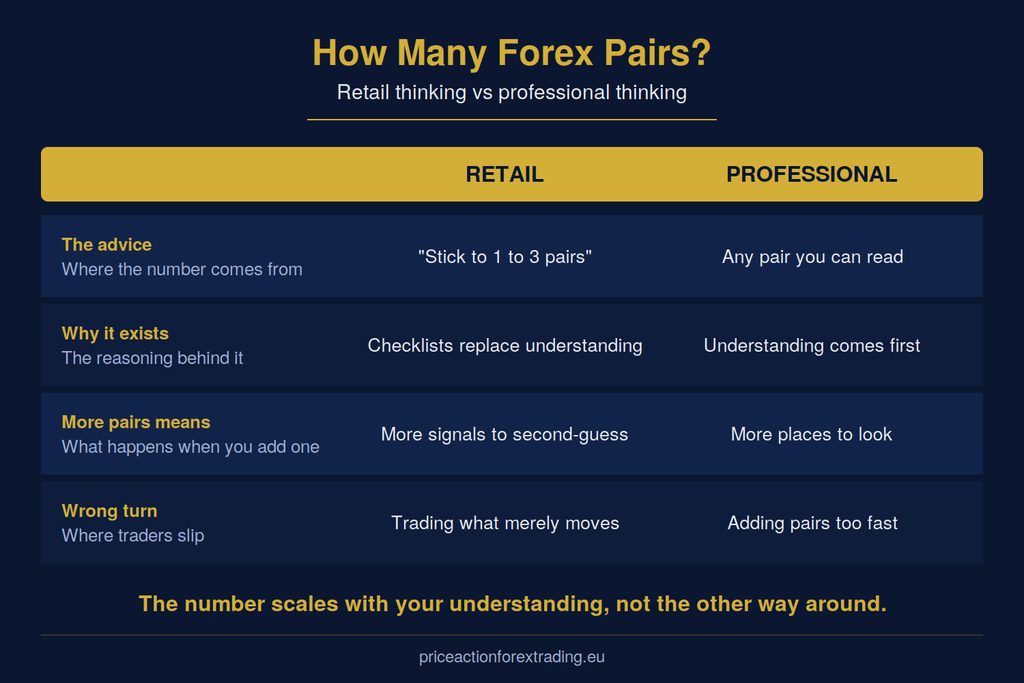
Most educators tell beginners to stick to one to three pairs. It sounds sensible. Fewer charts, less confusion, more focus.
And for a trader using the usual retail toolkit, it is sensible. Here is why.
If your approach is built on indicators, memorised chart shapes and checklists in place of real understanding, every new pair is another chart you have to run all of that on. Another set of readings to interpret. Another pile of signals that may or may not agree with each other. Ten pairs means ten times the confusion.
So the advice to limit yourself is really a workaround. It manages the overwhelm that comes from not understanding what you are looking at.
That is worth pausing on. The “one to three pairs” rule does not tell you how many pairs the market allows you to trade. It tells you how many pairs a trader relying on checklists instead of understanding can keep track of before it falls apart.
Different problem. Different answer.
The Real Question Behind the Question
When someone asks “how many forex pairs should I trade,” what they usually mean is one of these:
- How do I avoid being overwhelmed?
- How do I avoid losing money on too many positions?
- Will more pairs mean more opportunities?
All fair. But notice that none of them are about the number. They are about understanding.
Here is the contrast that matters:
A trader who reads the market like a retail trader will lose on one pair or on twenty-eight. Adding pairs just multiplies the same mistake.
A trader with genuine professional understanding can apply it to any chart, because it is the same market and the same kind of behaviour showing up in different places.
For a professional trader, all pairs are tradable. The number on any given day is simply where the opportunities are.
Why My Number Is Never the Same
People often want a fixed answer from me. “Tomas, how many pairs do you trade?”
There is no fixed answer. On one day I might trade a single pair because that is where the opportunity is. On another, four. On a busy day, I can be trading across all 28.
I do not decide a number in the morning and then hunt for trades to fill it. That would be backwards. The market decides where the opportunities are, and I go where the reading takes me.
That is the difference between a plan built around pair count and one built around understanding.
- Pair-count thinking: “I trade EUR/USD and GBP/USD, so I wait for those to do something”
- Professional thinking: “I can read any pair, so I look wherever the market is offering something”
The first one leaves you idle for days and tempts you to force trades. The second one means you are never dependent on a single chart waking up.
How I Cover a Wide Watchlist
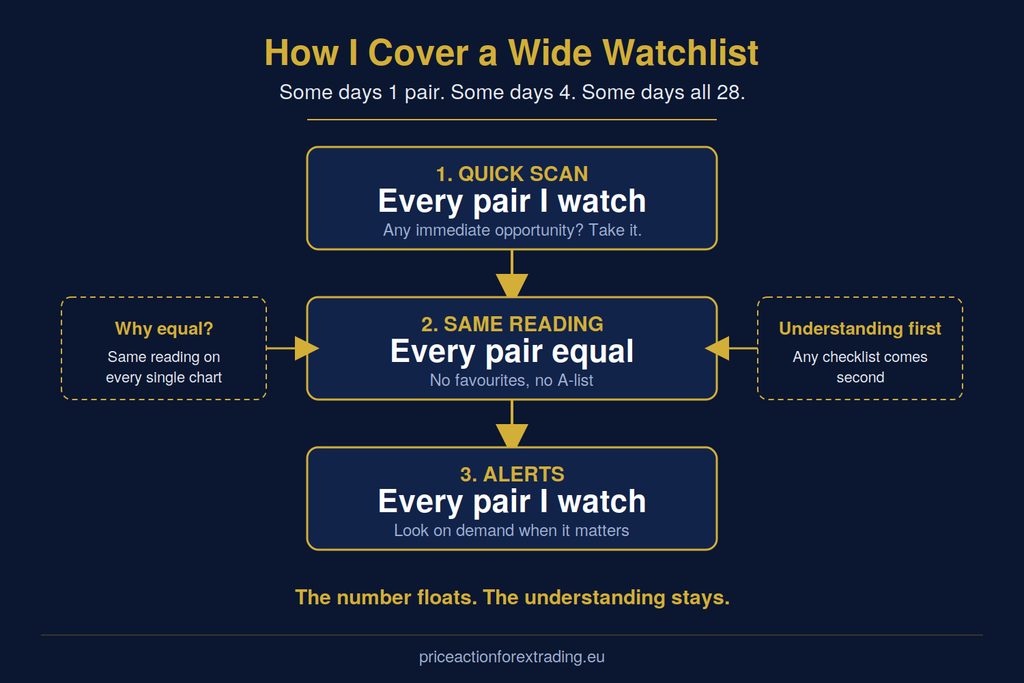
When I am watching many pairs, the process stays simple.
I open my charts and scan quickly for any immediate opportunity. If something is there, I take it. If not, I move on to my analysis.
And here is the part that matters: I treat every pair equally. No favourites, no “A-list” and “B-list”. The same reading applies to every chart, so there is no reason to give one pair a deeper look than another.
My charts stay open through the day, and I use alerts so I can look on demand when something interesting starts happening. That is just my convenience. It is not a rule, and it is not the edge. If you want to know how I think about screen time in general, I covered it in how often you should check forex charts.
So the structure is simple:
- Quick scan: every pair I am watching, for immediate opportunities
- Same reading on every pair: no pair gets special treatment
- Alerts: to look on demand when something interesting is happening
Simple on purpose. Professional understanding comes first, and everything else is secondary to it.
Majors, Minors and Crosses: Do They Matter?
Beginners get told a lot about pair categories. Majors are liquid, minors are trickier, exotics are dangerous. Much of it is repeated without much thought.
Here is what I would say from experience.
I treat every pair equally. Major, minor or cross, the reading is the same. No pair is off limits when you genuinely understand what you are looking at.
What does differ is who is trading it. Some pairs have more retail traders than others. That is a real difference, and it is worth knowing about. Once you can read the market properly, it is one more thing you are aware of, not a reason to avoid a pair.
There is also the practical side: spread, liquidity and how a pair behaves at different times. Around the daily rollover, I tracked spreads on several brokers and saw them jump from close to zero to around 12 pips on majors and around 30 pips on minors. Different pairs have different personalities, and it pays to know them.
What Actually Goes Wrong When You Add Pairs Too Early
I am not saying you should open twenty-eight charts tomorrow. There is a real way to get this wrong.
The mistake is not “too many pairs.” The mistake is adding pairs faster than your understanding grows.
Here is what that looks like:
- You open a new pair because it is moving, not because you can read it
- You trade it with a different logic than the pairs you know
- You end up with several open trades and no clear reason for any of them
- One bad day feels like five, because everything went wrong at once
None of that is caused by the pair count. It is caused by trading things you do not understand.
And notice the flip side. A trader who sticks to a single pair but does not really understand what is happening will still lose. They just lose slowly and with fewer charts.
Fewer pairs does not fix a lack of understanding. It just hides it for a while.
Why “More Pairs = More Opportunities” Is Only Half True
The other common belief is the opposite: more pairs means more setups, so more money.
Partly. More pairs gives you more places to look. But an opportunity only counts if you can recognise it.
If you cannot read a pair properly, a hundred charts will not create a single real opportunity. You will just generate more things to second-guess.
If you can read pairs properly, then yes, more pairs means you are less dependent on any single chart doing something. You are not waiting around for one market to wake up.
Opportunity is not created by the number of charts. It is created by the number of charts you can read with confidence. That is the only number that matters.
So How Do You Decide Your Number?
Here is the approach I would give someone starting out today. Not as rules, just as a way to think.
Start with what you can read
Pick the pairs where you feel you understand what price is doing. If that is one pair, fine. If it is six, also fine. Your comfort with a pair should come from understanding it, not from having stared at it for a long time.
Add a pair when you can explain it
Before adding a new pair, ask yourself a simple question: can I explain what is happening on this chart in the same terms I use for the pairs I already trade?
If yes, add it. If no, you are not adding a pair, you are adding a lottery ticket.
Go where the opportunity is
Do not marry a pair. Once you can read many charts, the goal is not to trade “your” pairs. It is to trade wherever the market is offering something.
Count your exposure honestly
This one is just arithmetic. If you have three open trades and they all involve the same currency, you effectively have a bigger position on that currency than it looks like at a glance. Know what you are actually holding.
Let your number float
Your number is not fixed. It moves with the market and with your understanding. There is no finish line where you are “allowed” to trade more pairs. It just happens as you get better at reading.
What About Time?
A common worry is that more pairs means more hours at the screen. It does not have to. A structured scan, the same reading applied to every pair, and alerts to look on demand is a workflow that fits around a normal life. I break down what a working day looks like in how many hours a day forex traders trade.
The time you spend is not tied to the pair count in a straight line. It is tied to how efficiently you read each chart. Someone who understands what they are looking at can process a chart in seconds. Someone who does not can stare at one chart for an hour and come away with nothing.
That is another reason understanding comes first. It is what makes a bigger watchlist manageable.
Where the Timeframe Fits In
If you trade several pairs, your choice of timeframe matters more than it would with a single pair. It gives your scan a consistent structure, so every chart is read the same way.
I go into how I approach this in the best timeframe for price action forex trading. Higher timeframes carry more weight because more capital moves through the key reversal levels visible there. That is true on every pair, which is why the same timeframe logic applies across my whole watchlist.
Consistency here is what lets a big watchlist feel calm instead of chaotic.
The Professional Angle
Here is the bigger idea behind all of this.
Retail education treats forex like a menu. Pick a pair, pick an indicator, pick a strategy, and hope the combination works. In that world, the number of pairs is a menu decision, and limiting it is a way of limiting mistakes.
Professional understanding works differently. You are reading the behaviour of the market participants behind the price, and that behaviour shows up across pairs. It is not a different game on each chart. It is the same game in different places.
I will not go into the details of how that reading works here, because it is the part I only teach through training. But the practical result is what I have described above: when you understand what you are looking at, the number of pairs stops being a source of anxiety. It becomes a choice about where you want to look.
And when Professional Alignment is present, meaning the different pieces of the picture line up at a key reversal level, it does not matter whether the pair is the first on your list or the twenty-eighth. The read is the read.
The Short Version
- The “one to three pairs” advice exists because retail methods do not scale, not because the market limits you
- For a professional trader, all pairs are tradable
- My own number changes constantly: sometimes 1, sometimes 4, sometimes 28
- The number of pairs is a result of your understanding, not a cause of your success
- Add a pair only when you can read it in the same terms as the ones you already trade
- Count your exposure by currency, not just by number of trades
Ready to Build Real Understanding?
If you want to stop guessing at questions like “how many pairs” and start reading the market properly, that is exactly what I teach.
The Forex Training Course works for new and experienced traders alike, and it is where I go into the professional reading I have only touched on here. If you would rather begin with one complete strategy and get moving fast, Learn to Trade in 5 Days gives you a full standalone way to trade with professional understanding.
Either way, the number of pairs will sort itself out.
Thanks for reading and have a beautiful day!