
If you’ve spent any time in forex forums or watching YouTube tutorials, you’ve run into the same debate over and over: price action vs indicators. Which one actually works? Should you use both? Is one “beginner” and the other “advanced”?
Here’s my honest answer, and it might surprise you. I do enter trades on indicator signals sometimes. What most people get wrong about this debate is assuming that avoiding indicator entries is what separates a professional from a retail trader. It isn’t, plenty of retail traders avoid pure indicator entries too, and it doesn’t make them professional. What actually separates the two sides is something most retail education never touches: knowing exactly how retail traders use common indicators, and what decisions they’re likely to make once they see one.
That knowledge is genuinely valuable. It’s information I factor into my own decision-making, and it’s one of the clearest, most factual lines between the retail side of this market and the professional side.
What Forex Indicators Actually Are
Before going further, it’s worth being precise about what an indicator actually does. A moving average, RSI, MACD, stochastic, Bollinger Bands, whatever your platform has loaded by default, they all share one thing in common: they are mathematical calculations built from past price data.
That’s not a criticism, it’s just a definition. An indicator takes closing prices, or highs, lows, volume, from a lookback period, runs them through a formula, and plots the result. This is exactly why indicators are so useful for understanding retail behaviour. Retail traders overwhelmingly rely on a small handful of well-known indicators, applied in fairly predictable ways. That predictability is the whole point of this article.
What Price Action Actually Is
Price action is the direct study of price movement itself, the candles, the levels, the behaviour of the market as it happens, with nothing standing between you and the chart. I’ve written a full breakdown of this in what price action actually means, but the short version is this: instead of asking a formula to summarise the past for you, you read what the market is doing right now, at the exact level where it matters.
This is where every one of my decisions actually starts. Not with an indicator, with price and the behaviour of participants at a key reversal level.
Entry Is the Least Important Part of the Decision
Here’s the piece that gets lost in most “price action vs indicators” content. The decision to enter a trade at all, and the mechanics of exactly when that entry happens, is the smallest, least consequential part of the whole process.
By the time I’m looking at an entry, the real work is already done: the level has been identified, and price and participant behaviour at that level have already been read. What happens at entry, whether that’s on a specific candle, a break of a short-term level, or yes, sometimes an indicator signal, is largely mechanical at that point. The outcome of the trade was already shaped by everything that came before it.
This is exactly why obsessing over whether an entry “counts” as price action or indicator-based misses the point entirely. Both retail and professional traders can technically enter on the same indicator signal. What differs isn’t the entry trigger, it’s everything that led up to it, and what each side understands about why that signal is firing in the first place.
The Real Differentiator: Knowing What Retail Indicators Make Traders Do
This is the part that actually matters, and it’s the part almost nobody talks about. Retail traders, as a group, use a fairly small set of popular indicators, and they tend to use them in fairly predictable ways. A crossover on a well-known moving average, an RSI reading past a common threshold, a familiar oscillator signal, these produce fairly consistent reactions across a large, predictable group of traders.
To someone with genuine professional understanding of the three groups of market participants, that predictability is information. Knowing what a common retail signal is likely to make a large group of traders do next is a real input into a professional decision, not because the indicator itself is meaningful, but because the behaviour it triggers is. I go into this in more depth in how I actually read momentum, not with indicators, where I look at how retail-driven reactions factor into a professional read of strength and weakness in a move.
This is also why “don’t use indicators” was always the wrong framing. The indicator itself was never the issue. What matters is whether you understand it as a readable piece of retail crowd behaviour, or whether you’re simply following it the way the crowd does.
A Practical Example of the Difference
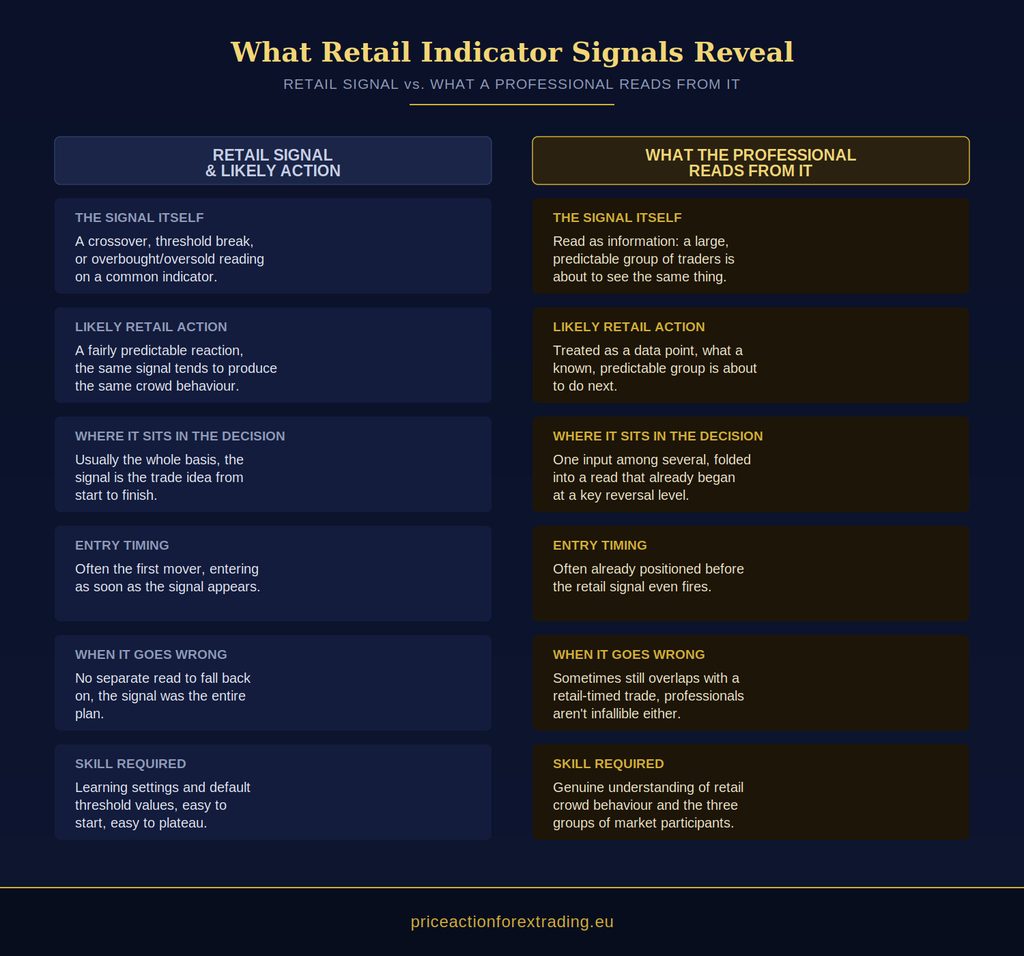
Picture a well-known indicator flashing a signal that a large portion of retail traders watch closely. A retail trader sees the signal and treats it as the entire basis for a trade, enter now, because the indicator said so.
A professional trader looking at the exact same signal isn’t asking “should I enter.” They’re already read the level, already understand where price is likely going, and they’re now looking at that same retail signal as a piece of information, what is a large, predictable group of traders about to do because of it. Sometimes that information lines up with a trade already being taken. Sometimes it doesn’t matter at all. Either way, it’s read, not obeyed.
Are Professionals Immune to Retail-Timed Trades?
No, and it would be dishonest to claim otherwise. Professional traders aren’t gods, and genuine professional understanding doesn’t come with a guarantee of avoiding every trade that retail traders also end up in. Sometimes a professional entry and a retail entry land in the same trade.
What’s worth noting is the direction that usually happens in. It’s typically retail traders joining a trade after a professional has already entered, reacting late to a signal or a move that’s already underway, rather than professionals following retail traders in first. That distinction matters. Overlap isn’t the same as dependence. A professional trade that happens to coincide with retail activity was still built on a read of price and participant behaviour that came first, retail crowd reaction is something read and factored in, not something waited on.
The Retail and Professional Sides of the Market Are Factually Different
I want to be direct about this because it gets diluted in a lot of trading content: the separation between the retail side of the forex market and the professional side is factual, not a marketing angle. It’s obvious to anyone with genuine professional understanding of how this market actually works, in the same way a structural difference between two systems would be obvious to someone trained to see it, even if it isn’t obvious from the outside.
That doesn’t mean the two sides never intersect, they clearly do, an indicator signal can be looked at by both a retail trader and a professional trader at the exact same moment. What differs is what each side is doing with it. One is reacting. The other is reading a reaction and deciding whether it fits into a decision that was already largely made.
Where Trend and Structure Fit Into This
A lot of retail price action education tries to bridge the gap by teaching structure, higher highs, higher lows, trendlines, as a kind of halfway house between indicators and true price reading. It’s a step in the right direction, but it still tends to get taught as a rigid checklist: you need X structure before a setup counts.
I don’t trade that way. Structure is context, not a gate. A key reversal level can be traded whether or not a clean trend structure is present, what matters is genuine understanding of where price is actually going, combined with price reaching that level. Retail indicator behaviour sits in that same category, useful context that’s read and weighed, never a rigid precondition.
Why This Distinction Matters More Than It Seems
The “avoid indicators” framing that dominates a lot of price action content actually undersells what separates professional trading from retail trading. It focuses attention on the wrong variable, whether an indicator appears on the chart, instead of the variable that actually matters, whether you understand the behaviour that indicator is about to trigger in a large, predictable group of traders.
That understanding doesn’t come from a checklist or from stripping indicators off your chart. It comes from genuine understanding of how the three groups of market participants behave, something that’s trained, not read about. The traders I’ve seen make the fastest progress are the ones who get direct training in that understanding first, and only then start seeing indicators, retail behaviour, and their own entries in proper proportion. Under the right mentor, that shift can happen far faster than most people expect, it isn’t a multi-year process if you’re being trained properly. I explain why in more detail in how to learn forex trading without wasting years on the wrong things.
How to Actually Make the Shift
If you currently treat an indicator signal as the entire basis for a trade, the honest answer is that reordering that isn’t something you piece together from scattered articles and forum threads, mine included. Understanding how the three groups of market participants actually behave at key reversal levels, and how retail crowd reactions to common indicators fit into that picture, is proprietary knowledge that I only reveal to people I’m directly training, because it took real, structured mentorship for me to learn it properly myself.
What I can tell you is that the fastest path isn’t deleting every indicator from your charts, and it isn’t stacking more of them either. It’s learning, directly, how to read what’s actually happening, so an indicator signal becomes information you understand rather than a rule you follow. That’s exactly what I built my Forex Training Course around, taking traders from wherever they currently are to genuine professional understanding, without years of trial and error.
If you’d rather start with something narrower and immediately actionable, Learn to Trade in 5 Days teaches one complete strategy end to end. It’s not a teaser or a funnel into something bigger, it’s a standalone course, and traders have gone on to be profitable from it alone.
Final Thoughts
The price action vs indicators debate usually gets framed as a question of what’s on your chart. That framing misses what actually matters. I use indicators. So do plenty of retail traders. The difference isn’t the tool, it’s whether you understand what a signal is about to make a large, predictable group of people do, and whether your entry is the outcome of a decision that was already made, or the entire decision itself.
The traders who struggle aren’t failing because an indicator is visible on their screen. They’re missing the actual skill, genuine understanding of retail and professional behaviour in this market, that has to come before any signal means anything at all. That skill is learnable. It just isn’t learnable from a formula.
Thanks for reading and have a beautiful day!