
I get asked this question more than almost any other, usually by someone who has just spent a weekend watching YouTube videos about pin bars and engulfing candles and is trying to decide whether to keep going. It’s a fair question. It’s also the wrong question, or at least an incomplete one, because “price action trading” isn’t a single thing you either succeed or fail at. It’s a label that covers wildly different approaches, and whether it’s profitable depends entirely on which version you’re actually trading.
I trade price action for a living. I don’t use indicators as a decision trigger, I don’t follow a system someone sells in a $47 course, and I don’t rely on the textbook patterns that get taught in every “learn price action” video on the internet. So when I answer this question, I’m not answering it as a marketer trying to sell you optimism. I’m answering it as someone who has to be right about this, because my own income depends on it.
Let me walk through what actually determines whether price action trading makes you money, because the honest answer is more useful than the short one.
Why This Question Keeps Coming Up
Most people who ask “is price action trading profitable” have already tried it and lost money, or they’ve watched enough forums to notice a pattern: a huge number of traders who describe themselves as price action traders are not profitable. That observation is correct. Most of them aren’t.
But that’s not evidence that price action itself doesn’t work. It’s evidence that most people trading “price action” are trading a very shallow version of it. If you read what price action in forex actually means, you’ll see the term simply refers to trading decisions made by reading the raw movement of price, without relying primarily on lagging indicators. That’s it. It says nothing about how well the person reading that movement actually understands what’s driving it.
This is where the confusion starts. Reading price action well and reading price action badly produce completely different outcomes, but both get filed under the same label.
The Honest Answer: It Depends Entirely on What You’re Actually Doing
There are, broadly, two versions of price action trading out there, and they produce opposite results.
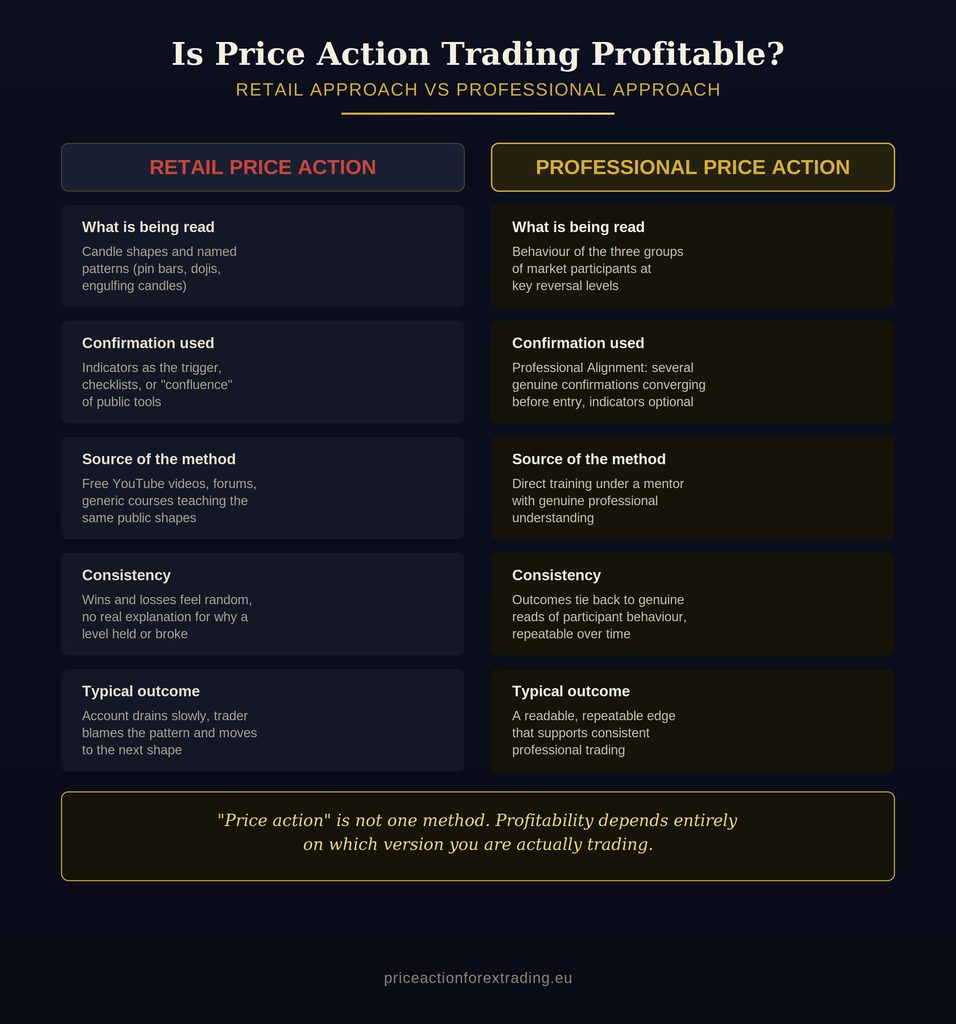
The first version is what almost everyone learns first: memorise a handful of candle shapes, wait for one to appear near a support or resistance line, check a couple of indicators for “confluence,” and take the trade. This is taught everywhere because it’s easy to teach and easy to package into a course. It’s also, in my experience and in the experience of most people who’ve tried it honestly, not a real edge. The shapes themselves carry very little information. A pin bar at a random point on the chart means almost nothing.
The second version is reading what’s actually happening in the market: understanding the behaviour of the participants who move price, recognising the levels where that behaviour becomes readable, and only acting when several genuine confirmations line up. I call this Professional Alignment, and it’s the standard I hold every one of my own trades to before I take them. This version has nothing to do with memorising shapes. It has everything to do with understanding why price does what it does at a given level, which is a different skill entirely.
Below is a side-by-side of what separates the two in practice.
Why Most Retail Price Action Traders Lose Money
I want to be specific here rather than vague, because vague explanations are exactly what keep people stuck.
Retail price action fails as a strategy for a simple reason: it treats the symptom as the cause. A candle shape is a symptom of what just happened in the market. It is not the cause of what happens next. When a trader learns to spot a pin bar and treats that shape as the signal itself, they’re reacting to the aftermath of a move rather than understanding the forces that produced it.
This is also why so many retail traders bounce between strategies. They trade pin bars for a few months, lose money, decide pin bars “don’t work,” switch to engulfing candles, lose money again, and conclude that price action trading in general doesn’t work. I’ve written before about why the shape of the candle was never the point and the same logic applies to every named pattern out there. The shape was never carrying the edge. What was missing was genuine understanding of what happens at the level where that shape appeared.
There’s a second reason retail price action struggles, and it’s less discussed: most retail approaches gate their entries on things that don’t actually determine whether a trade works. Trend structure, higher-highs-and-higher-lows checklists, session timing rules. These add the appearance of rigor without adding real information. A key reversal level is either genuinely aligned with what the market is about to do, or it isn’t, and that has very little to do with whether price happened to be in an uptrend on a higher timeframe an hour earlier.
What Actually Makes Price Action Profitable
If shapes and checklists aren’t the answer, what is?
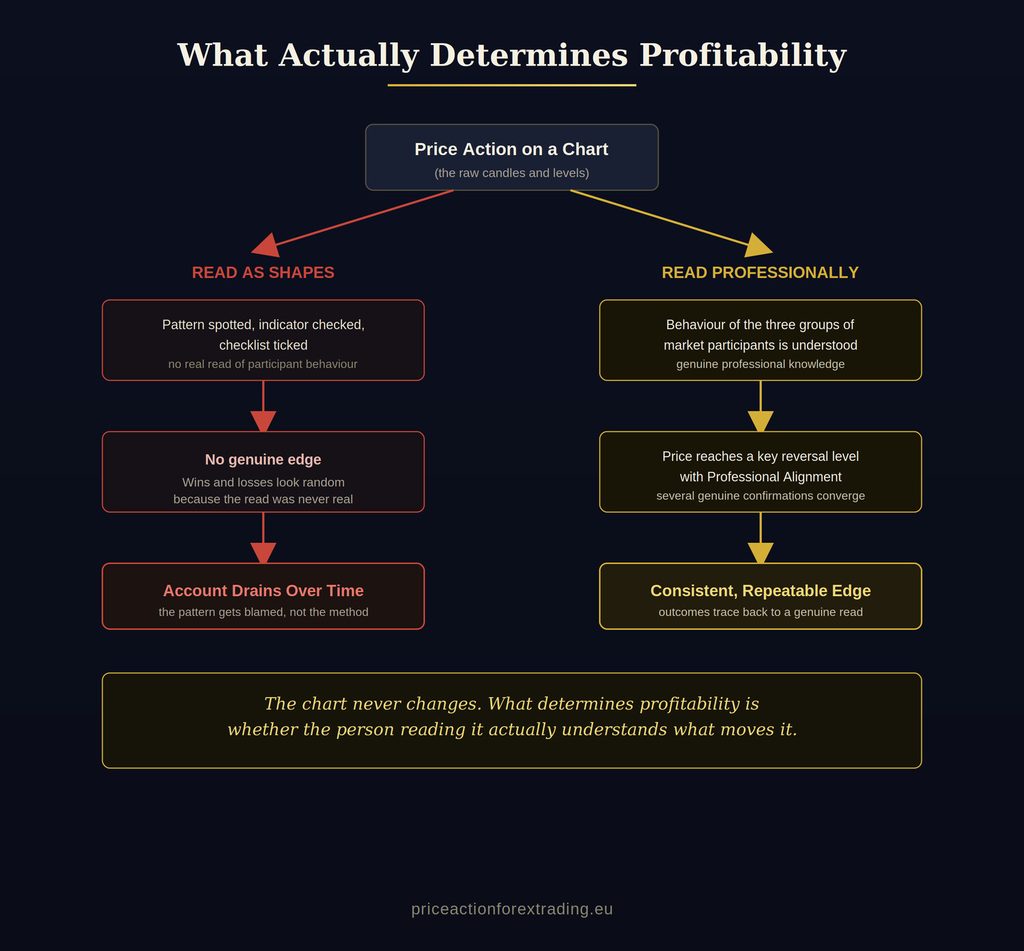
In my own trading, profitability comes from reading the behaviour of what I refer to as the three groups of market participants. I won’t go into who they are publicly here, that understanding is something I only pass on directly to people I train, because it’s the actual mechanism behind why key reversal levels hold or break, and it’s not something that belongs in a free blog post. What I can tell you is that once you genuinely understand how these participants behave at specific levels, price action stops looking random. Patterns that looked meaningless before start making sense, not because the shapes changed, but because you’re finally reading what produced them.
This is the difference between price action as decoration and price action as information. The chart never changes. What changes is whether the person looking at it actually understands what’s moving it.
I go into more detail on how this plays out day to day, including what I actually look at before entering a trade, in how I trade. It’s not a system with rigid rules. It’s a way of reading the market that becomes more precise the deeper your understanding goes.
My Own Results as Evidence
I don’t think claims about profitability mean much without something behind them, so I publish my own trading statements rather than just asserting that this works. I’m not going to walk through every number here, but the short version is that price action trading, done properly, has been consistently profitable for me across different months and different market conditions. It’s not a strategy that only works in trending markets or only works during a particular session. Once you’re reading key reversal levels and participant behaviour rather than session timing or a specific setup shape, the approach travels well across different conditions, because liquidity context changes but the underlying behaviour doesn’t disappear.
That consistency is the real test. Anyone can have a good month. What separates a genuine edge from luck is whether the results hold up over time, across different pairs, across different volatility environments.
How Long Does It Take to Become Profitable
This question comes up almost as often as the first one, and I want to answer it honestly because the industry norm here is dishonest. A lot of trading content tells you that profitability takes years, that you should expect plateaus, that progress isn’t linear and you just need to be patient. I don’t subscribe to that framing. It’s generic advice that applies to someone teaching themselves in isolation with no real feedback loop, and it gets repeated so often that people assume it’s simply how trading works.
It isn’t, if the learning is happening correctly. Under direct, competent mentorship, the gap between “reading shapes” and “reading the market professionally” can close fast, sometimes within days rather than years. The slow, multi-year timeline people associate with becoming profitable is largely a consequence of learning in isolation from public sources that were never going to get you there in the first place. I wrote about this in more depth in how to learn forex trading without wasting years on the wrong things, and it’s worth reading if you’ve been trading for a while and feel like you’re stuck in the same place you were a year ago.
Can You Learn This on Your Own?
Technically, yes, in the sense that nobody is stopping you from staring at charts for years trying to reverse-engineer what actually moves price. Practically, it’s an extremely slow and inefficient path, because the public information available on price action, YouTube channels, forums, most paid courses, teaches the shallow version. You can spend a decade getting very good at spotting pin bars and still not understand why some of them work and most of them don’t.
This is why I’m direct with people about the value of proper mentorship. I learned this from my own mentor, and it fundamentally changed the speed at which I improved. If you’re evaluating whether to find one for yourself, I’ve written a full breakdown of how to find a forex mentor worth learning from, and why most traders never do. It covers the red flags that separate a genuine mentor from someone reselling public information with a personal brand attached.
If you’d rather get straight into structured training, my Forex Training Course walks through the full framework I trade with, built around genuine professional understanding rather than retail checklists. And if you want a faster, focused entry point, Learn to Trade in 5 Days is a complete standalone course built around one strategy, and it’s enough on its own to become profitable if you apply it properly. It’s not a teaser for something bigger. It’s a full, usable approach in five days.
Final Verdict: Is Price Action Trading Profitable?
Yes, but only the version of it that involves genuinely understanding what moves price. The version most people are taught, spot the shape, check the indicator, take the trade, is not price action trading in any meaningful sense. It’s pattern recognition dressed up as a strategy, and it fails for the same reason most retail strategies fail: it mistakes the symptom for the cause.
The version that works requires reading key reversal levels, understanding participant behaviour, and only acting when Professional Alignment is genuinely present. That’s a skill, not a checklist, and it’s learnable, often faster than the industry likes to admit, under the right training.
If you’ve been trading price action and it hasn’t worked, the honest question isn’t “does price action work.” It’s “which version have I actually been trading.” For most people, the answer changes everything.
Thanks for reading and have a beautiful day!