
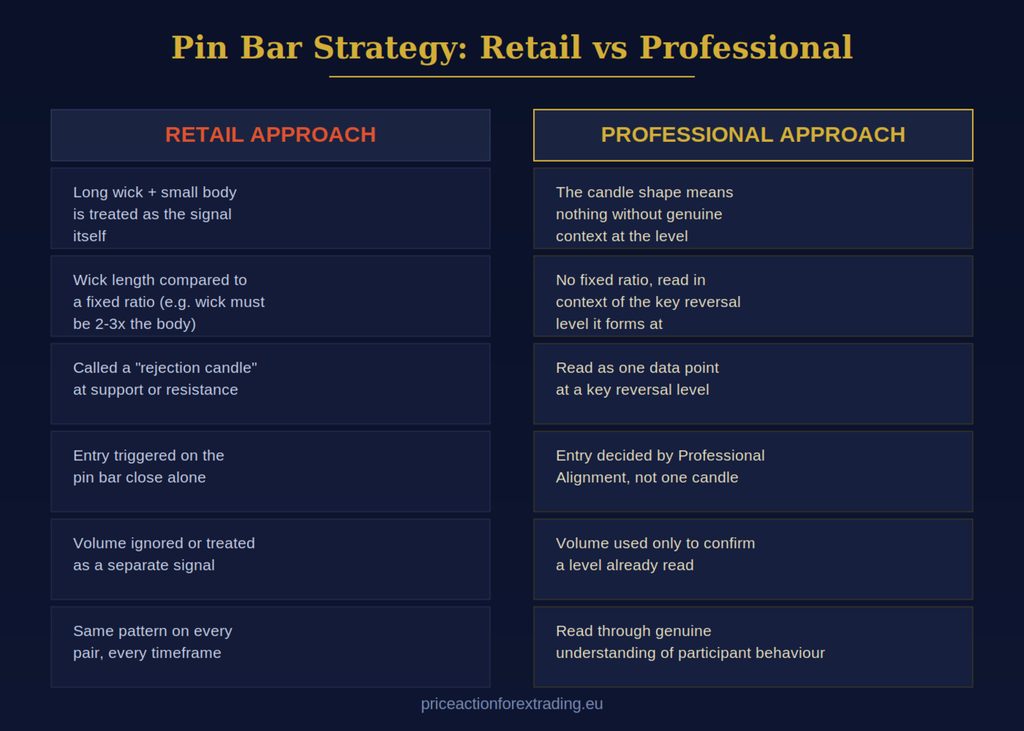
If you have spent any time reading about price action, you already know the pin bar. Long wick, small body, sitting at a level on your chart. Every course, every YouTube video and every forum thread teaches it the same way – measure the wick, check it is two or three times the size of the body, confirm it is sitting at support or resistance, and take the trade on the close.
I taught myself that version once too. It cost me money for a long time before I understood why.
The pin bar is one of the most recognisable candles in forex trading, and also one of the most misunderstood. Traders memorise its shape and treat that shape as a signal. It never was. What the wick and the body are actually telling you only makes sense once you understand what is happening at the level where the candle formed – and that is the part almost nobody teaches, because almost nobody who teaches it actually knows.
In this article I will walk through why the retail pin bar checklist fails so often, what I actually look at when a candle like this forms, and where it fits into a professional approach to reading price.
What Traders Are Taught About the Pin Bar
The standard definition goes something like this: a candle with a small real body and a long wick protruding in one direction, ideally with little to no wick on the opposite side. The long wick is supposed to show that price moved sharply in one direction and then closed back near where it opened.
From there, the checklist usually includes:
- The wick must be a certain multiple of the body, often two or three times its length
- The candle should form at an obvious support or resistance zone
- A “confirmation candle” should follow in the expected direction
- Entry is placed on the break of the pin bar’s high or low, stop behind the tip of the wick
None of this is wrong in the sense that it describes what the candle looks like. What is wrong is what it implies – that the shape itself is the reason to trade. That a long wick automatically means something happened that you can act on.
I have gone through what price action actually is in forex in detail elsewhere, and the pin bar is a perfect example of the gap between reading candles and reading price. Most traders think they are doing the second when they are only doing the first.
Why the Checklist Approach Fails
Here is the problem with treating a pin bar as a standalone signal. If a long wick with a small body was genuinely a reliable trigger on its own, it would work consistently across every pair, every session and every timeframe. It does not. Traders who trade every pin bar they see at every level they can draw a line at lose money, and they lose it in a fairly predictable way.
The candle shape is common. It happens constantly, in both directions, at levels that matter and at levels that do not. A retail trader scanning charts for pin bars is essentially pattern matching on noise, because the shape alone carries no information about why price moved the way it did before printing that wick.
This is the same mistake I see across almost every “pattern” retail traders are taught to hunt for. A shape on a chart is the visible residue of something that already happened. It is not the cause, and treating it as a trigger skips the part that actually matters.
Location Is Not Enough Either
Most pin bar education tries to fix the “shape alone isn’t enough” problem by adding location as a filter. Trade the pin bar only at support or resistance, they say. This is progress, but it is not the fix people think it is.
I have written before about how support and resistance zones actually get used by retail traders, and the same issue applies here. A pin bar forming at any random horizontal line drawn on a chart is not the same thing as a pin bar forming at what I call a key reversal level – a level that reflects genuine, structural significance in how the market has behaved around it.
Most of the horizontal lines retail traders draw are not that. They are reactive, hindsight-drawn levels fitted to where price has already turned once or twice. A pin bar at one of those levels is just as meaningless as a pin bar in the middle of nowhere, because the level itself was never meaningful to begin with.
What a Pin Bar Actually Tells You
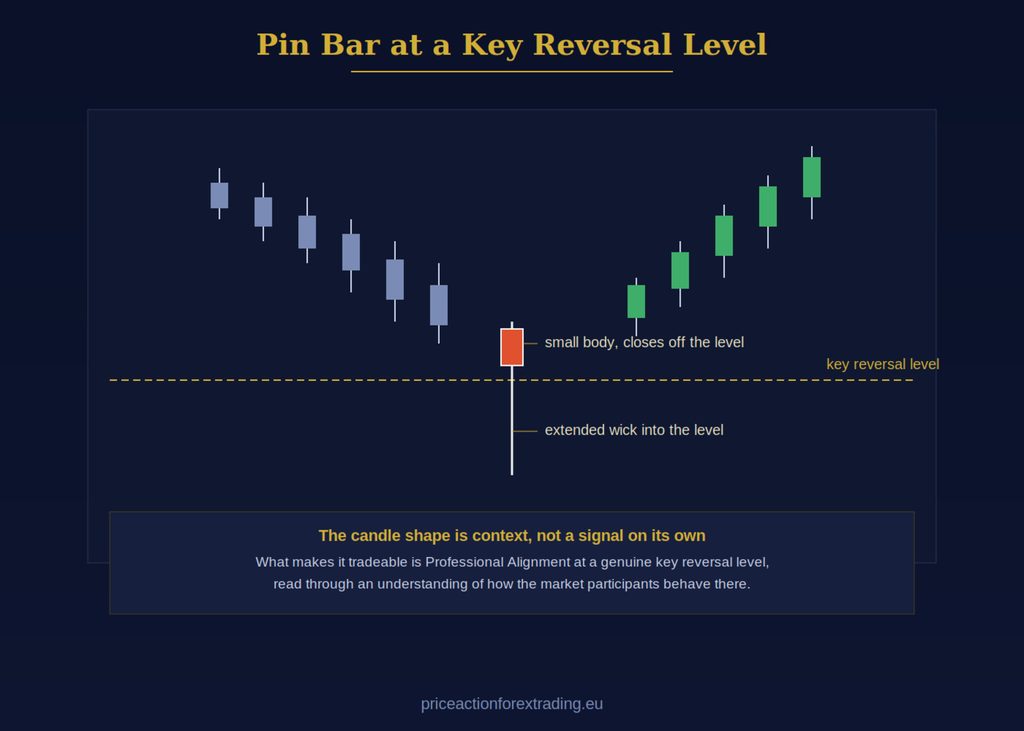
Strip away the retail language for a moment. What you are looking at with a pin bar is simply this: price extended into a level, then closed away from it within a single candle. That is the observable fact. Everything past that – why it happened, what it means, whether it is tradeable – depends entirely on context that the candle itself cannot give you.
I will not pretend the wick and the close are meaningless. They are a piece of information. But they are one data point, not a conclusion. On their own, they tell you what price did. They do not tell you why, and the why is what separates a candle worth acting on from a candle worth ignoring completely.
This is where genuine understanding of how the market actually moves comes in – specifically, understanding of the three groups of market participants whose behaviour shapes every key reversal level on your chart. This is not something I can lay out in a blog post. It is confidential material that I only go through in depth with people I train directly, because it took years to build and it is not available anywhere else, not on YouTube, not in forums, and not in most privately run courses either. What I can tell you is this: once you can read what those participants are actually doing at a level, a pin bar stops being a shape you are hoping means something, and starts being one confirming detail inside a much bigger picture.
Professional Alignment, Not a Standalone Trigger
In my own trading, I never act on a pin bar in isolation. What I am looking for is Professional Alignment – multiple things pointing the same direction at the same key reversal level before I consider a trade. The candle can be part of that picture. It is never the whole picture.
This is the same principle I apply across every setup I trade, whether that is a pullback into a level or a reversal. The specific mechanics of what I am aligning and how I read it are part of what I teach directly rather than publish, but the principle itself is simple to state – no single piece of evidence, however visually convincing, is enough on its own. A long wick at a level you have correctly identified as significant is worth paying attention to. A long wick anywhere else is just a long wick.
Where Volume Fits In
Volume gets dragged into pin bar strategies constantly, usually as a second filter stacked on top of the shape and location checklist. High volume on the pin bar, the theory goes, means the move is “stronger” or more likely to hold.
I use volume differently. It is never a standalone signal for me, and it never triggers a decision by itself. What it does is confirm a level I have already read as significant through other means. If I have identified a key reversal level and price prints a pin bar there, volume can add weight to that read. It cannot create significance out of nothing, and it cannot rescue a level that was never meaningful in the first place.
Traders who lean on volume as a primary signal are usually trying to compensate for not having a genuine read on the level itself. It is an understandable instinct. It does not solve the underlying problem.
Common Mistakes Traders Make With Pin Bars
A few patterns come up again and again when I look at how retail traders handle this setup:
Trading every pin bar they see. Once you know what to look for, pin bars are everywhere. Trading all of them, or even most of them, guarantees you are trading plenty of meaningless ones.
Drawing levels to fit the candle. It is tempting to look at a pin bar and then go find a reason it formed at “resistance.” This is backwards. The level has to be genuinely significant independent of the candle, not justified by it after the fact.
Ignoring what happens after. A pin bar is one candle. What price does in the following candles at the same level often tells you more than the pin bar itself did.
Assuming a bigger wick means a stronger signal. There is no fixed ratio that makes a pin bar “more valid.” A small, unremarkable-looking candle at a genuine key reversal level can matter far more than a dramatic-looking wick at a level that was never significant.
Treating it as beginner-friendly because it looks simple. The shape is easy to spot. Understanding when it actually matters is not, and that gap is exactly why so many traders lose money trading it.
Learning to Read Candles Properly
None of this means the pin bar is useless. It means it was never meant to be read alone. The candle is a piece of the puzzle, and understanding which pieces matter and why requires the kind of genuine professional understanding that most retail education simply does not teach, because most people teaching it do not have it themselves.
This is the gap my Forex Training Course is built to close, whether you are just starting out or you have been trading for years using checklists like the one above without knowing why they keep failing you. It is not an advanced-only course – it works the same whether this is your first month reading charts or your fifth year.
If you want a faster, more simplified route into how I actually read price, Learn to Trade in 5 Days walks through a full professional strategy from the ground up. It is a complete course in its own right, not a teaser for something else, and traders have gone on to be consistently profitable from it alone. Under the right training, this kind of understanding does not have to take years to build. I have seen it click for people in a single session, because the missing piece was never effort, it was access to genuine knowledge.
Final Thoughts
The pin bar is not a bad candle to pay attention to. It is a bad candle to trade in isolation. The wick and the body tell you what price did, not why it did it, and that missing piece is exactly what separates traders who read charts from traders who read the market.
If you take one thing from this article, let it be this: stop asking whether a candle looks like a pin bar, and start asking whether it formed at a level worth caring about in the first place. Everything else follows from that.
Thanks for reading and have a beautiful day!