
New traders ask me this question constantly: how many hours a day do forex traders actually trade? They expect a number. Six hours. Eight hours. Maybe “as long as London and New York overlap.” I understand why. It feels like a measurable, controllable variable in a business that otherwise feels chaotic.
But after years of trading full time, I can tell you the honest answer isn’t a number of hours at all. It’s a question of what you’re doing with the time you spend at the chart, and that distinction is exactly where retail traders and professionals part ways.
In this article I’ll walk through why “hours traded” is the wrong metric, what actually determines how much time a session takes, and what a realistic day looks like when you’re trading with genuine professional understanding instead of chasing candles.
Why “Hours Traded” Is the Wrong Question
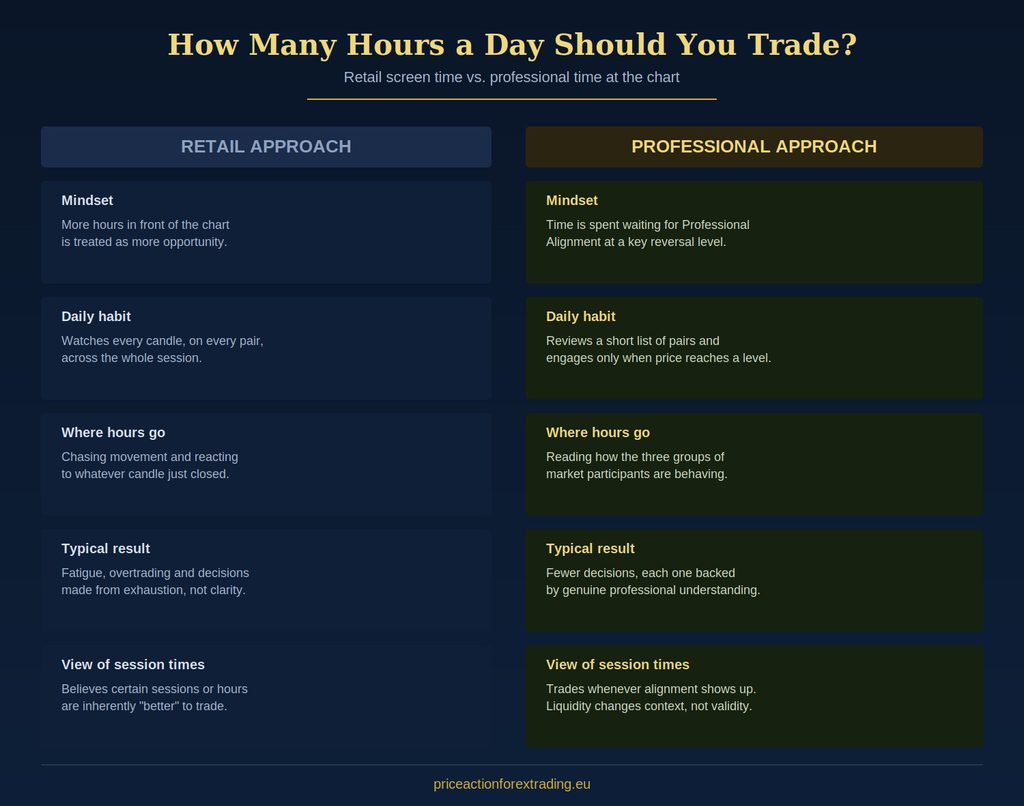
Screen time feels productive. If you’ve spent six hours watching charts, it’s tempting to believe you’ve done six hours of “work” as a trader. But watching price move and reading price move are two completely different activities, and only one of them produces decisions worth acting on.
Retail traders tend to treat every hour at the chart as equally valuable. More hours means more chances to catch a move, so the logic goes. That mindset is what leads people to sit through entire sessions, watching every candle on every pair, waiting for something – anything – to happen.
Professionals don’t operate this way. Most of a trading day is spent waiting for price to reach a key reversal level where Professional Alignment can actually be read. The chart can sit quietly for long stretches, and that’s not wasted time. It’s price building toward a location that matters. The number of hours you’re technically “at the chart” tells you almost nothing about whether that time was well spent.
There Is No Universal Number
If you ask ten profitable traders how many hours a day they trade, you’ll get ten different answers, and all ten can be legitimate. The honest range runs from under an hour to most of a working day, and the variation comes down to a handful of factors rather than a rule anyone should copy blindly.
Your Strategy Shapes Your Time Commitment
A trader working the H1 chart checks in periodically through the day rather than staring at the screen continuously. Because I start my own top-down read on H1 and H4, a lot of my process involves marking levels, stepping away, and returning when price is closer to somewhere worth paying attention to. That’s a very different time footprint than someone trying to catch every five-minute swing.
It’s also worth clearing up a common misunderstanding about scalping here, since it comes up constantly around this topic. Scalping isn’t defined by short holding times, it’s defined by a tight profit target. A scalp trade can sit open for a day or more if price hasn’t reached that target yet. So “I scalp, therefore I only need thirty minutes a day” is a myth built on a misunderstanding of what scalping actually is. If that’s a strategy you’re considering, it’s worth understanding properly rather than picking up the label from a forum post.
Market Conditions on a Given Day
Some days, price reaches meaningful levels quickly and decisively. Other days it grinds sideways for hours before anything worth reading develops. You can’t schedule genuine opportunity in advance. Some sessions require more patience than others, and pretending otherwise is how traders end up forcing entries just to justify the time they’ve already spent watching.
How Many Pairs You’re Following
Watching one pair closely takes far less total time than trying to track eight pairs simultaneously across multiple timeframes. Most professional traders narrow their focus rather than widen it. A shorter watchlist, reviewed properly, produces better decisions than a long one skimmed under pressure.
What a Realistic Trading Day Actually Looks Like
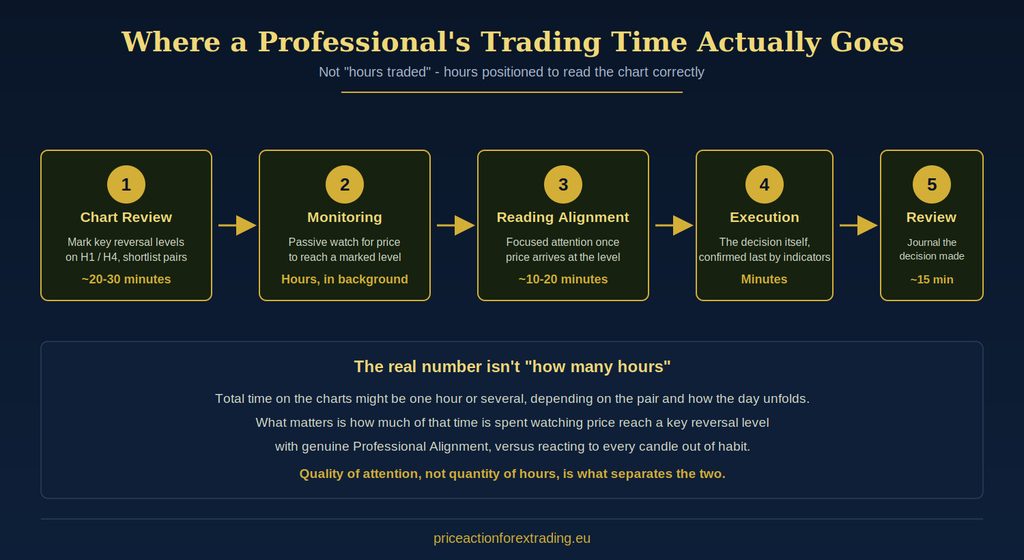
Here’s roughly how time breaks down on a normal trading day for me, and it might look different from what you’d expect if you’ve been picturing eight straight hours of chart-watching.
Chart review and level marking takes maybe twenty to thirty minutes. This is where I go through my shortlist, mark key reversal levels on H1 and H4, and get a sense of which pairs are worth watching that day.
Monitoring is the largest chunk of time by the clock, but it’s mostly passive. Price needs time to travel toward a level, and there’s no benefit to staring at that process candle by candle. This is the stretch retail traders spend glued to the screen and professionals spend doing almost anything else, checking back periodically rather than continuously.
Reading alignment happens once price actually reaches a level worth reading. This is where focused attention matters, and it might take ten to twenty minutes of genuine, undistracted concentration on what the three groups of market participants are doing at that specific location on the chart.
Execution itself is quick. By the time indicators confirm what the level reading has already suggested, the decision takes minutes, not hours. As I’ve written elsewhere, indicators are the last piece of the process, not the starting point, and the actual edge comes from understanding retail indicator behavior, not from avoiding indicators altogether.
Review at the end of the session, journaling what happened and why, takes another fifteen minutes or so.
Add it up and the “active” time – the part where real decisions get made – is a small fraction of the total day. That’s not a flaw in the process. It’s the entire point.
Why More Screen Time Doesn’t Mean More Profit
I’ve mentored enough traders to see this pattern repeat itself: the trader spending the most hours at the chart is frequently the one struggling the most, not the one performing best. It seems backwards until you understand what’s actually happening.
More hours at the chart, without a professional framework for reading price, just means more exposure to impulsive decisions. Every extra hour spent watching without a genuine reason to act is another hour where boredom, frustration, or FOMO can talk you into a trade you shouldn’t take. I’ve covered this dynamic in more depth in is price action trading profitable, and the short version is that profitability tracks the quality of your decisions, not the quantity of hours behind them.
This is also where the checklist mentality does real damage. Traders who think success comes from mechanical discipline – trade this many hours, check the chart this often, follow this rulebook – are optimizing for the wrong variable entirely. What actually separates outcomes is professional thinking applied with professional knowledge at the moment a level is reached. That’s not something more hours can substitute for.
Does Time of Day or Session Matter?
This question usually comes bundled with “how many hours,” so it’s worth addressing directly. A lot of retail material insists certain sessions – London open, the New York overlap – are inherently better times to trade. I’d push back on that framing.
A professional strategy works at any time of day. What changes across sessions is liquidity, not validity. A key reversal level doesn’t stop being meaningful because it’s being read during the Asian session instead of London. What does shift is how much volume is moving through that level, and volume matters only as confirmation of a read that’s already been made, never as a standalone signal to trade off. If you’ve marked a level correctly and price arrives at it with genuine alignment, the clock on the wall isn’t the deciding factor.
This ties into a closely related misunderstanding worth clearing up too – the idea that higher timeframes are somehow “cleaner.” They’re not cleaner. They simply carry more weight, because more capital moves through the levels visible there.
What About Hours Per Week?
The daily question usually leads to a follow-up: if daily hours vary this much, what does a realistic week look like? Here again, there’s no single number that fits everyone, but a few patterns hold up consistently among traders who are actually profitable.
Most professional-style traders check the market five to six days a week, since the forex market itself runs from Sunday evening through Friday close across global sessions. But “checking the market” and “actively trading” aren’t the same commitment. On a given week, a trader might see genuine, tradeable alignment on only two or three pairs across the entire week, and skip everything else without a second thought.
This is a hard concept for newer traders to accept, because it runs against the instinct that more activity equals more progress. In reality, a week where you sat on your hands for four days and took one well-read trade on the fifth can be a far stronger week than one where you took a dozen mediocre entries just to feel productive. Weekly consistency comes from consistently applying the same standard to every level you look at, not from filling a weekly hours quota.
If you’re building a trading schedule around a day job, this is genuinely good news. You don’t need to replicate a full-time trader’s total screen time to develop the same skill. You need the same quality of attention during the windows you do have available, applied consistently over time.
Building the Habits That Matter More Than the Hours
If you’re new to this and still trying to figure out how much time to budget for trading each day, I’d gently suggest you’re asking the wrong first question. The number of hours you spend will sort itself out naturally once you understand what you’re actually looking for on the chart. Until then, more hours just means more time spent looking in the wrong places.
This is exactly the trap I address in how to learn forex trading without wasting years. Most traders assume competence is purely a function of time invested – years of screen time, thousands of chart hours, endless backtesting. Under the right mentor, that timeline compresses dramatically. Genuine professional understanding isn’t something you accumulate slowly through sheer repetition. It’s something you can be trained in directly, and once you have it, your relationship with time at the chart changes completely.
That’s really the shift I want every reader to take from this article. Stop measuring your trading in hours. Start measuring it in the quality of what you’re doing with the time you have. A trader who spends forty-five focused minutes a day reading key reversal levels with genuine Professional Alignment will outperform someone glued to five screens for ten hours, every time.
Building a Schedule That Actually Works for You
Once the framework is right, the practical question becomes how to structure your day around it. A few things I’d suggest:
- Narrow your watchlist. Following two or three pairs properly beats half-watching eight.
- Set specific check-in windows around when your marked levels are realistically likely to be approached, rather than sitting through the entire session.
- Treat the “waiting” portion of your day as legitimate work, not dead time. It’s part of the process, not a gap in it.
- Keep a journal of what actually happened at each level you tracked, whether or not you traded it. This builds the pattern recognition that makes future reads faster.
- Resist the urge to add hours when a strategy isn’t performing. The fix is almost never more screen time.
None of this requires a rigid schedule locked to specific clock hours. It requires knowing what you’re looking for, so the hours you do spend are doing something.
Final Thoughts
So, how many hours a day do forex traders trade? The professional ones spend as long as it takes to review the chart, wait for price to reach somewhere meaningful, and read what’s happening there with genuine understanding – sometimes under an hour of real decision-making inside a longer window of patient watching. There’s no fixed number worth chasing, and any answer that gives you one is oversimplifying a process that’s really about attention and understanding, not the clock.
If you want to build that understanding properly rather than guessing your way through it, my Forex Training Course walks through exactly how I read key reversal levels and Professional Alignment, or if you’d rather get moving faster, Learn to Trade in 5 Days is a complete, standalone course that can have you trading profitably on its own.
Thanks for reading and have a beautiful day!