
“How often should I check the charts?
Every hour? Twice a day? Only at candle close? Never on weekends?
Traders ask me this constantly, and they are usually hoping for a rule. Something clean they can follow so they feel like they are doing it right.
Here is my answer, and it will disappoint anyone selling a schedule: check the charts as many times as you want.
Once an hour, fifty times a day, or once a week. There is no correct number. If you are making money, your frequency is good. If you are not, changing the frequency will not fix it.
In this article I’ll explain why the whole question is built on a retail fantasy, where the fantasy comes from, and what you should be focused on instead.
The Answer Nobody Selling a Schedule Wants to Give
Type this question into a search engine and you will find the same advice repeated everywhere.
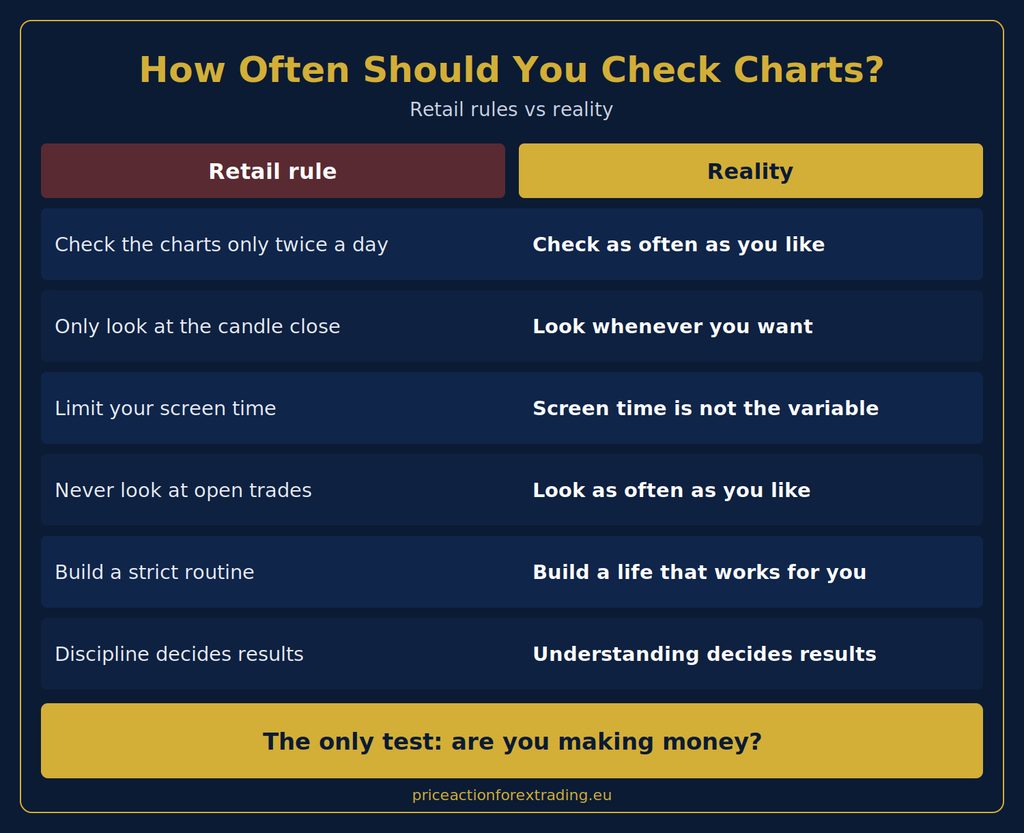
Check twice a day. Set alerts and walk away. Only look at the close of the candle. Limit your screen time. Never touch your open trades.
It all sounds reasonable. It sounds disciplined. And that is exactly why it spreads.
But ask yourself where these rules come from. They come from people who do not have a real answer to why traders lose, so they pick something measurable and blame that. Too much screen time. Too many looks. Not enough structure.
It is easy to count how often someone checks a chart. It is hard to teach someone to read what is on it. So the industry teaches the easy thing.
Where the Frequency Obsession Comes From
Retail trading education runs on rules and checklists. Rules are easy to write down, easy to sell, and easy to feel good about following.
When a trader loses, the retail explanation is always about behaviour:
- “You overtrade.”
- “You lack discipline.”
- “You watch the screen too much.”
- “You need a stricter routine.”
Notice what is missing. Nobody asks whether the trader actually understands what the market is doing. Nobody asks whether the decisions were sound in the first place.
So the trader adopts a schedule, checks the chart at exactly the approved times, and loses anyway. Then they are told the schedule needs to be stricter.
That loop can run for years. I have watched people go through it.
If you want to see how this plays out in a bigger picture, I wrote about what actually separates results in is price action trading profitable. Behaviour rules are nowhere near the top of the list.
What Decides Your Results
Let me put it as simply as I can.
Take two traders. Both look at the same chart. One looks once. The other looks five hundred times.
If neither of them understands what they are looking at, it makes no difference. They will both lose, one slowly and one faster.
If both of them genuinely understand what price is doing and why, it also makes no difference. They will both make money. One of them just spent more time on the couch.
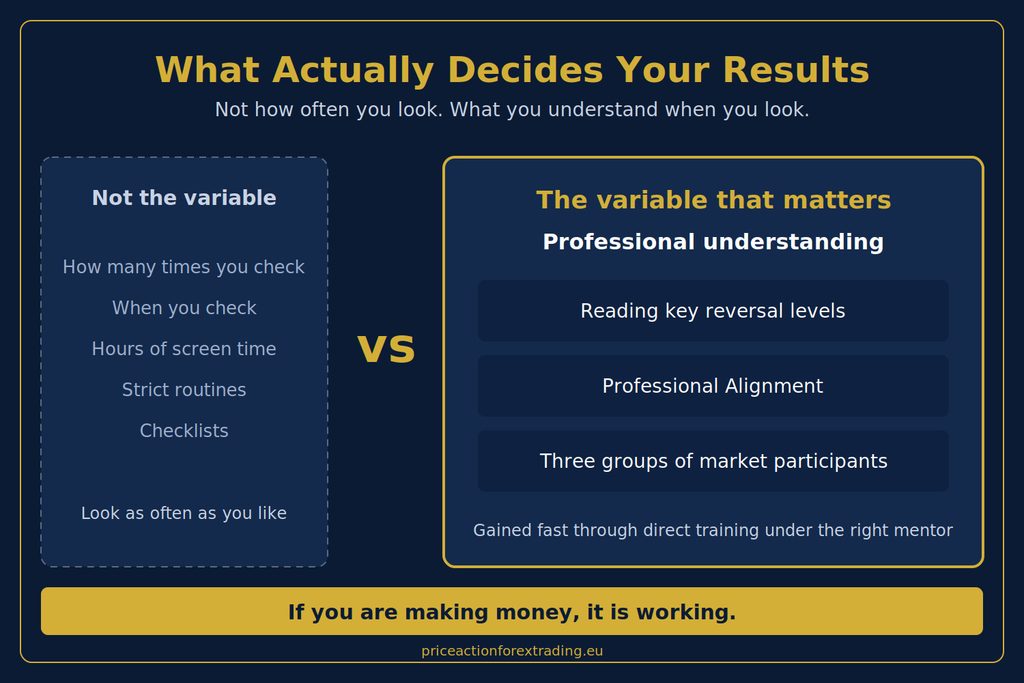
The number of looks is not the variable. What you understand when you look is the variable.
This is why I don’t treat a schedule as the answer. A schedule changes when you look. It does nothing about what you see.
Same Chart, Different Reader
Here is another way to think about it.
Imagine handing a page of a foreign language to someone who cannot read it. You can tell them to look at it twice a day, or once an hour, or only at sunrise. They will get exactly nothing from it either way.
Now hand the same page to someone who reads that language fluently. They can glance at it for two seconds or study it all afternoon, and they will understand it.
A chart works the same way. To someone who can read it, every detail carries meaning. To someone who cannot, more time just means more staring.
That is why I never say most of a chart is unimportant, and why I never tell people to look at it less. The question is not how much you look. It is whether you can read.
If You Are Making Money, It Is Working
This is the test I use, and I think it is the only honest one.
Are you making money? Then how you check your charts is fine. Keep doing it.
Do you check constantly and make money? Good. Do you check twice a day and make money? Also good. Nobody gets to tell you your method of looking is wrong when your results say otherwise.
Are you not making money? Then look at what is happening in the trades themselves. Why you entered, what you understood at that location, whether you were reading price with professional knowledge or with a public toolkit.
The frequency of your screen time is almost never the answer. It is just the most convenient thing for retail educators to point at.
How I Do It
I do check the charts on a repeated schedule. It’s a routine that fits my life and I’m comfortable with it.
On top of that, I use alerts. When something interesting is going on, I look on demand, whenever it happens, without waiting for the next scheduled check.
So I use both. Neither one is a rule, and neither one is the reason I make money. I start my top-down read on H1 and H4 (I go through how in my H1 forex trading strategy article), and my results depend on what I understand when I look, not on when or how I got there.
If a schedule suits you, use one. If alerts suit you, use those. Mix them like I do, or throw both away. The routine is a convenience. It’s not the edge.
If you are curious about the other side of this question, how long a trading day actually takes, I covered that in how many hours a day forex traders trade. The short version is the same: the clock is not where the edge is.
Retail Advice on Checking Charts You Can Ignore
Let me go through the most common rules and say why I’d drop each one.
“Only check at the close of a candle”
You can look whenever you like. A candle that is still forming still carries information, and a trader who can read price gets something from it. Waiting for a close is a rule made for people who do not trust their own read.
“Check only twice a day”
If you are trading H1 and H4 and you are happy with two looks, fine. If you want twelve, also fine. There is nothing magic about two.
“Set alerts and walk away”
I use alerts myself, so I’m not against them. They are a handy tool for looking on demand when something interesting is going on. But they are not a requirement, and they are certainly not the secret to good trading. Use them if they make your life easier. Skip them if they don’t.
“Limit your screen time”
Some traders love the chart and enjoy every hour with it. Others get their work done and close the laptop. Both are fine. Screen time is not a measure of anything.
“Never look at your open trades”
Look at them as often as you like. Looking at a trade does not change it, and it does not make you a worse trader. Whether you manage it well depends on your understanding, not on how disciplined your eyes are.
“Build a strict trading routine”
Build a life that works for you and trade around it. I check on a repeated schedule myself, so I have nothing against routines. They are just not a strategy, and they are not what makes the money.
Does Your Style Change Anything?
Not really.
A trader working the H1 and H4 charts and someone trading a lower timeframe will probably end up with different looking days. That’s natural. But it is a result of what they are doing, not a rule they need to follow.
Scalping is worth a quick note because it is so often misunderstood. Scalping is defined by a tight profit target, not by how long the trade stays open. A scalp can remain open for days if price has not reached the target yet. So the idea that scalpers must stare at the screen while everyone else can relax is just another retail myth.
Whatever your style, the principle holds. Look when you want. Trade what you understand.
What About a Day Job?
This is where the frequency myth does the most damage.
Plenty of people believe they cannot trade because they cannot watch the market all day. So they either give up, or they try to trade from a phone at their desk and feel guilty about it.
You do not need to be at the screen constantly. You also do not need to feel bad if you can only look a few times a day. What you need is understanding, so that when you do look, you know what you’re looking at.
There is one more thing worth saying. A professional strategy works at any time of day. What changes across the day is liquidity, not validity. So whatever window your life gives you, it can work.
What You Should Be Focused On Instead
If not frequency, then what?
Professional understanding of what price is doing at key reversal levels.
That is where results come from. Not from a schedule, not from discipline, and not from a checklist.
The market is driven by three groups of market participants, and genuinely understanding how they behave is what separates people who make money from people who don’t. It is not something you will find on YouTube or in forums, and it is missing from most private courses too. It is what I was trained in directly by my mentor, and it is what I teach.
When price reaches a key reversal level, the question is whether Professional Alignment is there. That is a question of understanding. Not of how often you looked, or when.
Volume, for the record, is only confirmation of a level you have already read professionally. It is never the reason to trade.
Understanding Is Faster Than You Think
Most people assume that learning to read the market takes years of screen time. That is exactly the retail belief that keeps people stuck: more hours, more charts, more backtesting.
Under the right mentor, it does not work like that. You can be trained directly, you can see the difference quickly, and the improvement can come fast. Hours at the chart were never the missing ingredient. Knowledge was.
That is what my mentor Robert Taylor gave me, and it is why I do not tell traders to look at the chart less, or more, or on a timetable. I tell them to learn to read it.
Final Thoughts
So, how often should you check forex charts?
However often you want.
Check them a hundred times or twice. Check at candle close or in the middle of it. Look at your open trades every minute if you feel like it. If you are making money, it is working. If you are not, the number of looks is not the problem, and no schedule will fix it.
Put your effort where it counts: learning to read price with genuine professional understanding.
If you want to build that understanding, my Forex Training Course shows exactly how I read key reversal levels and Professional Alignment, and it suits new and experienced traders alike. If you’d like something focused to start with, Learn to Trade in 5 Days is a complete, standalone course that can have you trading profitably on its own.
Thanks for reading and have a beautiful day!