
I still remember the first time I “found” an inside bar setup. I marked the mother bar, drew my two entry lines above and below it, set my alerts, and waited. Price broke one side, stopped me out, then ripped through the other. That was my introduction to a pattern that gets sold to retail traders as a clean, mechanical setup and almost never behaves that way in practice.
The inside bar is one of the most recognisable shapes on a forex chart. A small candle tucked entirely inside the range of the one before it. It looks tidy. It looks like something is “about to happen.” And that visual neatness is exactly why so many traders build entire strategies around it.
Here’s where I stand on it today: I notice inside bars constantly, on every pair, at every point on the chart. I just never trade them. Not at a key reversal level, not with confirmation, not under any condition. It’s a completely retail pattern, and I want to walk through why that’s the case, what I actually use it for, and what I do instead.
What an Inside Bar Actually Is
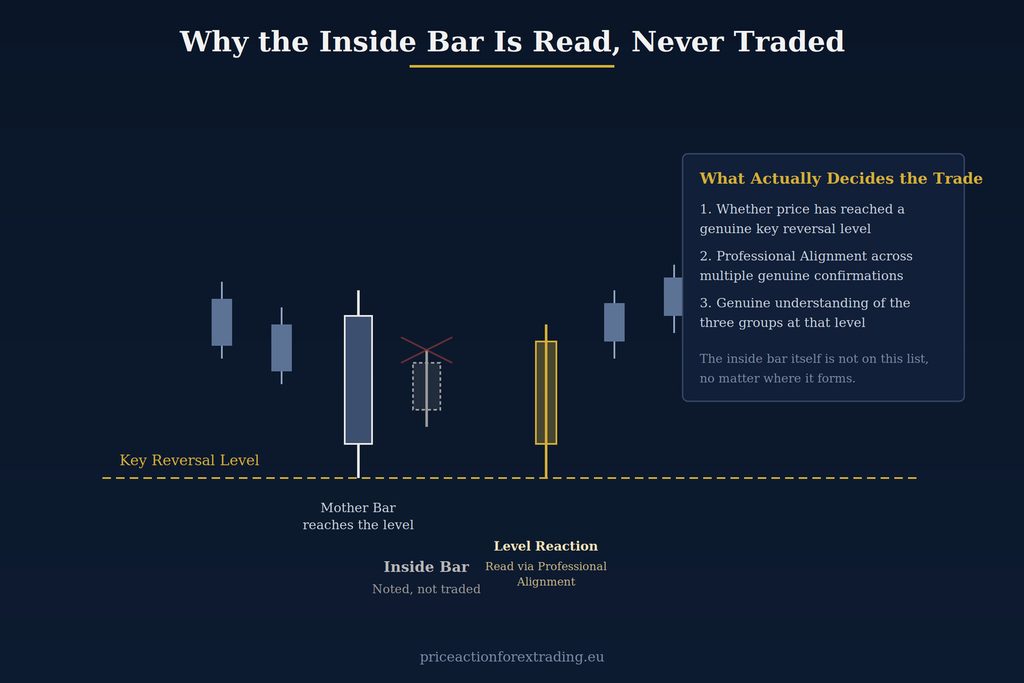
An inside bar is simple to define. It’s a candle whose full high-to-low range sits inside the high and low of the candle before it, sometimes called the “mother bar.” No new high, no new low. The market takes a breath.
Retail material usually explains this as “indecision” or “compression before expansion.” You’ve probably read that language before, maybe alongside a description of the setup as a coiled spring. It’s a memorable image. It’s also not particularly useful, because it treats a shape as if the shape itself carries meaning.
Here’s the part that gets skipped in most explanations: an inside bar forms constantly, everywhere on a chart, in every kind of market condition. It’s one of the most common shapes there is. That alone should tell you something about how much weight it deserves as a standalone signal.
The Retail Inside Bar Strategy, and Why It Struggles
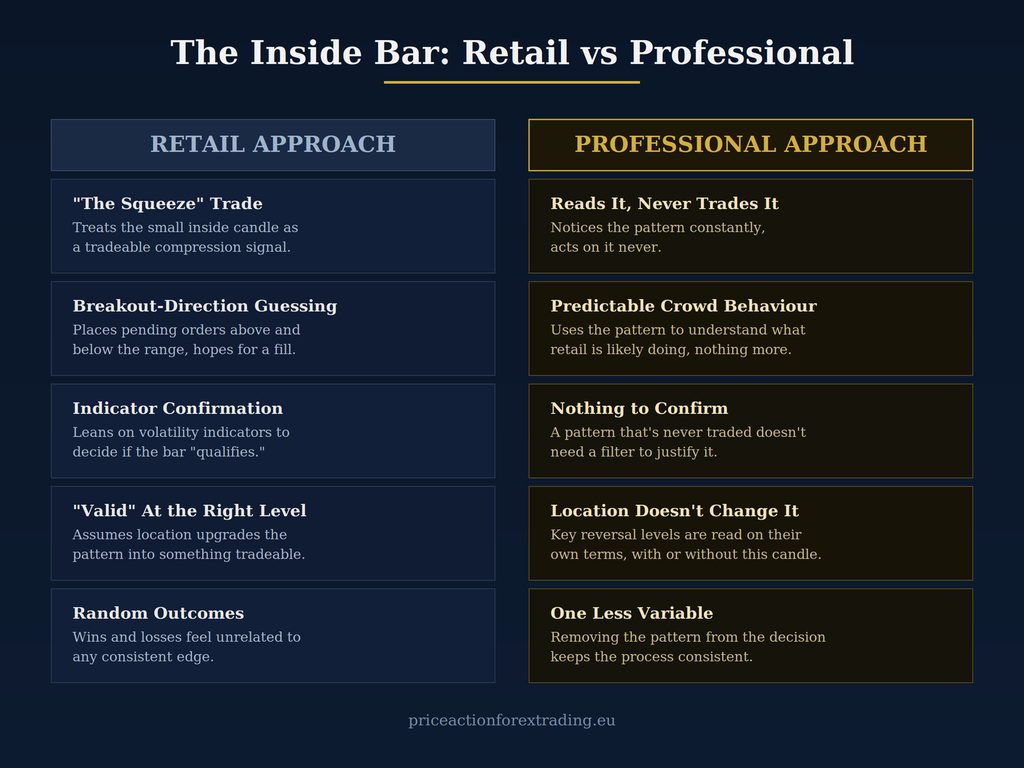
The standard retail approach to inside bars is a breakout play. Mark the high and low of the mother bar, place a buy stop above and a sell stop below, and let the market pick a direction. Whichever side gets hit first becomes the trade, and the opposite order gets cancelled.
On paper it sounds disciplined. In practice it has a structural problem: it treats every inside bar the same way, everywhere it forms, as if a pause in the range is itself a reason to enter the market. The strategy was built entirely around the shape of one candle relative to the one before it, and nothing else.
This is the same trap I’ve written about with other single-candle setups. When I broke down the pin bar forex strategy, the core issue was identical: traders were reacting to a candle’s shape instead of asking what actually drives price at that point on the chart. The inside bar has the same weakness. I just take it a step further than most retail material is willing to, and say outright that I don’t trade the pattern, full stop.
Add to that the habit of trading inside bars purely because “the pattern formed,” several times a week, on every pair being watched, and you get a strategy that fires constantly, wins inconsistently, and never builds the kind of repeatable edge that professional trading actually requires.
What I Actually Use the Inside Bar For
If I don’t trade it, why do I still pay attention to it at all? Because noticing an inside bar tells me something about the crowd, even though it never tells me anything worth acting on directly.
An inside bar sitting on a chart means a specific group of retail traders is about to do something predictable with it. Orders get built above and below that small range the moment traders spot the pattern, the same way I once built mine. That’s useful information about positioning, not because I’m going to trade the inside bar itself, but because understanding what the retail crowd tends to do at any given moment is part of reading the market the way I’ve been trained to.
I’ve written before about the three groups of market participants that actually move a currency pair, and I keep that framework deliberately private beyond a certain point. What I can say is that a pattern like the inside bar is far more useful to me as a marker of retail expectation than it ever was as a trade trigger. Seeing one doesn’t change what I do. It occasionally confirms what I already expect the crowd around me to be doing.
Why Location Doesn’t Change My Answer
You might expect me to say the pattern becomes tradeable once it forms at a key reversal level, the proprietary term I use for the handful of price points on any chart that actually carry weight. It doesn’t. I go into far more depth on how I identify and use these levels in my piece on key reversal levels in forex, and that piece describes exactly how I read price at these points. An inside bar forming there doesn’t change that process.
When price reaches a genuine level, I’m reading it through Professional Alignment, multiple genuine confirmations converging before I’d ever consider an entry. Whether the candle that happens to be sitting there is an inside bar, a pin bar, or something with no name at all makes no difference to that read. The level does the work. The candle shape doesn’t add anything to it, and I’ve never found a version of “inside bar at a level” that earned a different treatment than any other candle at that same level.
This is worth being direct about, because a lot of price action content tries to have it both ways: dismiss the pattern in general terms, then quietly reintroduce it as valid “in the right context.” I’d rather just say it plainly. The pattern isn’t part of how I trade, in any context.
Common Mistakes Traders Make With Inside Bars
A few patterns show up again and again with traders I talk to who’ve built strategies around this setup specifically.
The first is trading every inside bar they see, everywhere it forms, treating frequency as opportunity rather than noticing that a pattern this common can’t realistically carry a standalone edge.
The second is over-filtering with indicators. Traders add a volatility indicator, a moving average, sometimes two or three additional tools, trying to build confidence in a setup that was never going to become reliable no matter how it’s filtered. Layering more indicators onto a pattern I don’t trade doesn’t make it worth trading, it just adds noise to noise.
The third is gating the setup behind a rigid checklist, things like requiring a specific trend structure or a certain number of prior candles before an inside bar “counts.” I don’t gate any setup this way, including pullbacks, and I’m not going to make an exception here either. What actually qualifies a trade to be taken is genuine professional understanding of where price is going, combined with a genuine key reversal level. An inside bar contributes neither.
The fourth is treating a breakout of the inside bar’s range as automatic confirmation of anything. Price moving beyond either side of that small range is simply price continuing to move. It doesn’t validate a trade idea on its own, and I don’t treat it as if it does.
How I Actually Approach Inside Bars Now
These days an inside bar barely changes what’s on my screen. I see it, I register that a specific slice of the retail crowd is likely building orders around it, and I move on. My actual decisions come entirely from key reversal levels and Professional Alignment, exactly the same process I’d apply if that candle had never formed at all.
This ties directly into how I think about market structure more broadly. If you want the fuller picture of how I read price without leaning on retail frameworks, my article on how to identify trend in forex covers the thinking that sits underneath almost everything I do, including why a pattern like this one never makes it into my decision-making.
None of this happened overnight for me, and it doesn’t need to take years for you either, not with the right training behind it. What changed my results wasn’t finding a smarter filter for the inside bar breakout. It was learning to read the market the way my mentor actually taught me, which meant dropping single-candle patterns as trade triggers almost entirely.
Where Genuine Understanding Comes From
If there’s one thing I hope you take from this, it’s that the inside bar was never the edge, and dressing it up with better filters or stricter rules doesn’t change that. It’s a shape that forms constantly and tells you almost nothing about what’s coming next. What actually pays is understanding key reversal levels, reading Professional Alignment, and having the professional thinking to act on that read with real conviction, independent of whatever candle happens to be sitting on the chart at the time.
That kind of understanding isn’t something you’ll find by adding another indicator or memorising a longer checklist. It comes from direct training. If you’re ready to build that foundation properly, my Forex Training Course is built for exactly this, taking traders from wherever they currently are to a genuine professional understanding of how this market actually moves. And if you want to see how fast that shift can happen when you’re learning one strategy properly from the ground up, Learn to Trade in 5 Days is a complete course on its own, built to get you trading with real understanding in a matter of days, not years.
The inside bar isn’t going anywhere. It’ll keep showing up on your charts every week, in every pair, everywhere you look. The only question is whether you keep building strategies around it, or start understanding why I stopped a long time ago.
Thanks for reading and have a beautiful day!