
Every losing trader I’ve ever talked to has one thing in common: they tried to figure out the forex market entirely on their own. They read a few blogs, watched a hundred YouTube videos, bought an indicator or two, and then wondered why none of it held together once real money was on the line.
A good forex mentor is the single biggest shortcut in this business. Not because they hand you a magic strategy, but because they show you how a profitable trader actually thinks – something no course, no PDF and no indicator can teach you on its own.
Think about how every other serious skill is learned. Surgeons don’t become surgeons by watching recorded lectures alone – they operate under supervision for years. Professional athletes don’t get good by reading about technique – they train under a coach who corrects their form in real time. Trading is no different, yet it’s one of the only high-stakes skills where people routinely expect to become world-class entirely by themselves, from free YouTube content and a demo account. It rarely works, and it’s not because they weren’t smart or disciplined enough. It’s because self-study has a ceiling that is very hard to break through without direct mentorship from a real professional trader.
I know this first-hand. Everything I know about trading professionally, I learned from one man: my own mentor, Robert Taylor. Without him, I’d probably still be blowing small accounts and blaming the market for it. In this article I want to walk you through what a real mentor actually does, how to tell one apart from someone just selling you a dream, and what mentorship should look like if you’re serious about becoming a professional trader.
What a Forex Mentor Actually Does
There’s a lot of confusion around the word “mentor” in this industry, mostly because it gets slapped onto anything with a price tag. So let’s be precise about it.
A mentor is not someone who sells you a course and disappears into their inbox. Also, a mentor is not someone who pushed 50 videos of “comprehensive content” to YouTube and you watched them all and now you call that person “your mentor”. A real mentor is someone who:
- Watches you trade and tells you exactly where your thinking broke down
- Explains the reasoning behind a decision, not just the decision itself
- Has been through enough market cycles to recognise patterns you can’t yet see
- Corrects your psychology as much as your technical execution
- Is invested in your long-term independence, not your monthly subscription
That last point is the one people miss the most. A real mentor’s job is to make themselves unnecessary. If someone’s business model depends on you never becoming self-sufficient, they were never mentoring you – they were renting you their opinion.
When I talk about how I trade in detail – for example in my article on how I actually manage a live trade – I’m doing exactly what Rob did with me for years: showing the decision-making process in real time, not just the entry and exit. That’s the part retail education almost always skips.
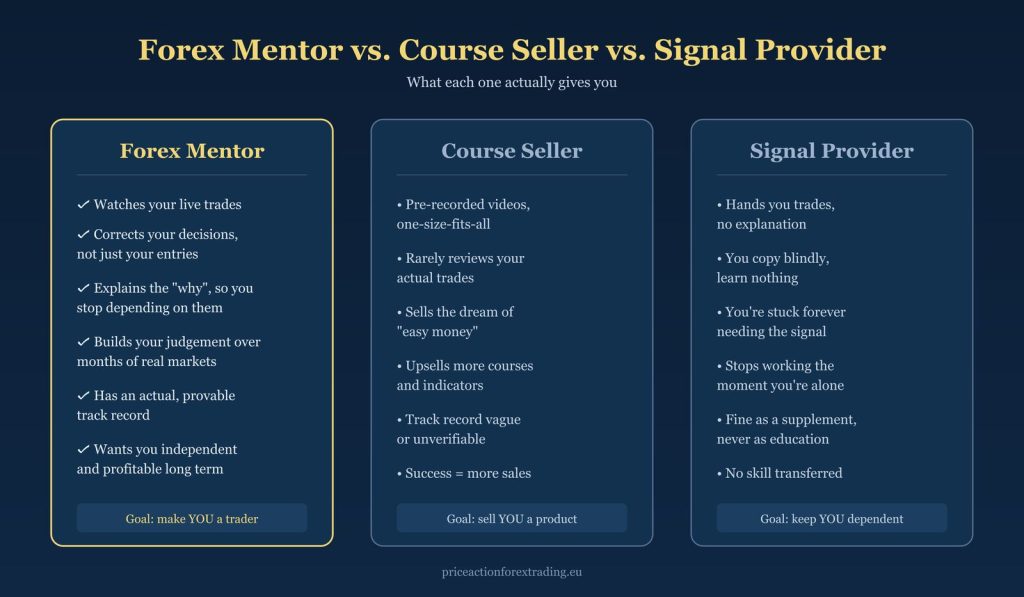
Mentor, Course Seller, or Signal Provider? Know the Difference
The forex education space blends three very different roles together, and most beginners can’t tell them apart until they’ve already paid for the wrong one.
A course seller gives you information. A signal provider gives you trades. A mentor gives you understanding and judgement. Only one of these three actually builds a skill you can keep for the rest of your life.
Signals can be a useful supplement – I occasionally share free trading signals myself, purely to demonstrate what’s possible and build credibility. But copying someone else’s entries will never make you a trader. The moment the signals stop, so does your ability to make money. A mentor, on the other hand, transfers the underlying skill, so you’re still profitable long after the relationship ends. But in our case, the relationship doesn’t really end because I offer a free “earn while you learn” option to everybody who completes my full training course. In that private group I post upcoming trades not just as signals like “buy there, exit there” but with reasons of why there’s a setup, the logic beyond the target and full explanation of how that trade fits into our professional framework.
Courses fall somewhere in between. They can be genuinely useful as a foundation, but a pre-recorded video can’t watch your live trade and tell you why you hesitated for three extra seconds and missed your entry. Only a mentor can do that.
The Red Flags (And Green Flags) of Real Mentorship
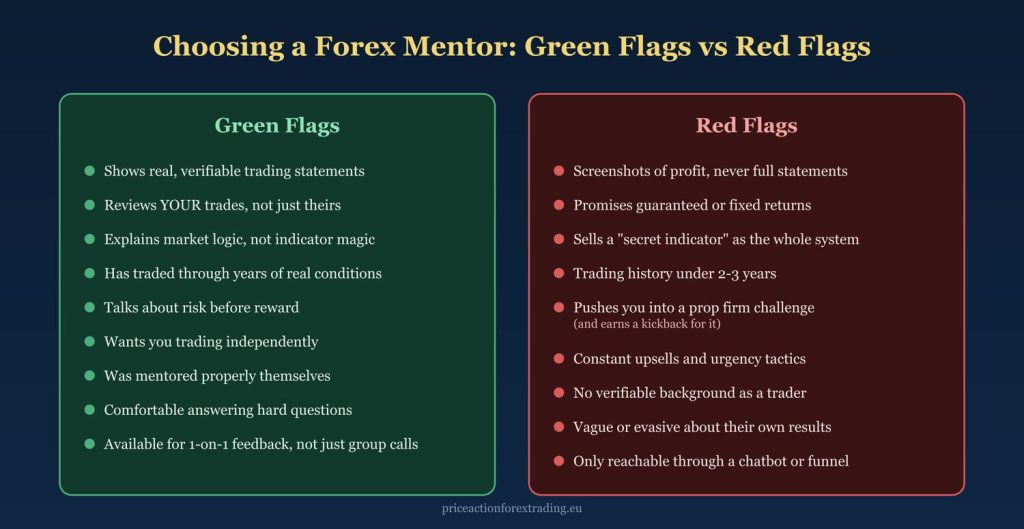
The forex industry is full of people calling themselves mentors who’ve never actually proven anything. Here’s how to separate the two.
Red flags to watch for:
- Screenshots of profit instead of full, verifiable statements
- Guaranteed or fixed monthly returns
- A trading history shorter than a few years
- Constant upsells, urgency, and “limited spots” pressure
- Pushing you straight into a prop firm challenge (often because they earn a kickback from it)
Green flags worth paying attention to:
- Full, transparent trading statements, not cherry-picked wins
- Willingness to review your actual trades, not just talk theory
- An explanation of market logic rather than a “secret indicator”
- Years of experience across different market conditions
- A genuine interest in making you independent, not dependent
If you want a sense of what transparency should actually look like, I regularly publish my own trading statements on this blog, including the losing trades, not just the highlight reel.
Also, by verifiable statements I don’t mean asking for a MyFxBook link. The problem with those external services is that they’re often funded by the brokers and everything that you see there can still be faked, either on the platform or on the broker side (e.g. marketing accounts). So if someone sends you a MyFxBook link, it doesn’t have more credibility than a simple screenshot.
What I mean by verifiable is that you need to do your own due diligence: ask very specific questions about certain trades of interest that you found in the statement of your potential mentor and listen how they respond. You need to make sure that these are the trades they actually took and they have a very clear understanding of why they took those trades.
What I Learned From My Own Forex Mentor
I didn’t start out as a professional trader. I spent over a decade as a web developer before trading became my full-time career, and the transition nearly broke me before it worked. I was overconfident, over-engineered my strategies, and made every classic mistake a technically-minded person makes when they assume trading skills can be reverse-engineered like code (I wrote a longer breakdown of this in Making Forex Work For Web Developers & Software Engineers, if that sounds familiar).
What actually turned things around wasn’t just another course or another indicator. It was being mentored, one-on-one, by someone who had already spent 20 years in the market and had nothing left to prove. Rob didn’t sell me a dream. He corrected my thinking, week after week, trade after trade, until I stopped needing him to. He showed me, time and time again, how a real professional trader approaches the forex market, how he investigates and predicts the movements of the market with a high degree of probability using his professional understanding of the market and also how he applies his professional trading strategy when a good opportunity arrives.
That’s the part people underestimate about mentorship – it’s not a one-time transfer of information, it’s a slow rebuilding of how you see the market. You can read about technical analysis in a hundred articles, but until someone watches you apply it badly and tells you exactly why, none of it really sticks.
Some of the results I’ve shared on this blog, like my 21% month trading the London open or growing a small account by 56% in a single month, aren’t the product of a lucky strategy I stumbled onto. They’re the product of years of correction, repetition and feedback that started with Rob and that I’ve continued to refine ever since. Mentorship compounds. The lessons you absorb in year one keep paying off in year five, in ways a single course or ebook simply can’t replicate.
How Long Should Mentorship Actually Take?
This is a fair question, and the honest answer is: longer than most people want to hear. Nobody becomes a consistently profitable trader in a weekend, and any mentor promising otherwise is selling you a fantasy (for the record, I do have a short 5 hour course, but I recommend taking it over 5 weeks instead of a single weekend). What a structured mentorship can do is compress years of trial-and-error into months, by making sure you’re not repeating the same mistakes over and over without realising it.
In my own experience, the first phase of mentorship is about unlearning bad retail habits – the overconfidence, the over-engineering, the impatience and the illusion of knowledge I described from my own transition out of a tech career. The second phase is about building real pattern recognition through repetition, with correction along the way. The third phase, the one most self-taught traders never reach, is trading with genuine independence and confidence, because you’ve internalised why a trade works, not just memorised a rule.
Why Mentorship Beats Self-Study (And Backtesting)
A lot of self-taught traders lean heavily on backtesting, convinced that if they study enough historical charts, the pattern will eventually reveal itself. I’ve written before about why you can’t backtest your way to success – the short version is that backtesting keeps you trapped in the past, while real trading only ever happens in the present moment, under real emotional pressure, interpreting the market in real time and dealing with real uncertainty.
A mentor short-circuits this entire trap. Instead of spending years building a probabilistic model from old candles, you get direct, live feedback on decisions you’re making right now. You learn to evaluate the current situation from multiple angles, define your probabilities, and act – the way professionals actually operate, rather than the way retail traders are taught to.
This is also why so much “textbook” trading advice falls apart in live markets. Even something as widely misunderstood as news trading – which I cover in News Announcements: Real or Fake? – only starts making sense once someone with real market experience walks you through what’s actually happening behind the price action, rather than what a textbook claims should happen.
Questions to Ask Before Choosing a Forex Mentor
Before you commit your time and money to anyone claiming to be a forex mentor, ask them directly:
- Why are you a profitable trader? (I know it’s a tricky question and you may need to rephrase it depending on the person, but it can reveal you a lot about who they actually are)
- How long have you been trading profitably?
- Will you review my actual trades, or just teach a fixed curriculum?
- What happens after the initial training ends – do you leave me alone or do you make yourself available for continous mentorship?
- Were you mentored yourself, or were you entirely self-taught?
- What is the difference between the professional and retail sides of the forex market?
A mentor who’s confident in what they do will answer all six without hesitation. Someone who gets defensive, vague, or redirects you to “success stories” instead of actual facts is telling you everything you need to know.
What a Real Mentorship Should Look Like
If you’re serious about learning this properly, mentorship should be structured, hands-on, and built around your actual trades – not a library of generic videos you’ll watch once and forget.
That’s exactly how I built my own Forex Training Course. It’s not a course in the traditional sense – it’s a direct continuation of the way Rob trained me, adapted for a new generation of traders who deserve the same level of honesty and attention I received.
If you want a faster, more condensed introduction, my Learn to Trade in 5 Days program is built for traders who want to get a professional foundation quickly, without wasting years on trial and error. And if scalping fits your lifestyle or schedule better, Learn to Scalp in 5 Days applies the same mentorship-driven approach to shorter-term trading.
When You Don’t Want to Trade Yourself
Not everyone wants to become the one clicking buy and sell. Some people would rather have their capital professionally managed by someone who’s already been through the mentorship process and has years of real world results to show for it. If that sounds more like you, my Managed Forex Trading service exists for exactly that reason – you don’t need to become a trader to benefit from professional trading.
Final Thoughts
The forex industry is full of noise: indicators promising certainty, signal groups promising ease, and courses promising shortcuts. None of them come close to what a real mentor provides, because none of them can watch you make a decision in real time and tell you exactly why it was wrong – or right.
I was lucky enough to have that from Rob for years, and it changed everything about how I trade. If you’re tired of guessing your way through the market alone, that’s precisely the gap a real forex mentor is meant to close.
Whichever path fits you – hands-on mentorship, a condensed 5-day program, or having your capital managed professionally – the underlying principle stays the same: don’t try to build a professional skill in isolation. Find someone with a real forex market understanding, get close enough to their process to actually learn it, and give yourself the time that skill deserves.
Thanks for reading, and have a beautiful day.