
If you’ve typed “forex candlestick patterns that work” into Google, I already know what you’re hoping to find. A list. Pin bar, engulfing, doji, hammer, morning star, all ranked by win rate, so you can memorise the winners and skip the losers.
I’m going to save you some time. That list doesn’t exist, because the premise behind it is wrong.
I’ve spent years reading price on live charts, and I can tell you with total confidence that no candlestick shape “works” on its own. The same pin bar that prints a clean reversal on one chart will get run over ten pips later on another. The shape is identical. The outcome isn’t. If the shape itself carried the edge, that couldn’t happen.
So this article isn’t going to rank patterns for you. It’s going to explain what actually separates a candlestick pattern that works from one that doesn’t, which has almost nothing to do with the candle itself.
The Patterns Everyone Is Searching For
Before I get into why the shape isn’t the point, let’s quickly cover the patterns retail traders spend the most time memorising. You’ve probably seen all of these:
- Pin bar – a candle with a long wick and a small body, supposedly signalling rejection at a level
- Engulfing candle – a candle whose body fully swallows the previous one, taught as a strong reversal signal
- Doji – a candle with almost no body, framed as “indecision”
- Inside bar – a candle that sits entirely within the range of the one before it
- Morning star / evening star – a three-candle sequence marking a supposed turning point
- Hammer / shooting star – single-candle variations of the pin bar concept, usually tied to trend exhaustion
I’ve written dedicated breakdowns of two of the most searched patterns on their own pages, because they deserve a full explanation rather than a paragraph each. If you want the deep dive, read my articles on the pin bar and the engulfing candle. Both cover the same theme you’ll find running through this article: the pattern is not the edge, the location and the reading behind it are.
Why “Which Pattern Works Best” Is the Wrong Question
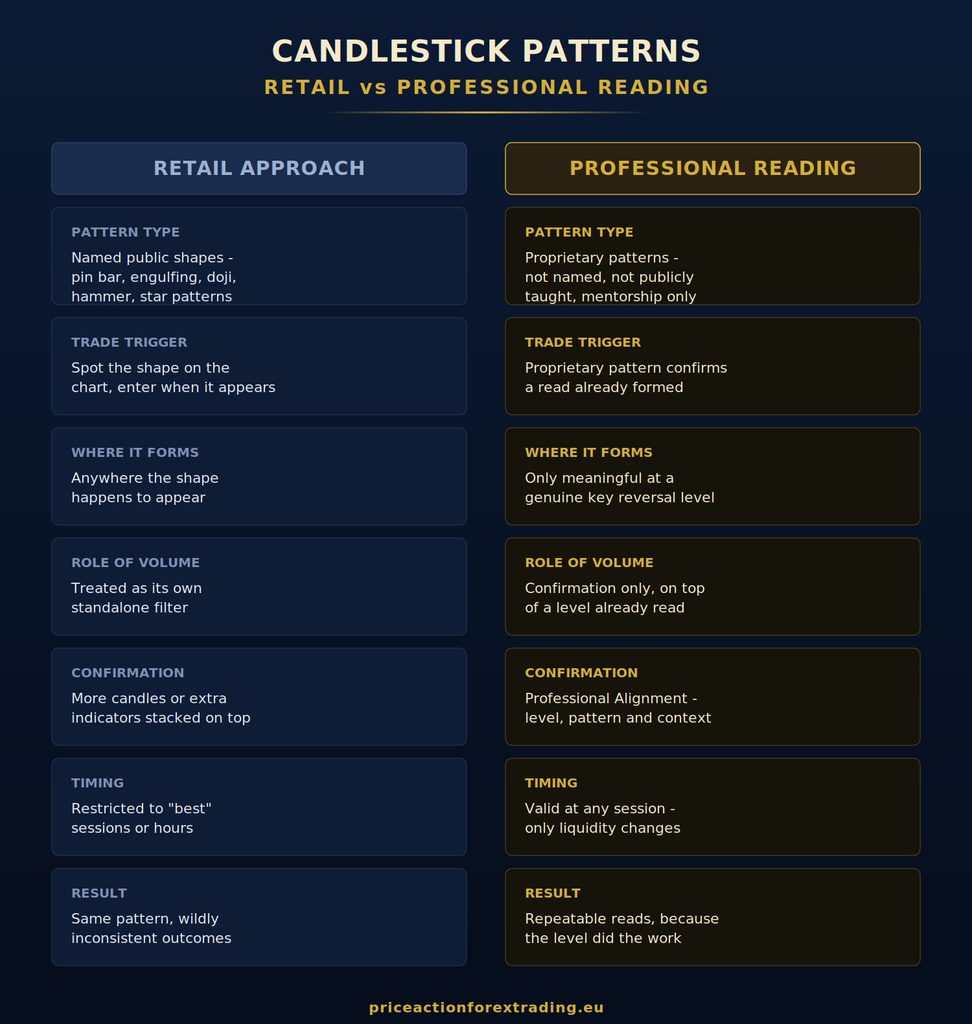
Here’s the retail approach in a nutshell: scan every chart for a specific shape, treat that shape as a signal, and enter when it appears. It’s a checklist. Spot the shape, tick the box, place the trade.
The problem is that a candlestick shape tells you what price did over one candle. It tells you nothing about who was actually behind that move, or what’s likely to happen next. Two identical pin bars can form for completely different reasons, at completely different points in the market’s structure, and produce completely different results.
This is why so many traders who “know” every pattern still lose consistently. They’ve memorised the vocabulary without understanding the language. Knowing that a hammer has a small body and a long lower wick is like knowing that the word “bank” exists in English. It tells you nothing about which meaning applies in a given sentence.
At priceactionforextrading.eu, I don’t teach shape recognition. I teach traders to read what’s actually driving what is price action in the first place, which comes down to genuinely understanding how the market’s participants behave. That’s the part almost nobody teaches, because almost nobody outside a professional environment actually understands it.
What Actually Makes a Candlestick Pattern Work
If the shape isn’t the answer, what is?
Two things have to line up before I’ll ever treat a candlestick pattern as meaningful.
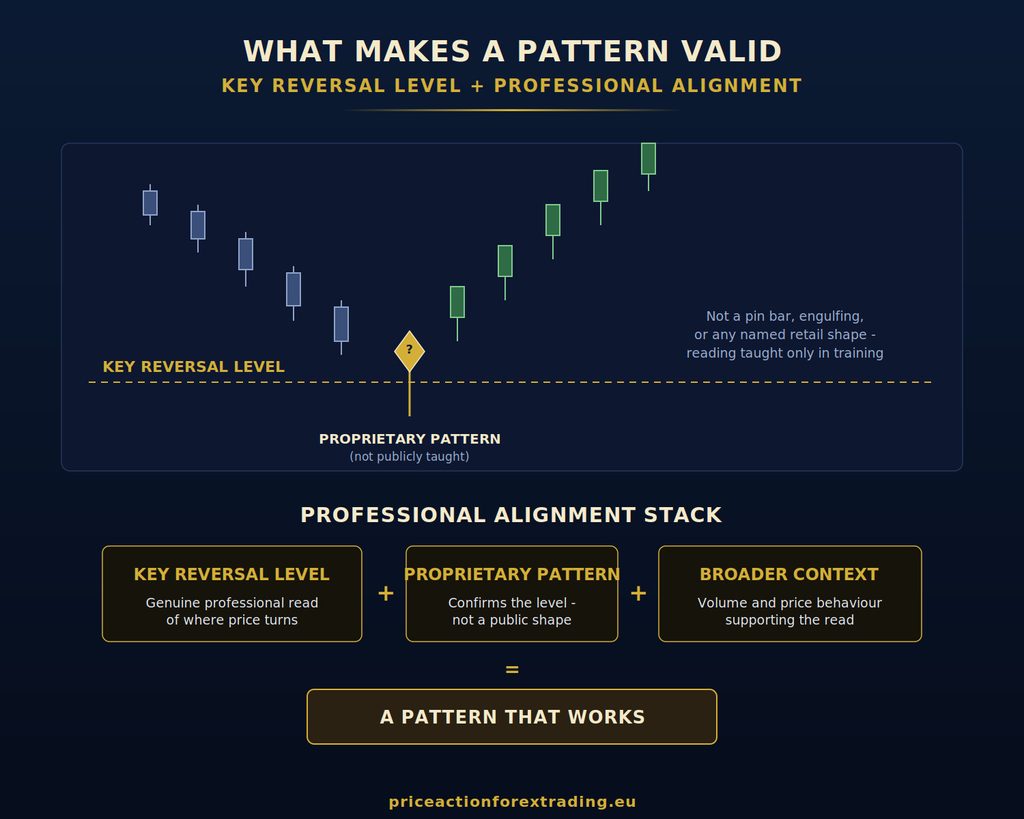
First, location. A pattern only matters when it forms at a key reversal level, a price point where I already have a genuine read on how the market’s participants are likely to behave. A pin bar in the middle of nowhere is just a candle. The exact same pin bar at a key reversal level is a different animal entirely, because now it’s forming exactly where my read on the market said something was likely to happen.
Second, Professional Alignment. This is the term I use for the way multiple pieces of evidence converge before I treat a setup as valid. A candlestick shape by itself is one data point. It’s not enough on its own, and it was never supposed to be. What makes a pattern tradeable is when the shape, the level, and the broader context all point in the same direction at the same time. That convergence is what I mean by Professional Alignment, and it’s the actual foundation of everything I trade.
This is the piece that gets left out of every “candlestick patterns that work” article you’ll find elsewhere. They treat the candle as a standalone signal because that’s all a shape-recognition approach can offer. Professional trading works the other way around. The level and the read come first. The candle is just the final piece of evidence, not the trigger on its own.
The Role of Key Reversal Levels
I can’t talk about candlestick patterns without talking about key reversal levels, because the two are inseparable in how I actually trade.
A key reversal level isn’t just a line I drew on a chart because price touched it twice. It’s a price point where my understanding of the market’s participants tells me something meaningful is likely to happen. When a candlestick pattern forms at one of these levels, it’s not a coincidence I’m chasing. It’s the market doing exactly what my read said it would do, with the candle simply confirming it.
This is also where most retail traders go wrong twice over. First, they mislabel ordinary price zones as significant levels using retail tools that don’t reflect genuine professional understanding of where the market is actually likely to turn. Then they layer a candlestick pattern on top of a level that was never meaningful in the first place, and wonder why the “textbook setup” fails.
Get the level wrong, and it doesn’t matter how clean the candle looks. The pattern has nothing real to confirm.
This is also why I never restrict candlestick reading to a particular session or time of day. A genuine key reversal level doesn’t stop being valid because it’s the Asian session instead of London. What changes across sessions is liquidity, not the validity of the level itself. A candlestick pattern that forms at a real key reversal level during a quieter session can be just as significant as one that forms during the busiest hours, provided the alignment behind it is genuine.
Volume: Confirmation, Never a Trigger
Volume gets bundled into a lot of candlestick pattern strategies as an add-on filter. “Only trade the pin bar if volume spikes.” I understand the appeal of that rule. It feels like an extra layer of objectivity.
But volume isn’t a standalone signal, and I don’t treat it as one. It’s confirmation of a level I’ve already read professionally, nothing more. If I’m looking at a candlestick pattern at a key reversal level and the volume behind it supports what I already expect to happen, that adds weight. If I hadn’t already identified the level correctly, no amount of volume on the candle would make the pattern valid. Volume never creates the read. It only confirms one that already exists.
Single Candle Versus Multi-Candle Patterns
One question I get asked often is whether multi-candle patterns like the morning star or evening star are more reliable than single-candle patterns like the pin bar, purely because they involve more price data.
They aren’t, and the reasoning behind that belief is another version of the same mistake. More candles doesn’t mean more genuine evidence. It just means more shape to memorise. A three-candle formation in the wrong location, with nothing real aligned behind it, is no more valid than a single misplaced pin bar. What determines reliability was never the candle count. It’s still the level and the alignment.
If anything, single-candle patterns force traders to be more disciplined about where they’re looking, because there’s less shape to hide behind. A multi-candle formation can feel more “confirmed” simply because it took longer to form, which is a psychological trap more than an analytical advantage.
Common Mistakes Traders Make With Candlestick Patterns
I see the same handful of errors repeated across every trader who reaches out to me still relying on pattern memorisation alone.
Trading the shape anywhere it appears. If the only qualification for a trade is “I saw a pin bar,” the level has been skipped entirely. That’s the single biggest mistake in this category, and it’s the one retail education reinforces the most.
Treating every pattern as equally reliable. A pattern’s usefulness has nothing to do with how “textbook” it looks and everything to do with where it formed and what’s aligned behind it. A messy-looking candle at a genuine key reversal level with real Professional Alignment behind it will outperform a picture-perfect pattern in the wrong location, every time.
Ignoring who is actually behind the move. The market is made up of distinct groups of participants who behave in genuinely readable ways at the right levels, and this is the part of my framework I keep confidential for a reason. It’s not publicly taught, and it isn’t something you’ll piece together from YouTube or forum threads, which is exactly why most retail pattern trading never gets past guesswork. Understanding how these groups actually behave is what turns a shape into something you can genuinely read, rather than something you’re hoping repeats.
Gating patterns on unnecessary structure. I regularly see traders refuse to act on a valid setup because price hasn’t printed a “confirmed” higher high or lower low first. That’s a retail checklist habit, not a requirement. A pattern can be valid within a trend, against one, or completely independent of trend structure altogether, provided the level and the alignment behind it are genuine. Waiting on structure to “confirm” itself is often just waiting until the best part of the move is already gone.
Overloading the chart with indicators to compensate. When the candle itself doesn’t feel like enough evidence, plenty of traders stack on moving averages, oscillators and momentum indicators hoping the extra lines will do what genuine reading should be doing. It rarely helps. Indicators describe price after the fact. They don’t explain who is behind the move or why a level is likely to hold, which is the actual question a candlestick pattern is supposed to answer.
How I Actually Use Candlestick Patterns
Here’s something worth being upfront about. Every pattern named in this article, the pin bar, the engulfing candle, the doji, the inside bar, the morning and evening star, the hammer and shooting star, is retail vocabulary. I don’t enter a single trade off any of them.
That’s not a contradiction of anything I’ve said above. Those are the shapes the public has been taught to look for, which is exactly why I’ve used them here to explain the difference between shape-recognition and genuine reading. The actual patterns I act on aren’t named on any retail chart course, and you won’t find them described on this page or anywhere else publicly. What I trade comes from proprietary pattern reading developed through direct training with my mentor, and it isn’t something that translates into a blog post. That level of detail is reserved for traders inside my training course and mentorship, where I can actually show it rather than describe it.
What I can tell you, and what does translate, is the process behind it. A candlestick pattern, named or proprietary, is always the last piece of a decision, never the first. By the time I’m watching for one to form, I’ve already identified the key reversal level, and I already have a genuine read on how the market’s participants are likely to behave there. The pattern is confirmation that the read is playing out the way I expected, not the trigger that creates it.
That’s a completely different process from scrolling through a chart hunting for shapes. It’s slower to describe, but it’s also the reason I can act with real conviction the moment a setup appears, instead of hoping a memorised pattern happens to work this time.
This is professional thinking applied with professional knowledge, and it’s the actual difference between traders who make candlestick patterns work and traders who keep collecting new pattern lists because the last one didn’t.
Where This Understanding Actually Comes From
None of this is something you piece together from free YouTube breakdowns or forum threads dissecting old screenshots. Genuine understanding of how the market’s participants behave, and how that behaviour shows up at key reversal levels, comes from direct, structured training. It’s not a slow process either. Under the right guidance, this kind of understanding can click fast, sometimes within a single session, because it’s a matter of being shown correctly rather than accumulating years of trial and error.
That’s exactly what I built my Forex Training Course around. It’s suited to traders at any stage, not just people with years of screen time already behind them.
If you’d rather get there faster with a single, complete strategy you can start applying immediately, my Learn to Trade in 5 Days course teaches the full professional approach behind reading candlestick patterns correctly, level, alignment and all, in a standalone format. You don’t need anything beyond it to start trading with real understanding.
The Real Answer to “Which Candlestick Patterns Work”
None of them work in isolation. All of them can work (coincidentally) at the right level, with the right alignment behind them.
That’s not the answer people expect when they search for a ranked list of winning shapes, but it’s the honest one, and it’s the reason I keep writing about this from a completely different angle than the rest of the internet. The shape was never the edge. It was always just the last thing to confirm what a professional read had already told you. However, professional traders do not use retail candlestick patterns to confirm their entries – they use their own proprietary patterns that I teach only directly to my mentees during live market conditions (no pdfs or pre-recorded videos).
Thanks for reading and have a beautiful day!