
Momentum is one of those words that gets thrown around in forex trading until it stops meaning anything. Ask ten retail traders what momentum looks like on a chart and you will get ten different indicator setups: RSI turning up, MACD crossing a signal line, a stochastic climbing out of oversold. None of them are wrong exactly, but none of them are actually showing you momentum either. They are showing you a lagging mathematical summary of price that already happened.
I read momentum a completely different way, and it has nothing to do with an oscillator in a box below my chart. It comes from price action itself, from watching how price actually behaves as it approaches and moves through specific points on the chart. That distinction is not a small one. It is the difference between reacting to momentum after the fact and understanding it while it is forming.
What Most Traders Get Wrong About Momentum
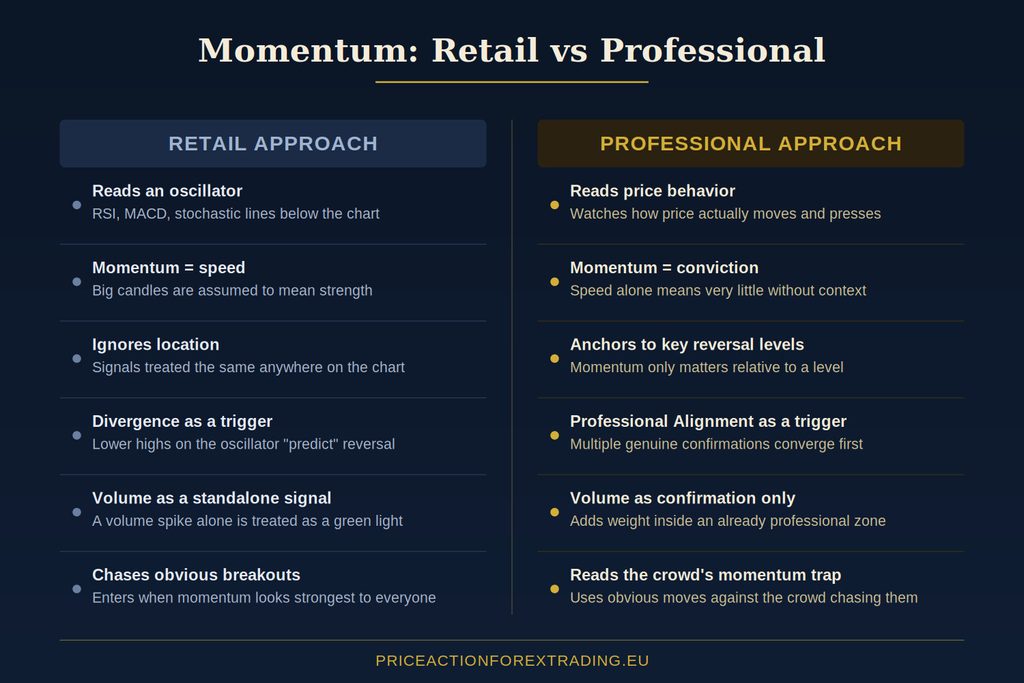
The retail approach to momentum treats it as a standalone signal. Line goes up, momentum is bullish. Line goes down, momentum is bearish. Divergence forms, momentum is supposedly weakening and a reversal is coming. Traders build entire strategies around this logic, and then wonder why momentum indicators seem to give strong signals right before price does the opposite of what they expected.
The problem is not that momentum indicators are calculated incorrectly. The problem is that they are measuring the wrong thing. They measure the rate of change of price over a fixed lookback period. That is a mathematical description, not an explanation. It tells you what happened, not why it happened or whether it is likely to continue.
Real momentum in a currency pair is not a number. It is the visible behavior of price as it moves, and that behavior is a direct reflection of what is happening between the participants actually driving that movement. Once you start reading it that way, the indicator becomes almost irrelevant. You are watching the source instead of a delayed echo of it.
Momentum Is Not Speed
Here is a mistake I see constantly, even among traders who have moved past pure indicator dependence. They equate momentum with speed. Big candles, fast moves, price tearing through several price levels in a handful of bars. Surely that is strong momentum, right?
Sometimes. But speed alone tells you very little. I have seen fast, aggressive moves that ran out of conviction within minutes and reversed hard, and I have seen slow, grinding moves that carried for hours because the underlying pressure behind them never let up. Speed is the surface. What actually matters is whether the move is being sustained by genuine reason from the participants pushing it, or whether it is a short burst that has already exhausted itself.
This is exactly why I never gate a setup on how a trend has been structured, whether that is a clean sequence of higher highs and higher lows or some checklist of prior swing points. A fast, choppy move can carry real momentum behind it just as much as a textbook trending structure can. What tells me whether momentum is genuine is not the shape of the last few candles on a lookback chart. It is what I read in price behavior itself, built from genuine professional understanding of the three groups of participants active in that pair at that moment.
How I Read Momentum Through Price Behavior
I will be direct about this: the full mechanism of how I read the three participant groups is something I only teach inside my mentorship, not something I lay out in a blog article. That understanding took direct training under my own mentor, Robert Taylor, to develop, and it is the single biggest edge separating professional execution from retail guesswork. What I can tell you is what it looks like from the outside, so you understand the difference between what I am doing and what most public content teaches.
When I watch price move, I am not asking “is this candle bullish or bearish.” I am watching how price is being pushed, how eagerly it moves through certain price points, and how it behaves once it reaches an area that actually matters on the chart. Momentum that is genuine tends to move with a certain character, a willingness to keep pressing forward without hesitation building up along the way. Momentum that is not genuine often shows itself through subtle changes in that character well before an indicator would ever pick it up.
This is not something you can shortcut with a formula, and I am not going to pretend otherwise or invent a mechanism to make it sound simpler than it is. It is a skill built through direct, professional training. But it is also a skill that develops far faster than most traders assume once they are learning it correctly. I did not need years of screen time to get there. Under the right guidance, this kind of professional reading can click in a matter of sessions, not seasons.
Where Momentum Actually Matters: Key Reversal Levels
Momentum on its own, floating in the middle of a chart with nothing else around it, tells me very little. What makes momentum actually useful is where it is happening. I care about momentum specifically as price approaches or interacts with a key reversal level, one of the points on the chart where I have genuine reason to expect participant behavior to shift.
This is where a lot of traders go wrong with continuation setups too. They see a strong move, wait for a shallow pullback, and jump in purely because the trend “looks strong,” without any regard for where price actually is relative to a level that matters. I cover this same mistake in more detail in my piece on continuation patterns, because the shape of the pattern is never the point. The location is.
Strong momentum arriving at a key reversal level tells a very different story than strong momentum arriving in the middle of nowhere. The first is something I can act on with confidence once everything else lines up. The second is often just noise waiting to happen, a move that looks impressive on the screen but has nothing meaningful backing it at that specific point in price.
Professional Alignment: Momentum Is Only One Piece
I want to be clear that momentum by itself is never enough to justify a trade. I do not take entries because momentum looks strong. I take entries when momentum is one part of what I call Professional Alignment, the convergence of multiple pieces of genuine professional confirmation pointing toward the same conclusion at the same location.
Momentum can tell me that a move has real conviction behind it. But without it converging with everything else I am reading, from the behavior at the key reversal level itself to the wider context of what the three participant groups are doing, momentum alone would just have me chasing moves that fizzle out. Professional Alignment is what keeps momentum from becoming a trap rather than a tool.
This is also why volume never acts as a standalone trigger in how I trade. Volume analysis has a role, but only as confirmation within an already professional zone, adding weight to a read I have already built from price behavior and Professional Alignment. It is never the reason I click the button on its own.
Why Indicator Divergence Isn’t What You Think
Divergence deserves its own mention because it is probably the single most misunderstood momentum concept in retail trading education. Price makes a new high, the oscillator makes a lower high, and traders are taught this means momentum is fading and a reversal is imminent. Sometimes price does reverse after a divergence signal. Often it does not, and the “weakening momentum” the indicator claimed to spot simply continues on for another leg.
The reason divergence is unreliable on its own is the same reason indicators in general are unreliable on their own: the calculation has no idea where price actually is relative to a key reversal level, and it has no ability to read what the participants behind that move are actually doing. Divergence is a pattern in a derived number, not an observation of behavior. Two charts can show identical divergence readings and mean completely different things depending on the location and the professional context around them.
I am not telling you to ignore divergence out of stubbornness. I am telling you that if you want to know whether momentum is genuinely fading, watching price behavior directly at a key reversal level will tell you far more, and far sooner, than waiting for an oscillator to catch up and draw two lines that may or may not point the right way.
Momentum Traps: When It Looks Real But Isn’t
There is a specific kind of momentum trap that catches a huge number of retail traders, and it usually happens around obvious chart levels. Price accelerates toward a level everyone can see, momentum indicators light up green or red, and traders pile in expecting a breakout to run. Then price stalls and reverses hard.
I will not pretend to explain the exact mechanism behind why this happens so consistently, because that understanding is something I keep for my mentees rather than speculate about publicly. What I will say is that this pattern is closely tied to why I do not treat breakout momentum around obvious levels the way most public education teaches it. If you want the fuller picture on that specific trap, I wrote about it directly in my article on why I don’t trade breakout and retest setups the way the crowd does. Momentum that appears right at these obvious points is very often crowd behavior I read and use to my advantage, not a signal I follow at face value.
The lesson here is simple even if the mechanism behind it is not something I lay out publicly: momentum needs context and location before it means anything at all. Momentum arriving exactly where everyone expects it, at a level with no genuine professional read behind it, is one of the most reliable ways to get trapped in this market.
Building This Skill the Right Way
I know how this reads if you are coming from years of trying to force indicators to give you clean momentum signals. It can sound like I am describing something vague or unlearnable. I promise you it is neither. It is a skill, and skills are trainable when the training itself comes from someone who actually understands the mechanism rather than someone repeating retail theory they picked up from a forum.
This is exactly what I built my Forex Training Course around, and it is suitable whether you are picking up a chart for the first time or you have been trading for years and have simply never had anyone show you how to read momentum this way. If you want a faster, focused entry point into this kind of professional reading using one complete strategy, my Learn to Trade in 5 Days course teaches everything you need to trade that strategy profitably on its own, momentum reading included, not as a taste of something bigger but as a genuinely complete method.
Final Thoughts
Momentum in forex is real, and it matters enormously to how I trade every single day. But it is not an indicator reading, and it is not simply a matter of speed. It is a reflection of genuine reason among the participants actually moving the market, readable through price behavior once you know what you are actually looking at and where on the chart it counts.
Stop asking your indicators whether momentum is strong. Start asking what price is actually telling you at the levels that matter, and start building the kind of professional understanding that lets you answer that question with confidence rather than a guess dressed up as a signal.
Thanks for reading and have a beautiful day!