
Search “forex breakout and retest strategy” and you’ll find hundreds of nearly identical explanations: wait for price to break a level, wait for it to come back and test that level, enter when it holds. It’s presented as a professional method. It isn’t one. I don’t trade breakouts and I don’t trade retests, and after years of watching how this pattern actually plays out, I don’t think there’s a genuine professional version of it at all.
What I do use is the fact that thousands of other traders are running that exact playbook, in the exact same spot, at the exact same time. That predictability is worth far more to me than the pattern itself ever could be.
Why “Breakout and Retest” Isn’t a Professional Strategy
Every strategy taught publicly has to be simple enough to explain in a blog post or a ten-minute video. Breakout and retest fits that requirement perfectly: draw a line, wait for it to break, wait for it to come back, enter. It’s teachable, it’s repeatable, and it feels logical. None of that makes it something a professional actually trades.
The reason it doesn’t hold up is that the pattern only works if enough people are unaware of how many other people are trading it the exact same way. Once a level is well known enough to produce a clean breakout, it’s well known enough that a large crowd is doing the same thing at the same price. That crowd isn’t a side detail. It’s the entire reason the pattern shows up in the first place, and it’s also the reason it fails constantly in live conditions.
I’ve written before about what happens mechanically when a level gives way, in my article on the forex breakout strategy and why most traders get it wrong. What I want to be completely clear on here is that recognizing that mechanism isn’t the same as having a strategy built around trading it. Understanding why a crowd behaves predictably at a level, and turning that into a repeatable professional edge, are two very different things.
What’s Actually Happening: Two Crowds at the Same Price
To understand why I don’t trade this pattern, it helps to separate the two groups of traders who show up around every well-known level. Range traders place their stops just beyond it, because that’s what every course teaches. Breakout traders place their entries right at it, expecting the break to run. Both groups are reacting to the exact same price, for reasons that have nothing to do with what’s actually happening in the market beyond “the line moved.”
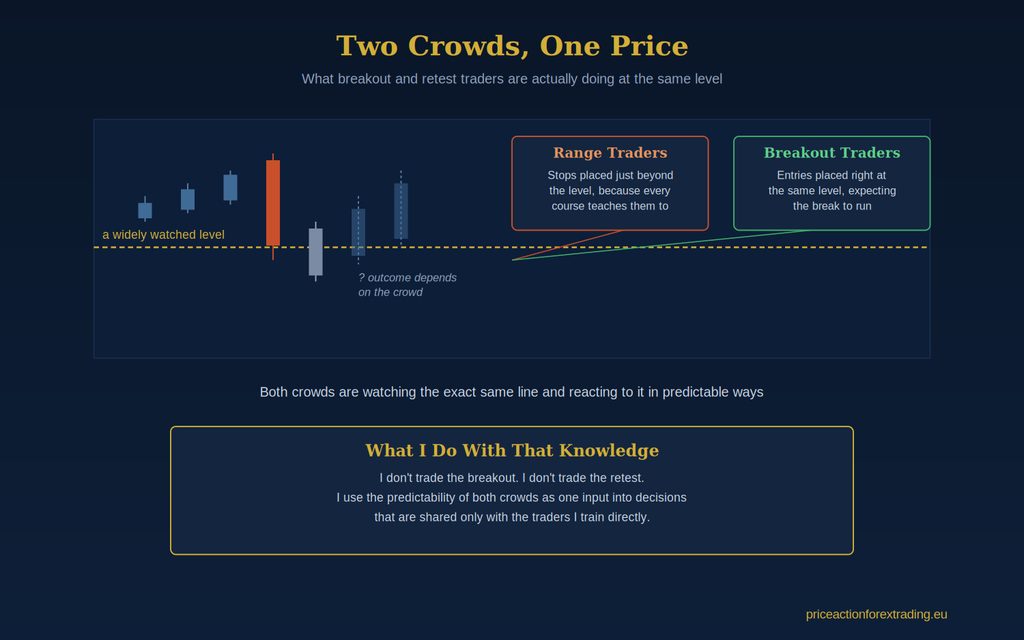
Neither group is wrong to notice the level. The level is genuinely significant, but not in the way the retail crowd expects. What both groups get wrong is assuming that a level being significant means the breakout, or the retest that follows it, is tradeable on its own. It isn’t. What’s tradeable is knowing how those two crowds are positioned, and what that positioning means for everything else happening around it.
Why I Don’t Reveal the Exact Decisions I Make Here
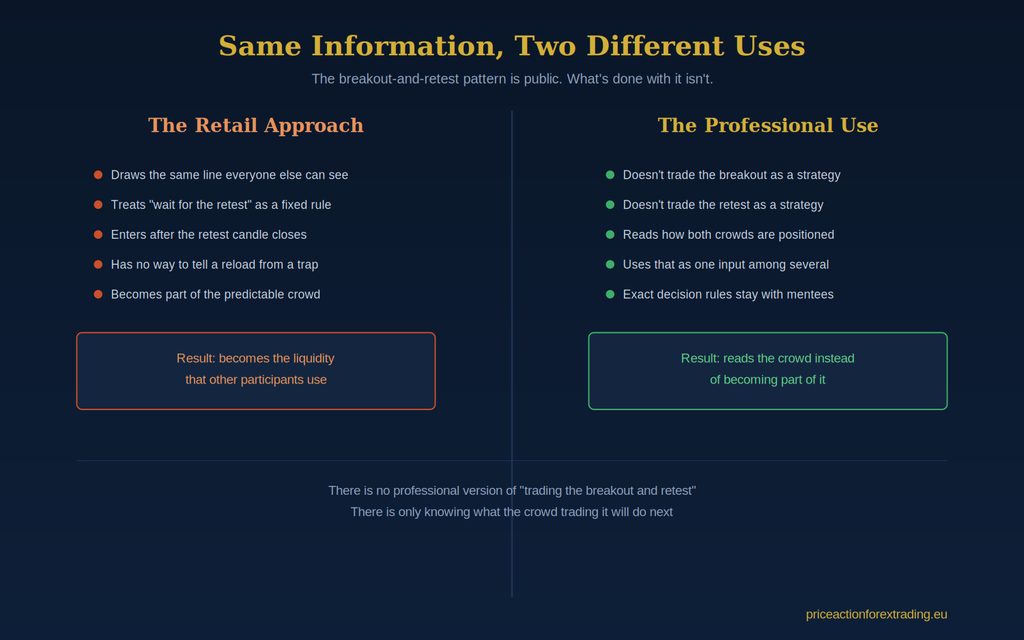
I want to be upfront about something rather than dance around it. I know the predictable behaviour of range traders and breakout traders around a level, and I use that knowledge to inform decisions I make elsewhere on the chart. What those decisions actually are – which conditions I need to see, how I weigh that crowd behaviour against everything else, what I do with it in practice – isn’t something I lay out publicly.
That isn’t me being coy for the sake of it. It’s the same reason a professional in any field doesn’t publish their exact process for free: it’s information built through years of direct training, and it only holds value while it stays scarce. What I teach mentees isn’t a variation of the retail breakout-and-retest rule with better wording. It’s a genuinely different way of reading what that crowd’s behaviour tells you about the market, taught directly, one trader at a time.
The Retail Version Turns Traders Into Liquidity
Here’s the part that retail material never addresses honestly. When you trade the breakout-and-retest pattern exactly as it’s taught, you’re not gaining an edge over the market. You’re becoming a predictable, visible part of it. Your stop sits where every other range trader’s stop sits. Your entry sits where every other breakout trader’s entry sits. You’re not reading the crowd at that point, you are the crowd, and crowds at predictable prices are precisely what gets used by other participants in the market.
This is why so many traders describe the same experience with this setup: the breakout looks clean, the retest looks like it’s holding, and then the move reverses hard right after they’ve entered. It isn’t bad luck repeating itself. It’s the structural weakness of trading a pattern that a large, identifiable group of people are all executing identically.
Market Structure Still Matters Here
None of this means the level itself, or the market structure leading into it, is irrelevant. Understanding how price built its way toward that level, whether the approach was clean or choppy, and what the broader trend was doing beforehand all still matters. I cover how I read that structure in how to identify trend in forex, and the shape of the higher highs and lower lows leading into a level is something I go through in detail in what higher highs and lower lows are actually telling you. Both of those pieces matter here, not because they tell you how to trade the breakout and retest, but because they’re part of the wider picture that actually informs professional decisions – decisions that go well beyond “the level broke, then it came back.”
This Applies in Every Session
One thing I want to be clear on: the crowd behaviour around breakout and retest setups isn’t confined to a particular session. Range traders and breakout traders place their orders around key levels regardless of what time it is. What changes across sessions is the depth of liquidity available once that crowd’s behaviour plays out, not whether the underlying pattern of predictable positioning exists in the first place.
Why Most Traders Never See This
If you’ve traded breakout-and-retest setups and had them fail on you repeatedly, it’s not because you executed the pattern badly. It’s because the pattern itself was never a professional method to begin with – it’s a widely distributed piece of retail education that creates a crowd, and crowds at known prices are something other participants in the market can act on. No amount of tightening your entry rules or waiting for a “cleaner” retest changes that underlying structure.
This is exactly the kind of gap between public information and professional understanding that direct training closes. It isn’t a matter of studying more chart examples on your own. It’s a matter of being shown, directly, what a level actually represents once you stop treating the breakout and the retest as tradeable events in their own right.
Where This Fits Into a Wider Approach
Reading crowd behaviour around a level is one piece of a much larger picture I build for every decision, not a standalone setup. That’s the core of what I teach in my Learn to Trade in 5 Days course – a complete, standalone way of learning to read the market properly, not a short introduction meant to funnel you elsewhere. Traders can be genuinely profitable from that course alone. For the full framework I apply across every situation, including how I actually use the behaviour of breakout and retest traders rather than trading alongside them, my Forex Training Course covers that in depth, and it’s built to suit new and experienced traders alike.
Bringing It Together
Breakout and retest isn’t a professional strategy, and I don’t trade it as one. What I do is recognise that a large, predictable crowd trades it exactly as it’s taught, and I use the knowledge of how that crowd is positioned as one input into decisions I make elsewhere. The exact detail of those decisions is something I keep for the traders I train directly, because that’s where genuine value in this business actually lives – not in a public rule anyone can copy, but in understanding what the public rule does to the people who follow it.
If you’ve been trading this pattern and wondering why it keeps failing you in the exact same way, that’s your answer. The pattern was never the edge. Knowing what it does to everyone trading it is.
Thanks for reading and have a beautiful day!