Tomas Vyšniauskas

Forex Mentor: How to Find One Worth Learning From (And Why Most Traders Never Do)

Every losing trader I’ve ever talked to has one thing in common: they tried to figure out the forex market entirely on their own. They read a few blogs, watched a hundred YouTube videos, bought an indicator or two, and then wondered why none of it held together once real money was on the line.

A good forex mentor is the single biggest shortcut in this business. Not because they hand you a magic strategy, but because they show you how a profitable trader actually thinks – something no course, no PDF and no indicator can teach you on its own.

Think about how every other serious skill is learned. Surgeons don’t become surgeons by watching recorded lectures alone – they operate under supervision for years. Professional athletes don’t get good by reading about technique – they train under a coach who corrects their form in real time. Trading is no different, yet it’s one of the only high-stakes skills where people routinely expect to become world-class entirely by themselves, from free YouTube content and a demo account. It rarely works, and it’s not because they weren’t smart or disciplined enough. It’s because self-study has a ceiling that is very hard to break through without direct mentorship from a real professional trader.

I know this first-hand. Everything I know about trading professionally, I learned from one man: my own mentor, Robert Taylor. Without him, I’d probably still be blowing small accounts and blaming the market for it. In this article I want to walk you through what a real mentor actually does, how to tell one apart from someone just selling you a dream, and what mentorship should look like if you’re serious about becoming a professional trader.
What a Forex Mentor Actually Does

There’s a lot of confusion around the word “mentor” in this industry, mostly because it gets slapped onto anything with a price tag. So let’s be precise about it.

A mentor is not someone who sells you a course and disappears into their inbox. Also, a mentor is not someone who pushed 50 videos of “comprehensive content” to YouTube and you watched them all and now you call that person “your mentor”. A real mentor is someone who:

  • Watches you trade and tells you exactly where your thinking broke down
  • Explains the reasoning behind a decision, not just the decision itself
  • Has been through enough market cycles to recognise patterns you can’t yet see
  • Corrects your psychology as much as your technical execution
  • Is invested in your long-term independence, not your monthly subscription

That last point is the one people miss the most. A real mentor’s job is to make themselves unnecessary. If someone’s business model depends on you never becoming self-sufficient, they were never mentoring you – they were renting you their opinion.

When I talk about how I trade in detail – for example in my article on how I actually manage a live trade – I’m doing exactly what Rob did with me for years: showing the decision-making process in real time, not just the entry and exit. That’s the part retail education almost always skips.

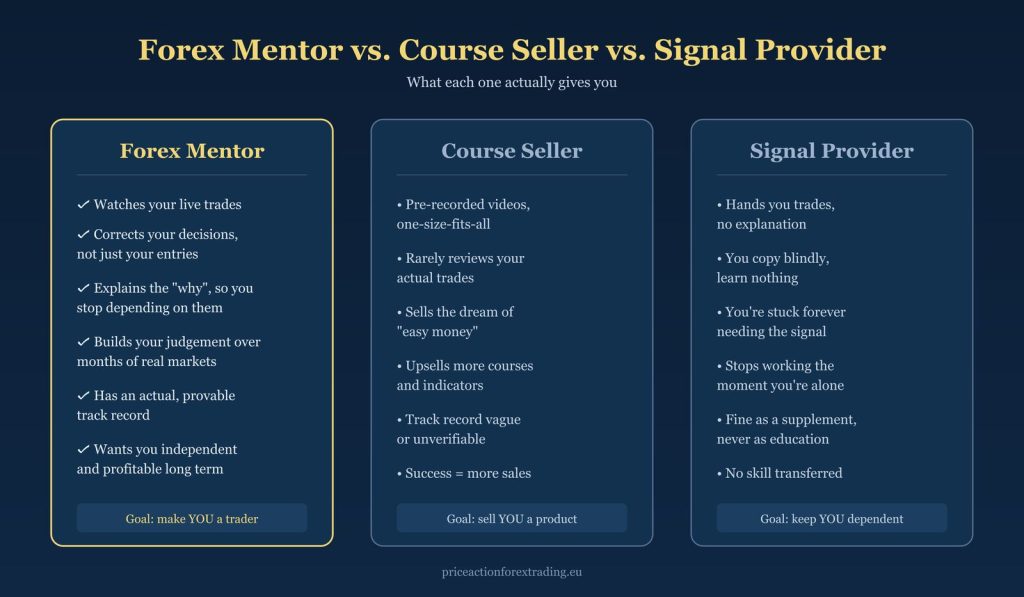
Mentor, Course Seller, or Signal Provider? Know the Difference

The forex education space blends three very different roles together, and most beginners can’t tell them apart until they’ve already paid for the wrong one.

A course seller gives you information. A signal provider gives you trades. A mentor gives you understanding and judgement. Only one of these three actually builds a skill you can keep for the rest of your life.

Signals can be a useful supplement – I occasionally share free trading signals myself, purely to demonstrate what’s possible and build credibility. But copying someone else’s entries will never make you a trader. The moment the signals stop, so does your ability to make money. A mentor, on the other hand, transfers the underlying skill, so you’re still profitable long after the relationship ends. But in our case, the relationship doesn’t really end because I offer a free “earn while you learn” option to everybody who completes my full training course. In that private group I post upcoming trades not just as signals like “buy there, exit there” but with reasons of why there’s a setup, the logic beyond the target and full explanation of how that trade fits into our professional framework.

Courses fall somewhere in between. They can be genuinely useful as a foundation, but a pre-recorded video can’t watch your live trade and tell you why you hesitated for three extra seconds and missed your entry. Only a mentor can do that.

The Red Flags (And Green Flags) of Real Mentorship

The forex industry is full of people calling themselves mentors who’ve never actually proven anything. Here’s how to separate the two.
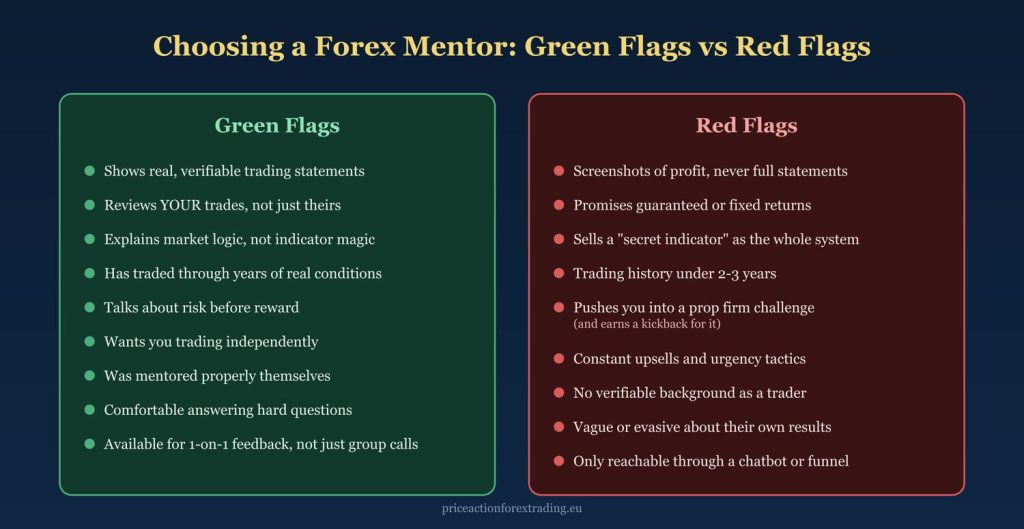
Red flags to watch for:

  • Screenshots of profit instead of full, verifiable statements
  • Guaranteed or fixed monthly returns
  • A trading history shorter than a few years
  • Constant upsells, urgency, and “limited spots” pressure
  • Pushing you straight into a prop firm challenge (often because they earn a kickback from it)

Green flags worth paying attention to:

  • Full, transparent trading statements, not cherry-picked wins
  • Willingness to review your actual trades, not just talk theory
  • An explanation of market logic rather than a “secret indicator”
  • Years of experience across different market conditions
  • A genuine interest in making you independent, not dependent

If you want a sense of what transparency should actually look like, I regularly publish my own trading statements on this blog, including the losing trades, not just the highlight reel.

Also, by verifiable statements I don’t mean asking for a MyFxBook link. The problem with those external services is that they’re often funded by the brokers and everything that you see there can still be faked, either on the platform or on the broker side (e.g. marketing accounts). So if someone sends you a MyFxBook link, it doesn’t have more credibility than a simple screenshot.

What I mean by verifiable is that you need to do your own due diligence: ask very specific questions about certain trades of interest that you found in the statement of your potential mentor and listen how they respond. You need to make sure that these are the trades they actually took and they have a very clear understanding of why they took those trades.

What I Learned From My Own Forex Mentor

I didn’t start out as a professional trader. I spent over a decade as a web developer before trading became my full-time career, and the transition nearly broke me before it worked. I was overconfident, over-engineered my strategies, and made every classic mistake a technically-minded person makes when they assume trading skills can be reverse-engineered like code (I wrote a longer breakdown of this in Making Forex Work For Web Developers & Software Engineers, if that sounds familiar).

What actually turned things around wasn’t just another course or another indicator. It was being mentored, one-on-one, by someone who had already spent 20 years in the market and had nothing left to prove. Rob didn’t sell me a dream. He corrected my thinking, week after week, trade after trade, until I stopped needing him to. He showed me, time and time again, how a real professional trader approaches the forex market, how he investigates and predicts the movements of the market with a high degree of probability using his professional understanding of the market and also how he applies his professional trading strategy when a good opportunity arrives.

That’s the part people underestimate about mentorship – it’s not a one-time transfer of information, it’s a slow rebuilding of how you see the market. You can read about technical analysis in a hundred articles, but until someone watches you apply it badly and tells you exactly why, none of it really sticks.

Some of the results I’ve shared on this blog, like my 21% month trading the London open or growing a small account by 56% in a single month, aren’t the product of a lucky strategy I stumbled onto. They’re the product of years of correction, repetition and feedback that started with Rob and that I’ve continued to refine ever since. Mentorship compounds. The lessons you absorb in year one keep paying off in year five, in ways a single course or ebook simply can’t replicate.

How Long Should Mentorship Actually Take?

This is a fair question, and the honest answer is: longer than most people want to hear. Nobody becomes a consistently profitable trader in a weekend, and any mentor promising otherwise is selling you a fantasy (for the record, I do have a short 5 hour course, but I recommend taking it over 5 weeks instead of a single weekend). What a structured mentorship can do is compress years of trial-and-error into months, by making sure you’re not repeating the same mistakes over and over without realising it.

In my own experience, the first phase of mentorship is about unlearning bad retail habits – the overconfidence, the over-engineering, the impatience and the illusion of knowledge I described from my own transition out of a tech career. The second phase is about building real pattern recognition through repetition, with correction along the way. The third phase, the one most self-taught traders never reach, is trading with genuine independence and confidence, because you’ve internalised why a trade works, not just memorised a rule.

Why Mentorship Beats Self-Study (And Backtesting)

A lot of self-taught traders lean heavily on backtesting, convinced that if they study enough historical charts, the pattern will eventually reveal itself. I’ve written before about why you can’t backtest your way to success – the short version is that backtesting keeps you trapped in the past, while real trading only ever happens in the present moment, under real emotional pressure, interpreting the market in real time and dealing with real uncertainty.

A mentor short-circuits this entire trap. Instead of spending years building a probabilistic model from old candles, you get direct, live feedback on decisions you’re making right now. You learn to evaluate the current situation from multiple angles, define your probabilities, and act – the way professionals actually operate, rather than the way retail traders are taught to.

This is also why so much “textbook” trading advice falls apart in live markets. Even something as widely misunderstood as news trading – which I cover in News Announcements: Real or Fake? – only starts making sense once someone with real market experience walks you through what’s actually happening behind the price action, rather than what a textbook claims should happen.

Questions to Ask Before Choosing a Forex Mentor

Before you commit your time and money to anyone claiming to be a forex mentor, ask them directly:

  1. Why are you a profitable trader? (I know it’s a tricky question and you may need to rephrase it depending on the person, but it can reveal you a lot about who they actually are)
  2. How long have you been trading profitably?
  3. Will you review my actual trades, or just teach a fixed curriculum?
  4. What happens after the initial training ends – do you leave me alone or do you make yourself available for continous mentorship?
  5. Were you mentored yourself, or were you entirely self-taught?
  6. What is the difference between the professional and retail sides of the forex market?

A mentor who’s confident in what they do will answer all six without hesitation. Someone who gets defensive, vague, or redirects you to “success stories” instead of actual facts is telling you everything you need to know.

What a Real Mentorship Should Look Like

If you’re serious about learning this properly, mentorship should be structured, hands-on, and built around your actual trades – not a library of generic videos you’ll watch once and forget.

That’s exactly how I built my own Forex Training Course. It’s not a course in the traditional sense – it’s a direct continuation of the way Rob trained me, adapted for a new generation of traders who deserve the same level of honesty and attention I received.

If you want a faster, more condensed introduction, my Learn to Trade in 5 Days program is built for traders who want to get a professional foundation quickly, without wasting years on trial and error. And if scalping fits your lifestyle or schedule better, Learn to Scalp in 5 Days applies the same mentorship-driven approach to shorter-term trading.

When You Don’t Want to Trade Yourself

Not everyone wants to become the one clicking buy and sell. Some people would rather have their capital professionally managed by someone who’s already been through the mentorship process and has years of real world results to show for it. If that sounds more like you, my Managed Forex Trading service exists for exactly that reason – you don’t need to become a trader to benefit from professional trading.

Final Thoughts

The forex industry is full of noise: indicators promising certainty, signal groups promising ease, and courses promising shortcuts. None of them come close to what a real mentor provides, because none of them can watch you make a decision in real time and tell you exactly why it was wrong – or right.

I was lucky enough to have that from Rob for years, and it changed everything about how I trade. If you’re tired of guessing your way through the market alone, that’s precisely the gap a real forex mentor is meant to close.

Whichever path fits you – hands-on mentorship, a condensed 5-day program, or having your capital managed professionally – the underlying principle stays the same: don’t try to build a professional skill in isolation. Find someone with a real forex market understanding, get close enough to their process to actually learn it, and give yourself the time that skill deserves.

Thanks for reading, and have a beautiful day.

27k in a month trading 1 contract

Just thought of sharing this trading statement to show you all how easy trading can be when you know what you’re doing. The statement is from April 2026, trading a small lot with 98% success rate. I took 115 trades total with 2 losers. It is a very relaxed way of trading where I follow just about half of the pairs and check the charts every 2 to 4 hours during the day. Sometimes I set entry alerts if I see something nice upcoming, other times I just take a late entry if the price’s still good. Both ways work with this method as the most important thing is to know where the price is going and then you simply wait to get paid. This trading method is one of Rob Taylor’s (my mentor’s) signature ones which he employed in the forex market for around 20 years.

To be fair there are some running trades from March that didn’t close yet, but they will reach TP in the near future. I trade this strategy with a no-swap broker. Trading with swaps is also possible, but I trade only in positive swap direction then.

The statement below is just the start and end of it as it’s too large to fit into one screenshot. Full statement available on request.

(Click on images to enlarge them.)

If you want to finally stop losing money in the market and become a professional trader, please consider my training & mentoring course.

If trading is not your thing and you’d like to make your money work harder for you passively, please consider my managed account service.

Thanks for coming to my website. Wish you a beautiful day.

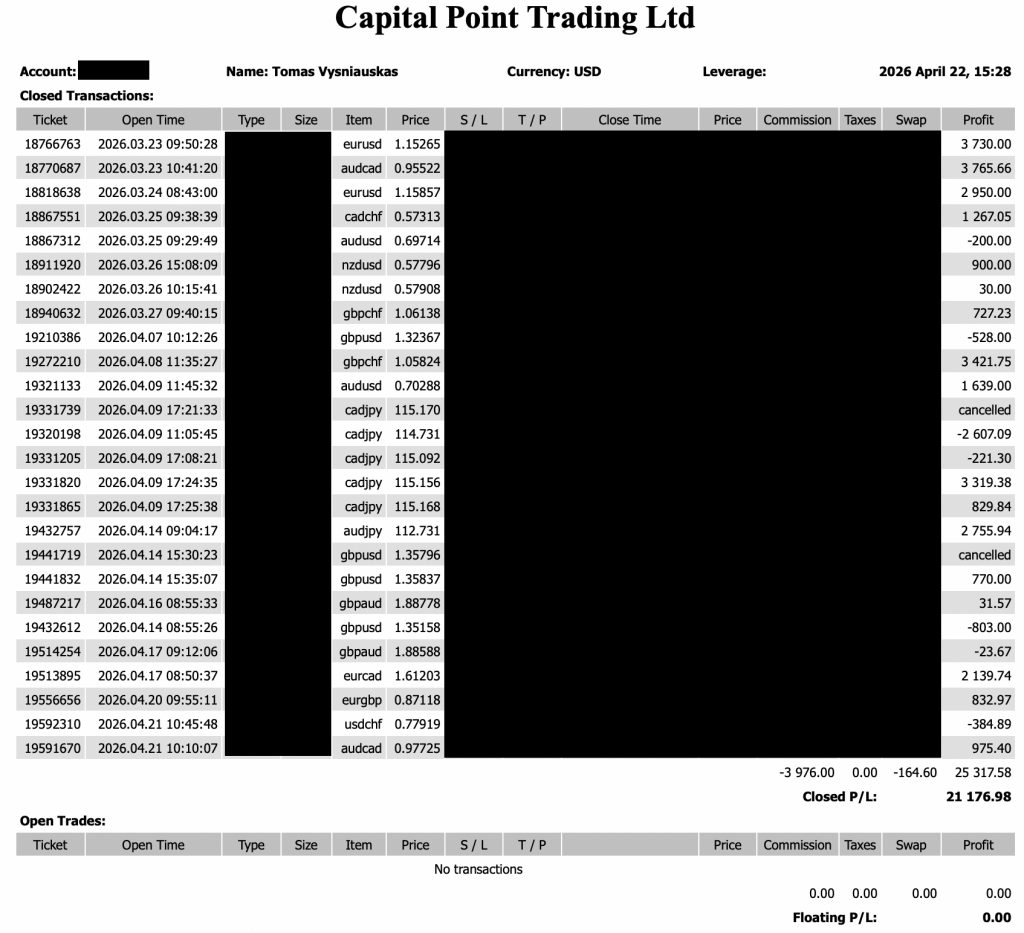
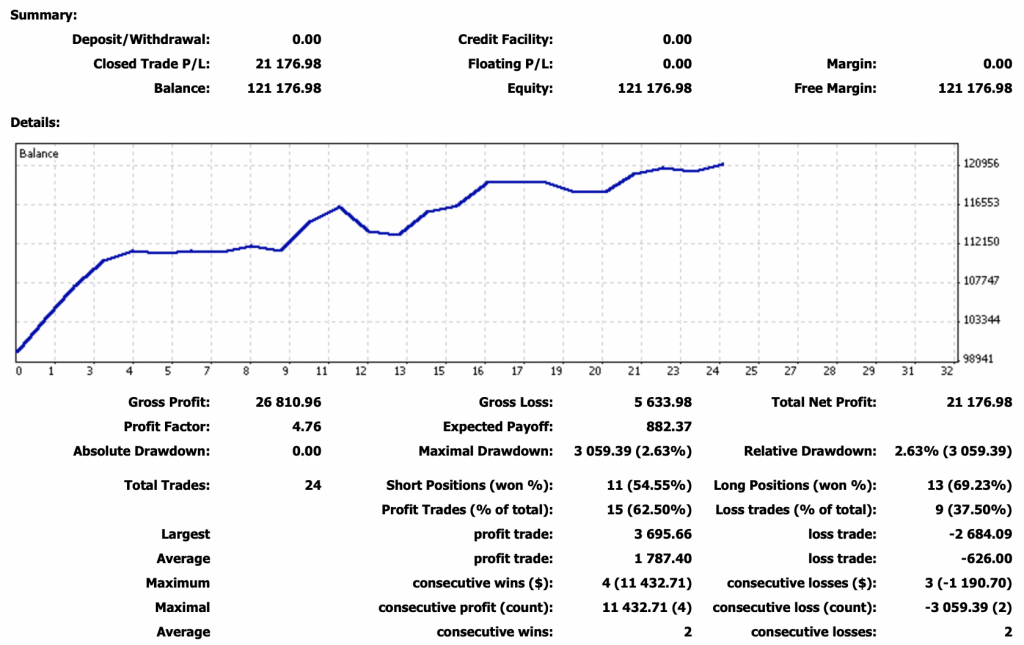
21k in a month trading London open (mostly)

Just sharing another trading statement from the last month. This was a relatively low effort trading method as on most days I traded only part time – in the European mornings. Some days I didn’t trade at all and some days I needed to stay longer throughout the day but these were just a few afternoons as you can see from the statement.

The key ingredient of this method was selection of the best opportunities after scanning the major and minor pairs every morning. This selectivity was reflected in the total number of trades (24), which is quite small relative to the overall profit made.

See the statement below for verification:

I’ve hidden some details because it’s confidential information only available to my mentees and investors.

I love this method because it gives a sizeable monthly return (21% in this case) and it requires very little effort. This London open method is mostly about pre-selection of the best opportunities with the execution and management parts being completely mechanical.

Of course, evaluation and selection of opportunities cannot be done without professional understanding of the forex market – you have to know what you’re doing otherwise it won’t work. You can’t just go to Google, type “London open strategy” and expect to make money with it. What you’ll find out there is just rehashed retail bullshit that simply doesn’t work.

If you wish to learn how to trade Forex using professional trading strategies, please consider my Forex training and mentoring course.

Thanks for visiting my blog and have a beautiful day.

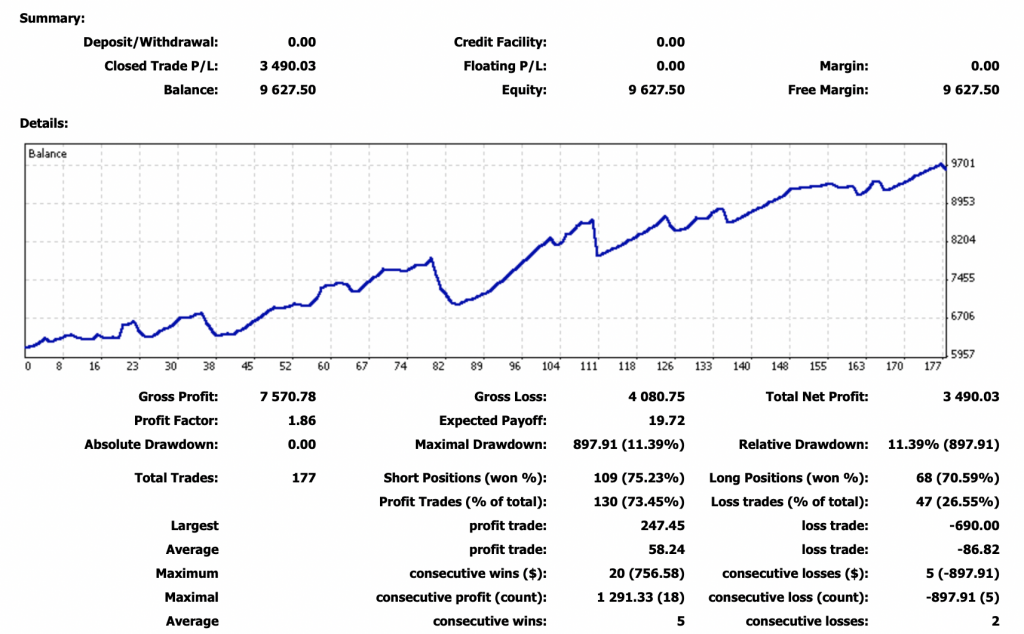
$3490 in a month on a $6K account

If you’re thinking about how to grow a small account quickly, then this article is for you.

I took this small account with a balance of $6137 on 13th Feb and turned it into $9627 in a month. That’s $3490, or 56% profit. For the record, I actually traded only 12 days because I went on holiday in Cyprus during that month and also because February is the shortest month of the year. See the account statement below.

For full transparency – this is not how I trade on large or client owned accounts. This was only to demonstrate what’s possible by applying my professional understanding of the forex market together with my professional strategies.

I took 177 trades total – that’s enough to prove it wasn’t a one-shot gamble. The result achieved is on par with the top performers of the World Cup Trading Championship, which proves that the trading education I provide is second to none.

Now most forex blogs will advise you to get a $100K prop funded account, make 3% a month and that will be your $3K a month. And of course they all get a kickback of your prop challenge fee so that’s why they uniformly advise that.

I’m an independent trader not affiliated with any company so my advice won’t be sexy. The truth is you don’t need a prop firm. You just need to know what you’re doing and use your trading account to the full extent if you want to grow it aggressively.

What most people do nowadays is pay $500 for a $100K prop challenge. It comes with no more than 10% max drawdown rule so you’re in fact aiming just for a $10K account. If you pass the challenge, your trading will be governed by a long list of rules of what you cannot do, with some of those rules being completely subjective (like “no one sided bets” – how can you trade without being one sided at all?). Also, even after you pass the challenge, each profit withdrawal is subject to approval so it may get denied or reduced for any stupid reason from that long list of rules. Knowing all of this, the true value of that account becomes a $5K at best, compared to a regular brokerage account.

Alternatively, if you put that $500 in your brokerage account, grow it aggressively at 50% a month, you’ll reach $5K in 6 months (equivalent of a $100K prop account) and you’ll be much happier because it’s your own account and you can trade it just about however you wish. Yes going the self funded route may take a bit more time initially compared to passing a prop challenge, but if you grow it further compounding will kick in and you’ll eventually be better off with a personal account. Also, prop firms come and disappear much faster than brokerage companies because they’re part of the current gold rush, so in the long term you’re still likely to benefit more going the self-funded route.

Once you have $10K or $100K sitting in your account, you can switch to a more conservative trading approach and use it for income. Alternatively, if you’re more of an entrepreneurial type of person who likes to endlessly re-experience the roller coaster of high growth – you can invest the money you made into passive income generating assets and start with a small trading account again.

Now let’s get to the “how” part. If you’re going to take the self-funded route, my advice is open a small account – the one that you truly wouldn’t mind losing to avoid emotional attachment. It can be 1-5% of your total savings or whatever is comfortable for you. You will need to push your account to the limits, but don’t use the maximum lot size available. You can use just 2-5% of max lot size and that will give you much more freedom to act logically (and I mean max lot size here, it’s not the same as risk per trade).

You’ll also need to change your beliefs. Don’t think in terms of “risk 1% each trade with a max drawdown of 10%”, but rather ask yourself “what can I REALLY achieve with this account if I use my trading knowledge and leverage to the full extent while always pre-defining my risk and action plan before each trade so that the chance of losing that account is minimised”. What if you could forget all the mediocre retail crap you’ve learned so far and really push yourself and finally start behaving like a true trading hero – not a narcissist but a seasoned sailor who’s been through all market conditions, loves a challenge and who can always find a solution to any problem because well, his life depends on that.

And then truly act with the winner’s mindset. You’re here to make significant money, often. Put that strange “losing is OK” mindset aside. In this case, it’s mostly not OK. Do all you can to come out of any situation in profit and make sure each of your trading day is green and you end it flat so that you can sleep peacefully, regenerate overnight and come back fresh the next morning. However, even with the winner’s mindset you still need to respect the market. There will be times when you will have an occasional red day or you will have to leave your trade running overnight, because the market died out and you simply can’t do anything anymore. But if you know what you’re doing you’ll be green 90%+ of days and that will help building your confidence and belief in your ability to be a consistent and grounded winner. Beliefs are very important when trading this way because you’re aiming for extraordinary, like a true Olympian contender. If you have conventional beliefs you cannot be an Olympian contender.

If you’re asking if you should trade with prop firms at all, my answer is yes, why not. Have as many options as possible, it won’t hurt. You can be trading multiple accounts in different styles and that will make your job as a trader more interesting. It will also boost your learning process because each account will give you unique lessons and then those learnings can be applied to other accounts as well. You’ll also feel less attachment to any single account and that will help with emotions and logical decision making. So I’m not against prop firms, but just wanted to shed some light on the self-funded route in this article as it seems that this route became very unpopular these days.

Also I have to mention that none of what I discussed before would be possible without Robert Taylor, who was a legendary forex trader and I was honoured to be his mentee. I was recently re-reading the archived chat messages between me and Rob and I was amazed to see there were thousands of messages exchanged between us from 2021 to 2024 when he passed away. I had completely forgotten how much we talked and that he was actually a much more relentless mentor than I thought he was – always willing to help, wishing me all the best and truly caring like a father. Rob, you’ll be remembered forever.

I am a living proof that Rob was one of the best forex traders in the world and that his training course was No. 1 on planet Earth. If you want to learn to trade like Rob did, I’m your best choice nowadays because I was trained and mentored 1-on-1 by him and I continue to trade in the same way up to this day.

So if you feel ready to finally leave the 95% losing crowd and become part of the top 5% winners group, see my training and mentoring offer.

Thanks for reading and have a beautiful weekend.

Rob’s (my mentor’s) website is available again

As you’ve probably know by now, my mentor Robert Taylor passed away in 2024. Recently, his website stopped working because web hosting subscription expired. I wasn’t managing his website and I have no contact with his relatives, but I made a copy of his blog after he passed away in case the blog goes away.

I believe it’s very important for all of Rob’s mentees to have access to Rob’s original blog because it carries a wealth of knowledge and experience. Also, he taught us how to trade the right way and make money, and our job is to build upon his legacy and maintain credit to him in the future. Rob was an undeniably legendary forex trader and the memory of him should continue to be alive.

You can visit the archived website by following this link.

You Can’t Backtest Your Way To Success

If you’re big on backtesting, listen to me now. How many times you backtested a specific pattern, saw it working X amount of times in the past, but failed to actually profit from it?

You were in a tunnel vision, completely forgetting that you can’t backtest the moment that is already gone. In that moment:

  • Would you be actually taking that trade, or does it look good in hindsight only?
  • When exactly you would be entering the trade, where’s your SL & TP?
  • What else would you be looking at, besides the main chart, and how that would be influencing your decisions?
  • What would be your emotional condition at the time? Would you be happy or sad? After a long winning or losing streak?
  • What fears or illusions would you have in your mind? What would be the degree of distortion in your perception of reality?

My dear reader, just tell yourself the truth – none of the above can be backtested and there’s no point in trying.

Through backtesting, you build a probabilistic model which you then use to predict the future behaviour of the market. You’re operating in the past, which is exactly what all retail traders are taught to do. Which makes you blind to the present moment, so you’re not learning anything new about the market, therefore you can’t make correct decisions, and obviously you can’t make money.

I can say this with confidence because I’ve spent around 10,000 hours watching the charts and this retail behaviour is dead obvious. It was obvious in the charts from 2005, and it will be obvious in 2045 too, because human nature doesn’t change so quickly. Retail stubbornness and short-sightedness are probably the most obvious things I’m witnessing in the forex market on a daily basis.

So if you want to trade “more” like a professional trader, you need to know how they act. Professionals also use probabilities but in a different way:

  1. They use their professional knowledge to evaluate the current situation from multiple angles,
  2. They define the current probabilities of their predictions,
  3. They watch the market as situation evolves and re-evaluate the probabilities,
  4. When the moment is right – they act on their predictions.

They operate in the present moment, and that puts them ahead of the crowd. They don’t search the past to confirm how probable their prediction is. They primarily use the data that they have in the present moment.

Deep down they know that whatever they do, it cannot be backtested, as the present moment is unique. This reveals the true nature of professional trading – while retail traders blame their strategy for their failures and keep backtesting, professionals know that they’re the only ones responsible for their results.

Looking for a safe haven in backtested data is the same as looking for the holy grail. It simply cannot be found because it doesn’t exist.

If you’re tired of searching for the holy grail and feel ready to be trained by a professional trader 1-on-1, check out my professional forex training & mentoring course.

Thanks for reading and have a beautiful day.

Free Signals Are Back

The last time I generated over 1000 pips for my signal subscribers, all for free, and you can still find all of this documented in my Telegram channel. To this day I haven’t seen another professional forex trader providing genuine signals to the public, free of charge. I could have been the only in the industry, but I’ll leave this for you to decide.

This week I started posting free signals again, just in a different format. My idea now is try to teach you how to fish instead of giving you the fish directly. This is an experiment and I don’t know how long I’ll be running it, so hurry up and take advantage. You’ll find more information in the pinned post inside of the channel.

Click here to join my Telegram channel.

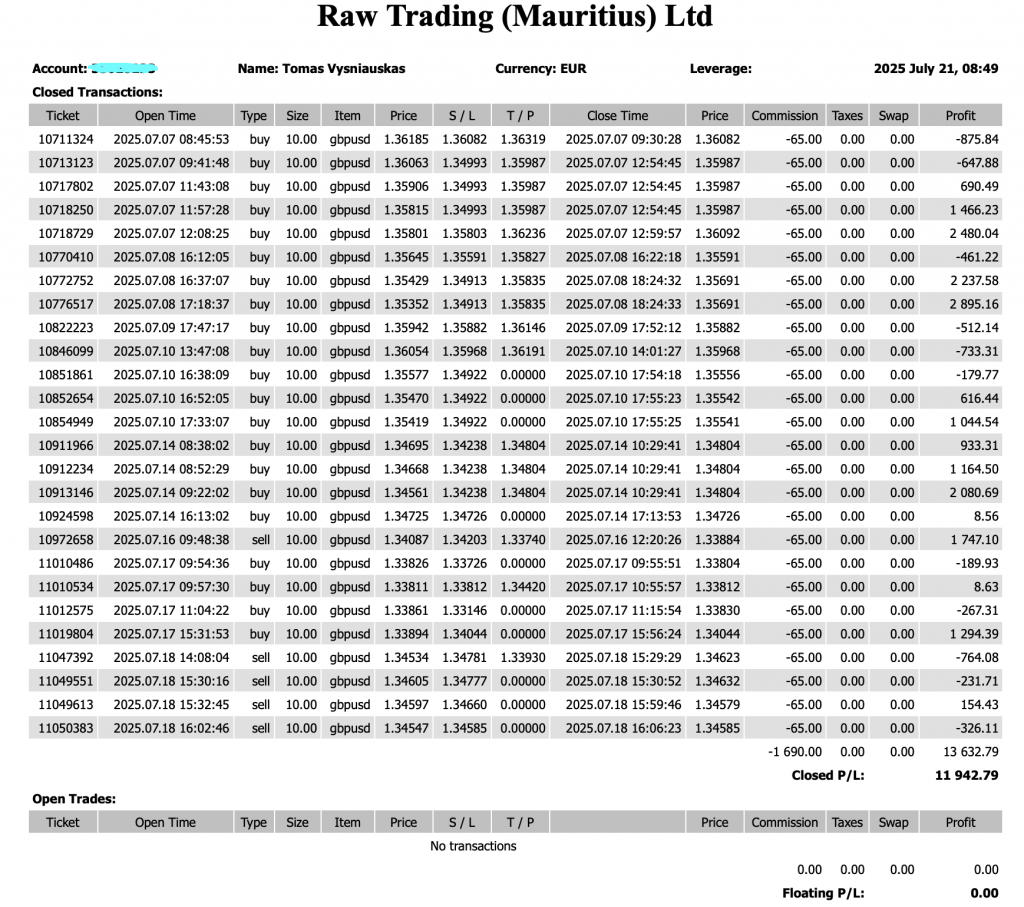
€11k profit in 2 weeks trading 1 pair only (July 2025)

I’m sharing one more trading statement for transparency reasons. Many traders think July and August are the worst months for trading because it’s holiday time so the markets are slow and unpredictable. I agree that most summers are slower than other months, but that doesn’t make the market less predictable. If you know what you’re doing you can make good money in summer as well.

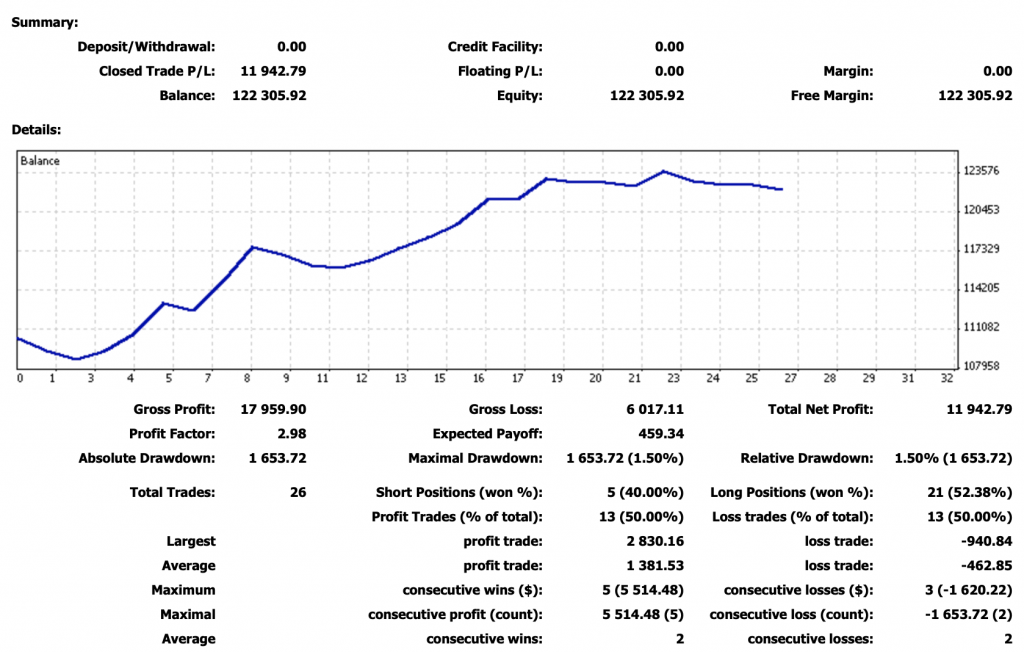
It’s worth mentioning that this statement is not perfect. It has only 50% win rate and my equity curve isn’t smooth as I wasn’t in my best shape during the last two weeks. This shows that even if you make mistakes, with the right training you can still bank a lot of pips.

Also please note that during these two weeks I traded only GBPUSD. This proves that you don’t need to be glued to 6 monitors watching 28 pairs all day to make good money. Less is more, because it gives you clarity.

Making Forex Work For Web Developers & Software Engineers

I worked as a web developer for 10+ years before coming into full time forex trading. Transition was painful as I had to overcome harmful habits that I brought from my tech career. If you try trading, you’re likely to face the same challenges, so let’s dive deeper.

1. Overconfidence (I’m a PRO!)

I was a respected, well-paid professional. I was convinced I’ll easily transfer my skills into forex trading. I was wrong. Trading skills have nothing in common with programming skills. Trading a serious job that must be learned properly.

I was so overconfident I even traded all of my mentor’s strategies without stop loss. It felt great because that way I made almost every trade a winner (with no respect for risk). When I became too smart to be wrong I blew my relatively large account.

Before playing with fire, I should’ve learned to handle water first. However, this experience helped me cure my overconfidence.

Approach trading like a new job. Look at it as a child. Don’t try to transfer your tech experience to trading. Otherwise, the market will give you a slap.

2. Emotional Decisions

Sounds contrary – we as IT guys are logical people, so how can we have problems with emotional decisions? As a developer, you spend most of your time in the logical realm. You don’t develop your emotional muscle.

In trading, it’s your cash at risk, so you face strong emotions like greed, fear, euphoria, panic. These emotions short-circuit your brain’s reticular formation. This disables you from making logical decisions. Then, your emotions rule. And they’re the worst ruler possible, forcing you to act against your best interest.

What helped me overcome this pattern is to be aware of my emotions and watch them diligently. If I felt that my emotions spiral out of control, I’d close my terminal, lie down on a sofa, breath deeply or go for a walk. I’d also do a 5 minute meditation before coming back to trading.

3. Automation Craziness

While trading, I also built a trading journal app, some tools and lots of EAs (trading robots) to automate my strategies. I spent 100s of hours coding and backtesting. I failed in all of my automation efforts.

I understood it’s impossible to automate professional trading. Human judgement is essential. My mentor already told me that before, but as a “pro handyman” I couldn’t believe it and I had to hit the wall 100x to finally accept it.

The idea of building a trading robot to print money while you sleep is attractive. Although trading is simple when you know what you’re doing, it’s not as easy as waiting for indicator signal and hitting buy/sell. If it was that easy then everyone would be making millions from trading robots, but reality is far from it.

Avoid the trap of automation. Don’t even start with it because it’s a dead end. Learn what’s required first, don’t search for greener grass and don’t look for shortcuts. Coding is not needed in trading. If you love coding, do it on the side, but don’t build trading robots.

4. Over-engineering / Over-thinking

It’s the cycle I’ve experienced many times: I write down a simple trading plan based on my mentor’s strategy. After a few trades, I want to “improve” my plan because my trades sometimes lose (perfectionism). I add extra rules. I do backtesting and add even more rules.

In the end, my trading plan becomes too complex to follow. Or if I manage to follow the plan, I can’t take any trades because there’s always that one rule that’s not satisfied.

Then I come back to square zero, remove the unnecessary burden and start fresh with a simple trading plan. And the cycle repeats again…

Engineers have convoluted minds. They can’t get it how simple trading is. Since they’re smart, they want to “solve the puzzle of the market” to become heroes. And they keep solving that puzzle (which doesn’t exist), while making things more complex than they are.

To fix overthinking issue, I focused on making myself “more stupid”. Because being smart was a major roadblock in my trading process. KISS – keep it simple, stupid – and your overthinking problem will go away.

5. Impatience

Developers are craftsmen. They code, hit refresh/compile and see the result instantly.

Trading is the opposite world. You wait for a setup, open the trade, set TP (take profit) which is nearby and you expect it’ll take 30 minutes for TP to be hit. Your excitement turns into frustration when you see how after 6 hours your TP wasn’t hit yet. You exit the trade and 30 minutes later your TP gets hit. Extremely painful.

In another scenario you’re waiting for a setup for 5 hours. You had 2 unsuccessful entries but the setup still looks good. You start feeling hungry and self-doubt clouds your mind. You go for lunch, miss the last entry and watch how the train left & accelerated without you. Frustrating.

Trading requires strong patience. I struggled with it. My mind used to go crazy after just 1 hour of waiting for a setup. Nowadays I can wait for 7 hours and it’s no problem. Waiting is boring, and I was impatient because I failed to see the bright side of boredom.

Society sees waiting as doing nothing so we naturally feel bad about it. But waiting is an essential part of any business owner’s workday, including trader’s. Boredom is painful, but ask yourself what’s good about it and what it wants you to teach. You’ll find the hidden blessing behind boredom and it’ll fix your impatience.

6. Misunderstanding Uncertainty

I didn’t come from a business family – craftsmen rarely do – and it’s likely you didn’t as well. Software engineers are used to deterministic systems and predictable outcomes. To put simply: it either works or it doesn’t and it’s obvious. If it doesn’t work then you need to fix the bug and it will work.

Markets and business in general, however, are non-deterministic. I do my homework and I enter into a trade only when I’m confident about its outcome. But that outcome is not guaranteed. So initially I have to act as if I know where the price is going to go, but under the hood it’s actually a 70-99% probability. At some point during the trade I may need to admit it’s not a 100% chance and make changes.

Having a rigid mind that sees apple only as an apple is bad for trading. It leads to debilitating emotions and stress when the future shows that apple was actually an orange. Stress is harmful and it lead me to health problems. To stop self-destruction I had to develop a flexible mind that is not fixated on a single outcome and is quick to change predictions.

To achieve that, I studied the biographies of famous entrepreneurs. Their success stories are usually 95% failure stories. Before they had 5 successful projects, they faced a frustrating failure with the other 95. And when they start their 101st project, there’s still no guarantee it’ll work. Surprisingly, it’s a feature, not a bug!

To make uncertainty your friend, tell yourself that every trade is a new startup. There’s a level of risk, reward and probability in each trade. All of the variables may change during the trade. Your job is to maintain reward, risk and probability in harmony, according to your best interest. When you realise that a degree of uncertainty is a core feature, not a flaw, of trading – your mind will stop exploding and you’ll trade with peace.

7. Perfectionism

I was a perfectionist web developer. Because I had perfectionist clients at the beginning of my career, who did well in their businesses. I’d measure every single pixel to see if it all aligns perfectly. I’d think about multiple worst-case scenarios and make sure none of them can happen. My goal was to always satisfy my clients 110%.

Trading is different. You act according to your rules with discipline, but if you do it perfectly you’ll miss most of your trades. Because perception of the chart is your responsibility. How you describe what you see and how it measures against your rules relies on your brain.

When I traded as a perfectionist, I’d reject an entry because “this price level is too flat” or “this looks too retail” or “this indicator signal should have appeared on previous candle 1 minute before, if it’s now then it’s not good”. These are situations when I see 9 out of 10 stars aligned and 1 (distant and small) star didn’t. And I’d focus on that 1 bad star, failing to see the full picture because… I was a perfectionist!

To cure perfectionism, act even if 1 out of 10 stars doesn’t seem to be aligned. But don’t break your rules. You do need a logical, well defined strategy. Just don’t make it too rigid, leave some loose ends that allow for flexibility. I recommend making entries your loosest part. Have 4-5 different entry methods, because entries are the least important part of professional strategy.

***

Thanks for reading this article and have a beautiful day.

If you’re a developer or engineer looking to learn how to make money trading forex, check out my training course for developers and engineers.


News Announcements: Real Or Fake?

Every trader is at least aware of major news announcements like NFP, interest rates, CPI. Some try to trade them by predicting where the price will go based on economic data.

However, during the announcement, forex market doesn’t always move the way it’s written in the “textbook”. Why is that?

Let’s look at a couple examples. You can click on images to enlarge them.

The first example above is GBPUSD interest rate announcement which happened at 14:00 in broker’s timezone, on June 19th 2025. I marked the exact news candle on M1 chart.

According to the textbook, “a higher than expected figure should be seen as positive (bullish) for the GBP while a lower than expected figure should be seen as negative (bearish) for the GBP”.

But the Bank of England didn’t change the interest rate on that day. It remained 4.25%, as it was before. Also, the prediction consensus was 4.25% as well, so it matched market’s expectations 100%.

So why did the market move? The textbook says it shouldn’t have moved at all because all expectations that are fulfilled in reality were already priced in.

Another example above is USDJPY NFP announcement which happened at 15:30 in broker’s timezone, on March 7th 2025. I marked the exact news candle on M1 chart.

The prediction consensus was 160K and the actual number announced was 151K. According to the textbook, “a higher than expected figure should be seen as positive (bullish) for the USD while a lower than expected figure should be seen as negative (bearish) for the USD”.

So the market should have moved down, but it actually moved up a lot before going down. Why did this happen?

When such things happen, people often say: “ah, it’s just the markets acting irrational”, thinking that it’s too complicated to look deeper.

But if Albert Einstein managed to explain space, time and gravity, then explaining how the market works must be easier. Market was made by man, and everything that is made by man is far simpler than God’s creations.

The Answer

So the actual answer is that news announcements do not move the market. Contrary to conventional wisdom, there’s no cause-and-effect relationship between news and market movements.

Forex market always moves to where the money is. It has to, and there’s no other way around it, and it’s that simple. And it’s the only reason the forex market moves, if it moves at all.

I can’t reveal who moves the forex market because it’s confidential information only available to my mentees, but to put simply: there’s always a price to be paid for market movers to move the price, and they only do that when it’s profitable for them to do so. The profits may come immediately or after some time, but the movements are always logical and never random.

How I Trade News

I don’t look at news announcement figures at all. I only check the news calendar every morning to understand when the market is likely to move and plan my trades accordingly.

I prefer to make entries after news announcements. But sometimes I’ll enter before news as well, if I have a good setup.

To protect my trade, I usually expand my stop loss during news because there’ll be increased volatility and spreads.

I don’t trade news for the sake of trading news (i.e. based on economic data). That would be gambling and I don’t think such a strategy could be profitable long term.

Hope this article was helpful, thanks for reading and happy trading.