Tomas Vyšniauskas

How I Trade

Somebody told me they’d like more transparency on how exactly I trade and how do I manage to make money trading on a consistent basis.

Although I’m transparent as much as I can, the problem with transparency is that if you go too far, you’ll be stripped naked and eventually harm yourself. I can’t show my chart template and I can’t explain my strategies to the public because it’s confidential intellectual property that must be kept private.

However, I’ll try to walk you through my today’s morning GBPUSD short trade on a blank template to give you a basic understanding of how I trade. I’ll explain what I was thinking about and how I was acting as the trade was developing but I won’t reveal any sensitive wording and terminology.

8:15 I start my morning preparation: checking if trade copiers are working properly on VPS, checking news calendar for today, doing a 5min meditation, reading my strategy rules. I’m happy there will be no news today, which usually means it will be a smooth sailing. It’s also July 4th – a public holiday in the USA, but that will only matter after 15:00 in my (European) timezone.

You can click on images to enlarge them.

8:30 ↑ I look at the chart and see a potential short coming up soon, because the price is in a correct zone and cycle and there are attractive targets for moving down.

So I start looking for entries. After a minute I understand that my entry indicator already signalled an entry 20 minutes ago – while I was still doing preparation work. The price has already moved down a bit, so I decide I’ll wait for another entry.

But then I tell myself: another entry might not come because we’re reverting from a perfect entry zone already. Also, you’re just a bit late and the price hasn’t moved too much. Do you want to be a perfectionist or do you want to make money?

8:36 ↓ So I enter short (time marked with a blue arrow, entry price marked with a white line).

9:05 ↑ The price moved down quickly. It appeared logical, but faster than I expected.

9:25 ↑ It violently moved back up again. Price is still in perfect zone, I believe in this trade.

9:30 ↑ I wasn’t stopped out, I’m still in the trade. Price went back up and my indicator gave me another entry signal, but I didn’t enter because it’s at the same price.

10:00 ↑ I’m still in the trade. At this point I’m already grateful for the market allowing me to watch this movement, no matter what the final result will be.

10:20 ↑ A very important moment – price is confidently moving down. But on H1 chart I’m already seeing a danger signal – a reason for price to come back and stop me out. However, although that is probable, it’s not very probable right now, due to the rules of cycles. So I acknowledge that and move on.

10:35-10:55 ↑ The price is struggling to go down, but I was expecting for it to struggle in this area. Nothing to worry about, even with this large candle up.

11:10 ↑ Usually, price doesn’t take so much time to break through this zone – it violently moved up again and my indicator gave me an exit signal. However, my rules do not allow to exit yet in this cycle. Also, I still don’t see any good reasons for price to move back up to my SL immediately. So I stay.

11:50 ↑ At this point I’m 90% confident price will continue moving down to take out the nearest lows. Thank you, market, for this gift.

12:10 ↑ At this point I was doing something else and didn’t watch closely as the price moved down strongly. Also, I’m becoming hungry. It would be nice to have lunch within the next 20 minutes.

12:25 ↑ My indicator signals an early exit. I check my rules and they say I should exit now because we’re already in the cycle which allows that. I think for 18 seconds: targets still look nice and I could stay in this trade longer, but I risk falling into the greed trap. I should follow my rules. So I’m going to exit (timing marked with arrow, price marked with white line).

In hindsight, I left money on the table because price continued to move down, hitting my original TP. But I can’t take it all every time – profit is profit.

My only objective as a trader is a good and logical execution of my strategy – all else is noise.

If you’re asking if it’s necessary to watch trades candle by candle with my methodology, the short answer is no. There are simple rules for trade management which only requires me to check the charts once per hour or when I get a certain alert.

I decided to watch it candle by candle this morning because I wanted to further study the relationship between USDJPY and GBPUSD in live charts. So I watched these two pairs together. Watching live charts with a trade on (skin in the game) is the best way to expand your understanding of the market.

I hope this article gave you a better idea of how I trade. If you’d like to learn to trade like I do, feel free contact me.

Thanks for reading and have a beautiful day.

How To Hold Trades Overnight

Some traders say that you should never hold trades overnight because it’s risky. But what if you got into a rare big pip trade which you know will take a few days to hit TP?

If you close it before going to sleep you may be leaving a lot on the table. But if you leave it running you risk of being stopped out during rollover and not making anything.

I coded some spread tracking EAs and watched a few pairs on different brokers. Spread during rollover usually go up to 12-30 pips depending on the pair (higher spreads on minor pairs).

To be on the safe side, that would mean having a stop of 50p during rollover for short trades to avoid being stopped out by the invisible asking price (variable spread). But that sounds like a risky proposition especially if you’re in a 50/50 chance scalping trade. So how can we approach this better?

I observed that quite frequently, the price at 1:30 (of the new day) would be around the same or better compared to the price at 22:30 (of the previous day). If not at 1:30 then there’s also a good chance price will come back to a favourable level during the night. Also, the spreads get increased between 23:00 and 1:00. Before and after the conditions are normal. 

The table below uses EURUSD data of 3 years and displays the average pip difference between a certain start and end time.

StartEndAvg Pips Diff
21:3001:308.44
21:3001:158.22
22:0001:306.50
22:0001:156.30
22:3001:305.51
22:3001:155.32
22:4501:305.08
22:4501:154.79

The strategy

Do what works for you. I simply exit the trade at 22:30 and open it again at 1:30, or create a limit order if price has moved already. My timezone is the same as broker’s timezone, so I do the closing manually and I’ve automated the re-opening of the trade at 1:30 because I’m asleep at that time.

The interesting part is that in most cases price will not have moved much because that’s the nature of rollover period. That way you don’t need to add 50p extra risk to your short trades, you also lock in some profits before midnight and you’re still open for taking more profits during the following trading day.

Now how about long trades? They’re safer in the sense that they can’t be stopped out by the invisible asking price. But it’s quite common that during rollover the price gets moved down to take out the most recent swing low by a few pips.

The solution could be to simply put your SL 10-20p below the most recent swing low. But that also poses unnecessary risk. If the market gaps after midnight, your SL may be slipped through. So it depends on your risk profile. Either follow the same rules as for short trades: exit at 22:30, re-enter at 1:30 or simply do nothing and let the trade breathe its life.

When not to use this strategy

If your target is 150p away and price has already moved 100p then your vulnerability to rollover tricks is almost not existent. The best thing to do in this case is don’t change anything just wait, and make sure you didn’t trail your SL too close to pre-rollover price (best to leave it at breakeven).

Thanks for reading and have a good time dealing with rollovers 🙂

Week 50 (2024) Trading Statement

I’m sharing my trading statement of week 50 (December 9-13, 2024) for transparency reasons.

The total was 230 pips.

And here’s the statement (click the image to enlarge it).

Thanks for reading and have a good weekend.

P.S. (July 2025 update) Some of you will be suspicious and ask why the commission column is 0. At the time, I was using XM Global Ultra Low account, which doesn’t charge commission but adds an extra markup to spread.

Week 49 (2024) Trading Statement

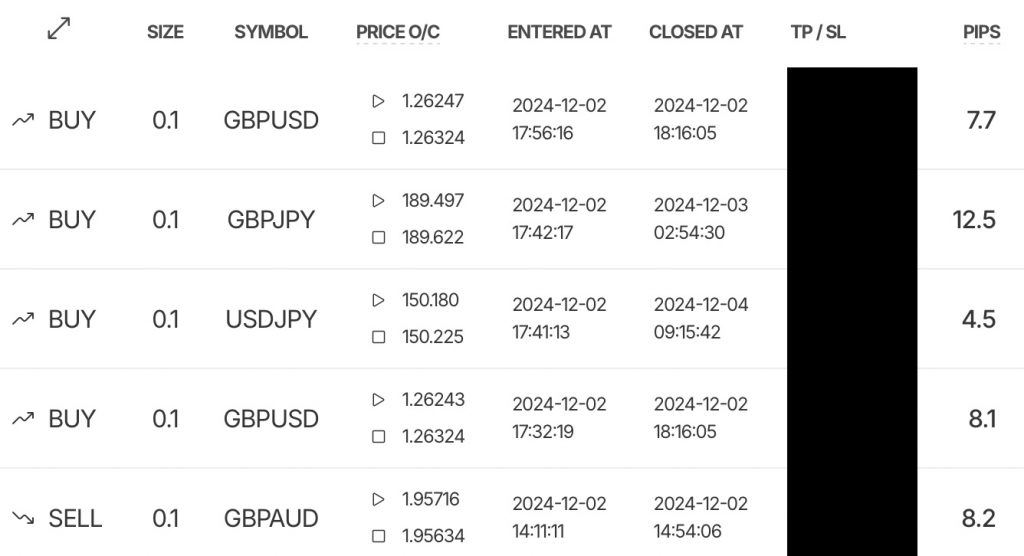
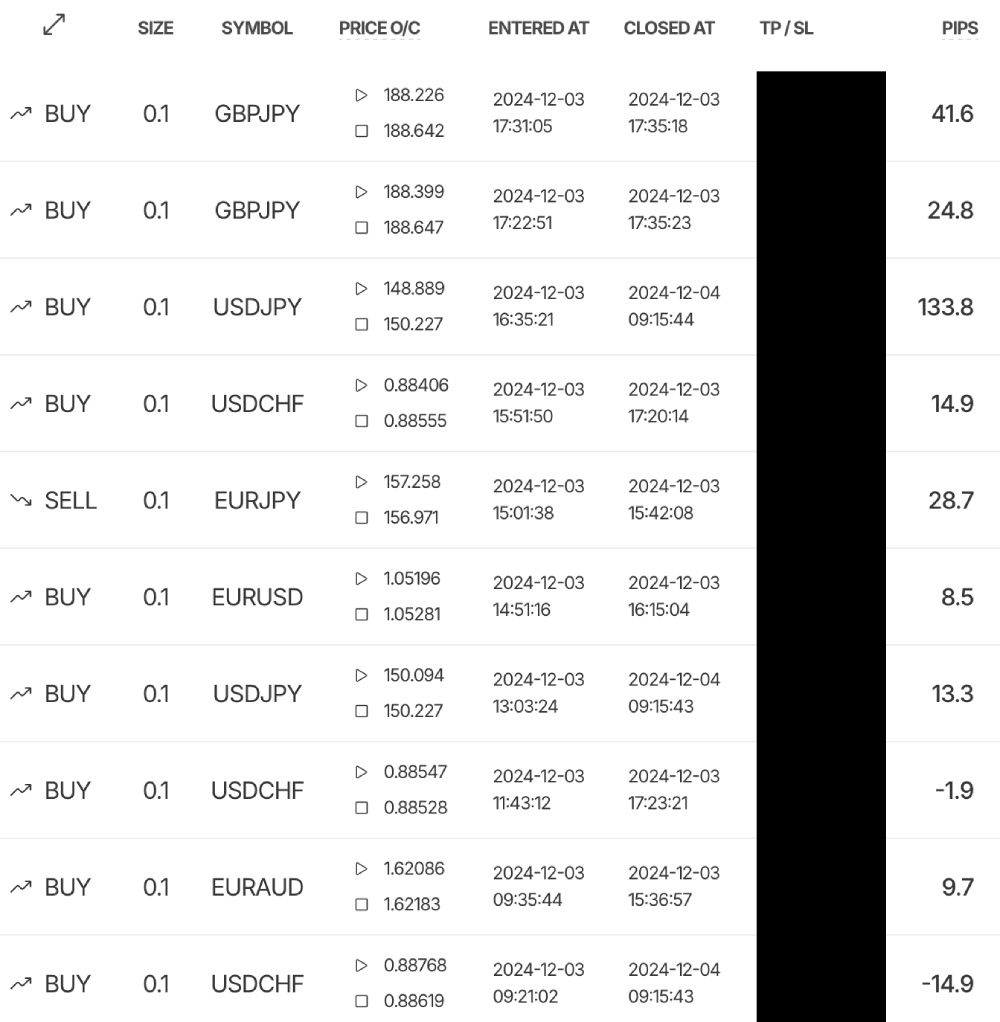
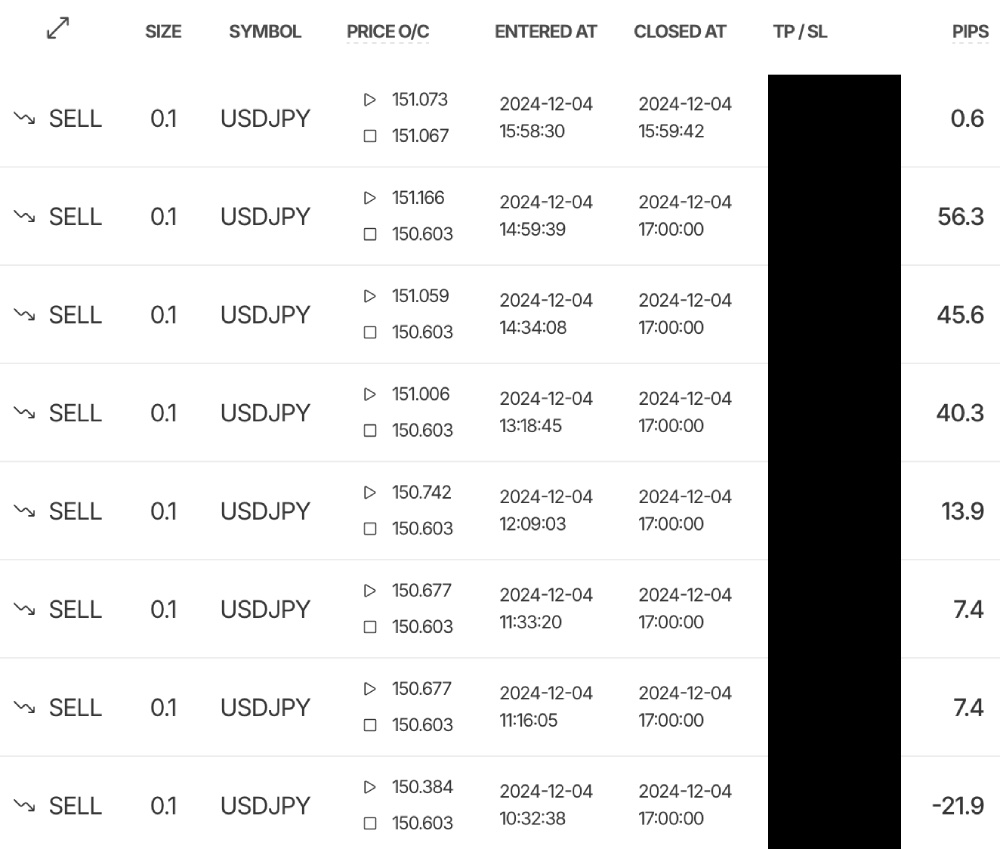
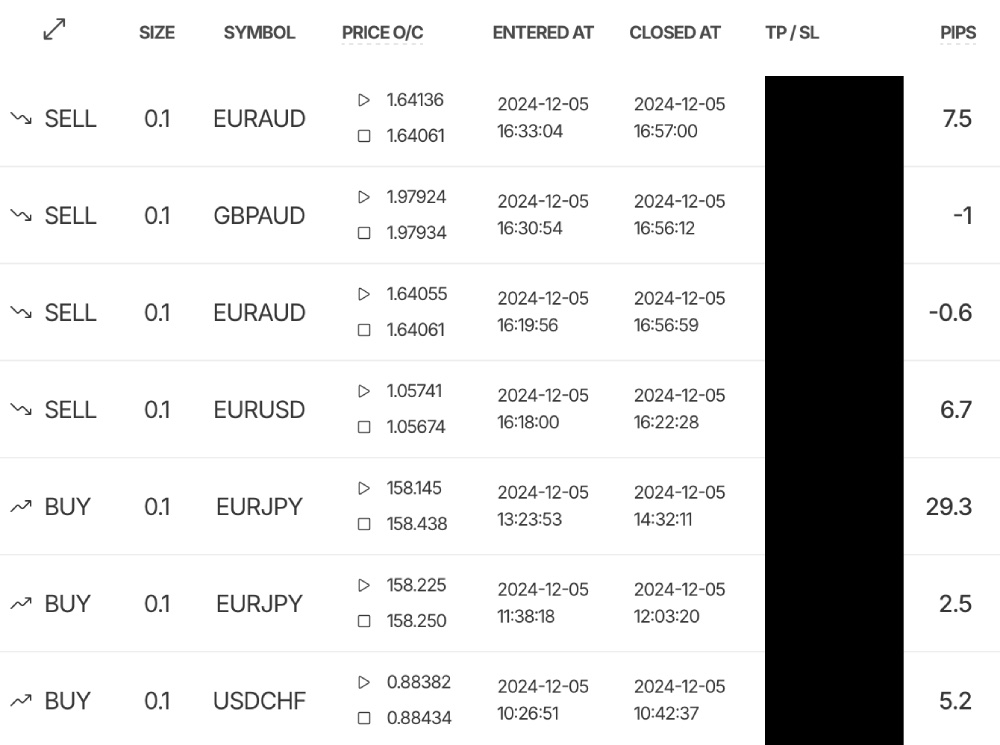
I’m sharing my trading statement of week 49 (December 2-6, 2024) for transparency reasons.

In total, I made 498 pips.

And here are the daily statements.

Monday

Tuesday

Wednesday

Thursday

Thanks for reading and have a nice afternoon!

Remembering Robert Taylor

Robert Taylor (1965-2024) was a legendary forex trader. He lived off of forex trading for the last 20 years of his life.

He had a true, undeniable understanding of forex market and an excellent prediction skill. He was passionate about trading and selflessly helped others almost until his last breath, even from a hospital bed.

He passed away in Gibraltar in July 2024. I was honoured to be his mentee between 2021 – 2024.

If you’d like to watch my detailed statement about Rob in video format, you can do so by following this link.

If you’d like to visit his archived blog which carries a wealth of knowledge and experience, you may do so here.

Rob, you’ll be remembered forever.

Proactive VS Reactive Trading

Many traders want a simple, mechanical trading plan that is based on indicators and chart patterns. It’s like you get something on the chart and you react by either trading it or not.

However, we see that indicators are more often failing than working. Chart patterns are also more often failing than working. So what can you do about it?

You need to be proactive.

First of all, you have to identify price areas where you’re going to expect a chart pattern or indicator signal to happen.

When you identify your price area and expect a certain pattern or signal to happen, you’re making a prediction (step 1). After you’ve predicted what’s going to happen, you wait for it to happen (step 2). And then you know that if A happened, followed by B, then it’s very likely that C will happen as well. So then you trade (step 3).

Sometimes I wait until evening for my morning’s predictions to happen. Or until tomorrow. Or longer.

Remember – patience is the name of the game and if you use proactive approach then you’re less likely to fall into greed/fear traps and also more likely to make money.

Two Sides Of Forex Market

There are two sides to the forex market: retail and professional. Do not confuse it with broker’s definition of retail vs professional client (by broker’s definitions). It doesn’t matter what kind of client you are.

What matters is how you trade. The two differences, compared to retail trading, are as follows: 

  1. In professional trading you trade by using a professional, not a retail strategy;
  2. To successfully employ your professional strategy, you are using your professional understanding of how the forex market works.

The two sentences above may not make any sense to you, but to put it short – when professional traders are long, retail traders are usually short and vice-versa. The difference is obvious and there’s a very clear line between professional and retail trading.

There’s just one correct way to trade the forex market and that way is called the professional way. If you trade on the professional side, you can make money consistently. Trading on the retail side is very unpredictable and it’s usually a losing game.