
Every trader has heard the same advice: “wait for the pullback.” Let price break out, let it retrace, then jump in at a better price. It sounds sensible. It is taught in almost every free course and repeated in almost every forum thread. And it is exactly why so many retail traders keep entering at the wrong moment, again and again.
I want to walk you through what a pullback actually is, why the popular version of this strategy keeps failing the people who trade it, and what I actually look at when price pulls back into a level I care about. This isn’t theory pulled from a textbook. It’s how I read pullbacks every single day in my own trading.
What a Pullback Really Is
A pullback is a temporary move against the dominant direction of price before that direction resumes. Price pushes up, pauses, drifts back down for a while, then continues higher. Or it pushes down, drifts back up, then continues lower. On the surface, that’s all a pullback is.
But that surface description is where most training stops, and it’s exactly where the useful information gets left out. A pullback isn’t just “price going the other way for a bit.” It’s a visible record of which participants stepped in during that move, how they behaved, and what they left behind on the chart. Every candle in that retracement is telling part of the story to someone who knows how to read it. None of it is filler. The pullback itself is data.
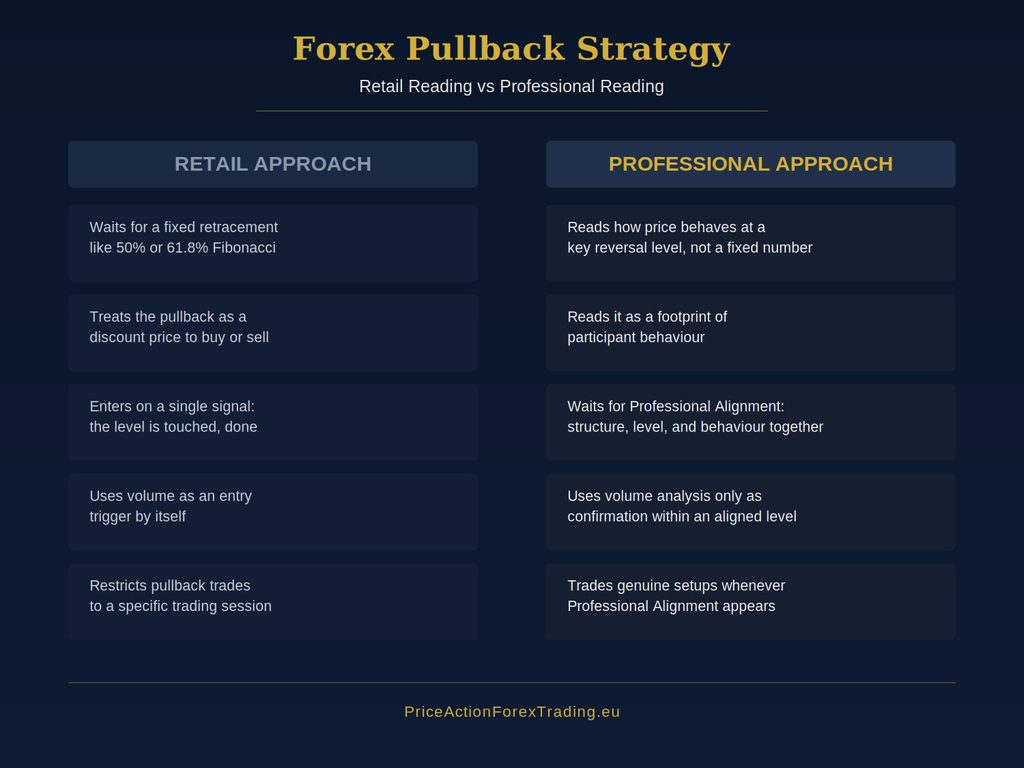
The retail version of this strategy treats the pullback as a discount. “Price went up, now it’s cheaper, buy the dip.” That framing misses almost everything that actually matters about why the retracement happened and what it reveals about who was buying and who was getting trapped.
Why the Popular Pullback Strategy Keeps Failing
If you’ve spent any time around trading content, you’ve seen the standard pullback playbook: wait for a retracement to a moving average, wait for a Fibonacci level like 50% or 61.8%, or wait for price to tag a trendline drawn across a couple of swing points. Then enter in the direction of the original move.
The problem isn’t that these tools are useless. It’s that they’re public, mechanical, and applied the same way by hundreds of thousands of traders at the same time. When that many people are watching the same retracement level and placing orders around it in the same predictable way, that behaviour becomes something the market can be relied upon to produce and something it can just as reliably punish.
This is the pattern I keep coming back to across every strategy I write about on this blog, including in my breakdown of the breakout and retest strategy: the moment a technique becomes public and mechanical, it stops being an edge and starts being crowd behaviour that gets exploited. A pullback strategy based on a fixed Fibonacci percentage or a generic moving average isn’t reading the market. It’s reading a rule that thousands of other screens are also reading, at the exact same time, with the exact same expectation.
That’s why so many “buy the pullback” entries get taken out almost immediately, price dips just a little further than expected, the stop gets hit, and then the original move resumes exactly as the retail trader expected, except they’re no longer in the trade. That isn’t bad luck. It’s a predictable outcome of trading a level that too many other people are watching in the same mechanical way.
Why Pullbacks Aren’t About Trend Structure
A lot of pullback material, including some of the more “advanced” versions of this strategy, will tell you to check trend structure first. Confirm the sequence of higher highs and higher lows, and only once that’s intact do you allow yourself to look at the pullback. That still sounds disciplined. It isn’t. It’s the same mechanical checklist thinking as a fixed Fibonacci retracement, just moved one step earlier in the process.
What actually qualifies a pullback to be traded has nothing to do with whether a sequence of swing points looks tidy on your chart. It has to do with whether you understand where price is actually going. Not “the trend is up so it probably continues up.” Real professional understanding, built from reading how the three groups of market participants are behaving, of what’s likely to happen next. That’s not something a swing-point checklist can give you. It’s built through direct training, under someone who already reads the market this way.
Once you have that understanding, a pullback becomes tradeable in one specific circumstance: when it reaches a key reversal level. That can happen inside a clean trend. It can just as easily happen without one. The trend isn’t the qualifying factor. Whether the pullback is interacting with a level that genuinely matters, and whether you understand where price is headed once it gets there, is what actually decides whether the pullback is worth acting on.
What a Pullback Actually Shows You
Here’s where I diverge sharply from how pullbacks are taught almost everywhere else. A pullback is not just a pause. It is the visible footprint of three groups of market participants interacting with each other, whose specific identities and behaviours I keep for my mentees rather than laying out publicly here. What I can tell you is that how price moves during that retracement, how it slows, how it compresses, how it approaches a level, tells you a great deal about which of those groups is currently in control and which is being drawn into a position it will later regret.
This is a completely different way of looking at a retracement than “price came back to the 50% level, so I’ll buy.” You’re not looking for a number. You’re watching behaviour. And behaviour, unlike a fixed percentage, can’t be gamed by thousands of traders drawing the same line on the same chart.
Key Reversal Levels During a Pullback
The place I actually pay attention to during a pullback is what I call a key reversal level. This is not the same thing as a textbook support or resistance line, and it’s not the same as a supply or demand zone the way most retail material describes them. If you want the full breakdown of why I treat these concepts as fundamentally different things, I’ve covered it in detail in support and resistance zones in forex.
A key reversal level is a proprietary read built from how price has previously behaved at a given area, combined with the structural context around it, rather than a line drawn from two touches on a chart. When a pullback approaches one of these levels, I’m not just checking whether price “reacted” there before. I’m reading how the retracement itself is behaving as it approaches that level, whether it’s slowing in a way that reflects genuine participant behaviour or barrelling through in a way that tells me the level has already been absorbed.
This is a large part of why two traders can look at the exact same pullback on the exact same chart and come to completely different conclusions. One is measuring a fixed retracement percentage. The other is reading how price is actually behaving at a level built from real structural history.
Professional Alignment: Bringing the Pieces Together
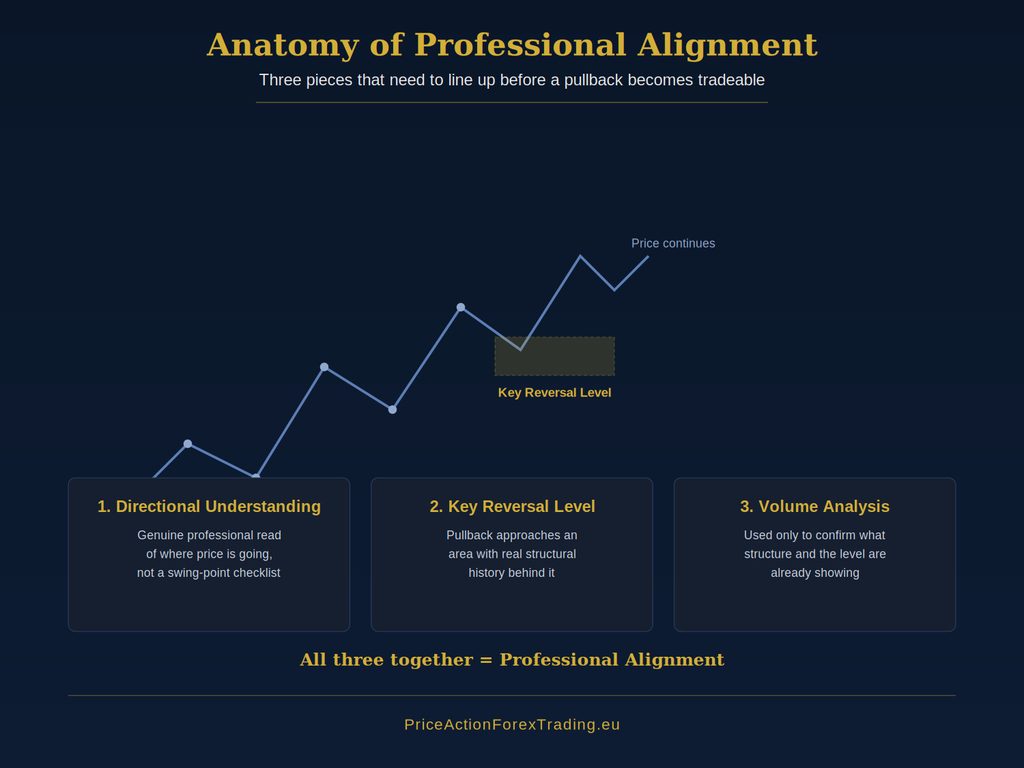
I don’t trade a pullback off a single signal, and I’d caution you strongly against ever doing that. What I look for is Professional Alignment, the point where genuine directional understanding of where price is going, a key reversal level, and the behaviour of the pullback itself all point in the same direction at the same time.
When only one of those pieces lines up, I stay out. A pullback into a key reversal level with no real understanding of where price is going behind it is a guess, even if the level itself looks right. Being right about direction with no meaningful level for the pullback to interact with is also incomplete, you might be reading the market correctly and still have nothing concrete to act on. It’s only when multiple pieces of the picture align that a pullback becomes something worth acting on rather than something worth watching.
This is also where I’d push back on the idea that pullback trading needs to be tied to a specific session. It doesn’t. A pullback that shows genuine Professional Alignment can appear during any session, and restricting yourself to trading pullbacks only during one window of the day means missing setups that have nothing to do with the clock and everything to do with what price is actually showing you.
Volume Analysis: Confirmation, Not a Signal on Its Own
Once I see Professional Alignment building around a pullback, I’ll use volume analysis as a final layer of confirmation within that key reversal level, never as a standalone reason to enter. Volume on its own, without the structural and behavioural context around it, tells you very little. It’s only meaningful once you already know you’re looking at a genuine key reversal level inside a properly aligned structure. At that point, volume analysis can add real confidence. Used before that, it just adds confusion to a decision that isn’t ready to be made yet.
The Execution Stage: Where Professional Thinking Matters Most
This is the part most pullback strategies get completely backwards. Retail material treats execution as a mechanical checklist: risk 1% per trade, use a fixed stop distance, move to breakeven after X pips. Those are position management habits, not trading decisions, and they don’t tell you anything about whether the pullback in front of you is actually worth acting on.
The execution stage of a pullback trade is where professional thinking, applied with professional knowledge of how these levels actually behave, matters more than at any other point in the process. It’s the difference between reacting to a retracement because it “looks like” a textbook setup, and recognising, from real experience reading how price behaves at key reversal levels, that this particular pullback carries genuine weight. My specific entries and the exact decisions I make in the moment are something I reserve for my mentees, but the principle holds for anyone: the quality of your execution depends entirely on the quality of your understanding, not on how disciplined you are about a fixed set of mechanical rules.
Common Mistakes Traders Make With Pullbacks
The most common mistake is treating every retracement as an entry opportunity. Not every pullback interacts with a key reversal level, and not every pullback happens inside a structure worth trading. Entering simply because price has “come back a bit” is how traders end up trading randomness instead of trading levels that actually matter.
The second mistake is anchoring to a fixed percentage. Waiting religiously for a 50% or 61.8% retracement means you’re trading a number that thousands of other charts are also displaying, rather than trading what price is actually doing at a level built from real structural context.
The third mistake is reacting to a retracement without any real understanding of where price is actually going. Watching the pullback in isolation, with no directional read behind it, leaves you with no reliable way to tell a genuine setup apart from a pullback that’s about to turn into a full reversal against you.
How to Actually Learn to Read Pullbacks Properly
None of this comes from watching enough charts eventually. Reading pullbacks the way I’ve described here, recognising key reversal levels, reading Professional Alignment, using volume analysis correctly, and applying real professional thinking at the execution stage, is not information that circulates on YouTube or in public forums. It’s the kind of understanding that gets passed on directly, under the right mentor, and it can click far faster than most traders expect once it’s explained properly rather than pieced together from scattered public sources.
If you want to build this skill set from the ground up, my Forex Training Course covers exactly this, and it works whether you’re picking up trading for the first time or you’ve already been trading for years and want to see the market the way I do. If you’d rather learn a complete, standalone approach built around one strategy that can make you profitable on its own, Learn to Trade in 5 Days is built for exactly that.
Final Thoughts
A pullback is one of the most misread setups in all of forex trading, not because it’s complicated, but because almost everyone has been taught to look at the wrong things when reading one. Fixed percentages, generic moving averages, and mechanical entry rules will keep producing the same disappointing results because they’re public, predictable, and already priced in by the crowd trading them.
Reading a pullback properly means reading behaviour, reading structure, and reading how price interacts with a genuine key reversal level, then applying real professional thinking at the moment it matters most. That’s the version of this strategy that actually holds up.
Thanks for reading and have a beautiful day!