
If you have spent any real time in retail trading communities, you have heard the phrase a thousand times. Price pushed through a level, traders piled in, and then it reversed hard and stopped them out. The verdict is always the same: “false breakout.” A strategy gets built around catching the next one. Indicators get added to filter them out. Entire YouTube channels are built on teaching people how to “avoid false breakouts.”
Here is the uncomfortable truth I tell every trader I train: there is no such thing as a false breakout. The market did not lie to anyone. It did not fake a move and then change its mind. What happened was entirely real, entirely intentional, and entirely explainable once you understand who actually moves price and why. The term “false breakout” is not a market phenomenon. It is a coping mechanism, a label retail traders invented so they don’t have to sit with the more uncomfortable conclusion, which is that they misread what was happening in front of them.
This article is going to walk through why that label exists, what is actually taking place when price pushes past a level and snaps back, and how professional thinking replaces the entire “false breakout” concept with something far more useful.
Where the Term “False Breakout” Actually Comes From
Nobody trading with genuine professional understanding of price action uses the phrase “false breakout.” You will not hear it from anyone who actually understands order flow and how the forex market is structured. It is a retail invention, and it exists for a very specific psychological reason.
When a trader enters on a breakout and gets stopped out by a reversal, they have two choices. They can accept that their read of the situation was wrong, that they misunderstood what the price action in front of them was actually communicating, and that the loss was the direct result of a gap in their knowledge. Or they can decide the market did something abnormal, something deceptive, something that was never going to be predictable in the first place. The second option is far more comfortable. It removes responsibility. It turns a knowledge gap into a market quirk.
That is the entire function of the term “false breakout.” It lets a trader keep believing their method is sound while blaming an invented category of market behaviour for the outcome. Once you accept that framing, you stop looking for the real explanation, and you stay stuck at the same level of understanding indefinitely.
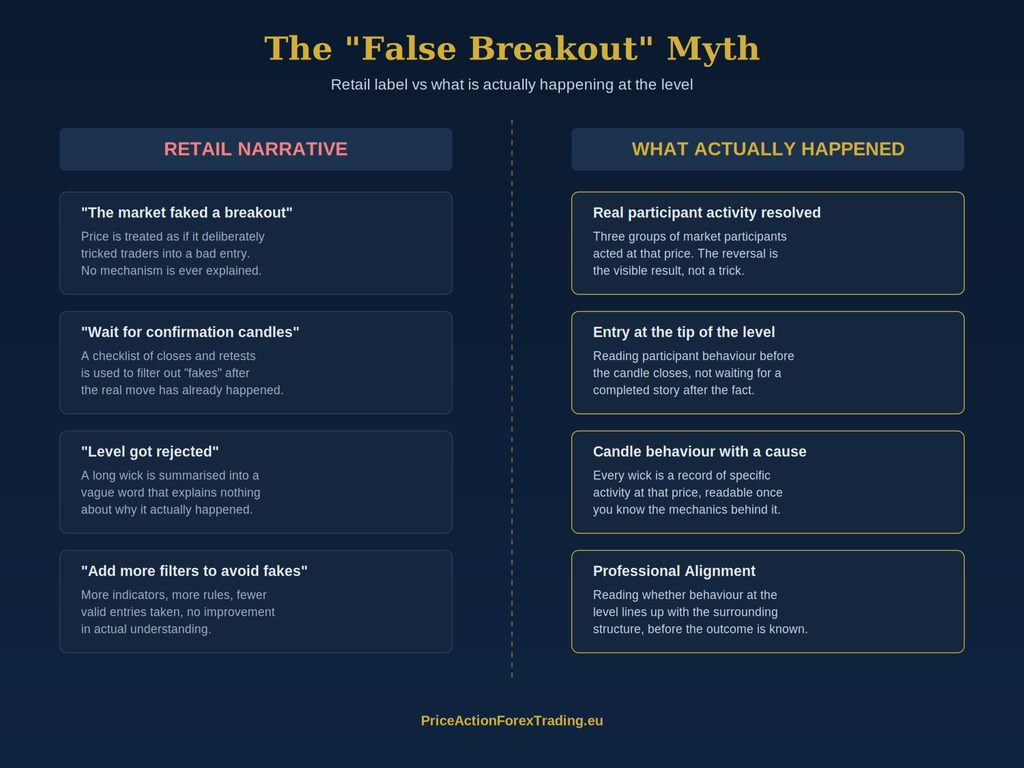
What Is Actually Happening When Price Reverses at a Level
Every single push through a key reversal level that then turns around is the direct result of participant behaviour at that level. Price does not move randomly and it does not move because retail orders alone can push it anywhere meaningful. It moves because of the activity of the market participants who actually have the size and the reason to move it, and those participants operate with intentions that have nothing to do with confirming a breakout for the crowd watching a chart pattern.
At a genuine key reversal level, there are typically three groups of market participants active, each with a different relationship to that price. Who they are and what exactly drives each of them is something I only go into detail on with mentees inside structured training, because it is not information you will find explained accurately anywhere public. But the short version every trader needs to understand is this: what looks like a single breakout attempt to a retail trader watching a candle close is actually several distinct flows of activity overlapping at that price, and the reversal is the visible outcome of that overlap, not a random betrayal of a chart pattern.
Once you can see that, the entire concept of “false” disappears. The move through the level was real. The reversal was also real. Both were produced by the same underlying activity, just at different stages. Nothing was faked.
Why Waiting for “Confirmation” Guarantees You Are Late
Most retail material on this topic tells you to wait for a candle close beyond the level, then wait for a retest, then wait for a second candle to “confirm” the breakout is genuine before entering. This entire sequence is built on the false breakout myth, because its whole purpose is to filter out moves the trader assumes might be fake.
The problem is that by the time all that confirmation has happened, the move that actually mattered is finished. The activity that was going to happen at that key reversal level has already occurred. What retail traders are entering on at that point is the aftermath, not the cause. This is precisely why so many “confirmed” breakout entries still fail: they were never early enough to be part of the actual move, they were reactions to a move that had already played out.
Professional entries happen at the tip of the key reversal level, before the candle closes, not after a sequence of confirmation candles has formed. That requires reading what is happening at the level in real time rather than waiting for the chart to tell a completed story after the fact. This is a skill, and it is trainable, but it cannot be built by memorising a checklist of confirmation candles.
The Language Problem: Why “Rejection” Is Also a Myth
Closely related to the false breakout myth is another piece of retail vocabulary: the “rejection candle.” A long wick forms at a level and traders declare the level “rejected” the price, as though the level itself made a decision. This is the same rationalisation problem wearing a different outfit.
A level does not reject anything. A long wick at a key reversal level is the visible record of specific activity taking place at that price, activity that has a cause and a logic to it once you understand who is behind it. Calling it a “rejection” flattens all of that into a single vague word that explains nothing and teaches the trader nothing. It is descriptive without being useful.
The same applies to the false breakout label. Both terms exist to summarise something the retail trader does not understand into a word that sounds like an explanation. Neither actually is one. If you want to genuinely read candle behaviour at a level rather than label it, you need a framework built around what candles at key reversal levels actually represent, not a glossary of retail shorthand.
Market Structure Makes This Even Harder to See in Real Time
One of the reasons the false breakout myth survives so well is that market structure is genuinely difficult to read while it is unfolding. In hindsight, a chart looks obvious. The push through the level, the reversal, the move back in the original direction, all of it looks clean and predictable once the candles have closed and the outcome is known.
In real time it is a completely different problem. You do not get the benefit of hindsight, and you are watching activity form without knowing yet how it resolves. This is precisely where retail traders reach for the false breakout label, because in the moment it happened they had no framework for understanding what they were watching, and only after the fact does a story get attached to it. Understanding how market structure actually forms in real time, rather than recognising it only in hindsight, is one of the biggest gaps between retail and professional trading.
What Replaces “False Breakout” in Professional Thinking
If the term itself is retired, what does a professional trader actually do at these levels instead of labelling outcomes after the fact?
The starting point is Professional Alignment: reading whether the behaviour at a key reversal level lines up with everything else you know about the current structure, rather than treating each level as an isolated coin flip between “real” and “false.” A push through a level that has no supporting structure behind it is read completely differently in real time than one that does, and that reading happens before the outcome is known, not after.
The second piece is accepting that the decision-making at these levels is not mechanical. It is not a checklist of candle patterns or a rulebook of confirmation criteria. It is professional thinking applied with professional knowledge of how the three groups of participants typically behave at these prices. That is a different skill entirely from pattern recognition, and it is the actual skill that separates traders who can read these levels from traders who need a label to explain what just happened.
None of this requires years to develop, despite what most retail education implies. Under direct, correct training, traders regularly develop this reading ability far faster than the “it takes years” narrative suggests, sometimes seeing a genuine shift in how they read a level within the same session as the training itself.
The Real Cost of Believing in False Breakouts
The false breakout label is not just an inaccurate description, it is actively expensive to hold onto. Once a trader accepts that some breakouts are simply “fake” and unpredictable, they stop trying to understand the mechanics behind them. Instead, they start building filters: extra indicators, extra confirmation candles, extra rules designed to dodge an outcome they believe is random. None of these filters work particularly well, because they are trying to solve a problem that was never correctly diagnosed in the first place. You cannot filter out something you have mislabelled.
This is also why so many retail traders end up with strategies that feel like they are constantly fighting the market. Every filter added to avoid a “false breakout” also removes valid entries, so the strategy becomes both less accurate and less profitable at the same time. The trader ends up further from professional understanding, not closer to it, because every adjustment reinforces the original false premise rather than correcting it.
Compare that to a trader who has actually been shown, through direct training from a mentor who understands the mechanics, what is genuinely happening at these levels. That trader is not filtering out unpredictability. They are reading a specific, recurring pattern of participant behaviour that has a logic to it every single time it occurs. The difference in outcomes between these two traders is not about discipline or risk management. It is entirely about the accuracy of what each of them believes is actually happening on the chart in front of them.
A Practical Way to Start Reframing These Moves
The next time price pushes through a level you were watching and then reverses, resist the urge to reach for the false breakout label entirely. Instead, ask what the behaviour at that price was actually telling you before the reversal happened. Was there anything in the structure leading into that level that suggested the push was unsupported? Was the level itself one with a real history of significance, or one drawn somewhat arbitrarily because price had touched it once before?
This is a habit shift more than a technical one. It means treating every push through a level as data to be read rather than an outcome to be labelled. Over time this rewires how you look at charts entirely, because you stop dividing moves into “real” and “fake” and start reading them as a continuous, meaningful record of participant activity, where every part of the chart carries information rather than being dismissed once it does not fit a pattern.
If you have been trading breakouts using retail confirmation rules, it is worth comparing that approach directly against how these situations are actually read professionally. I cover this in detail in my article on why most breakout strategies get it wrong, which goes further into how key reversal levels behave when price approaches them.
Where to Go From Here
Retiring the false breakout label is not just a vocabulary change. It is the first real step toward reading the forex market the way it actually behaves rather than the way retail education has taught you to describe it after the fact. Every reversal at a level has a cause. None of them are false. The only thing that was ever false was the assumption that the market owed you a clean, predictable pattern in the first place.
If you want to build this reading ability properly rather than continue collecting labels for outcomes you don’t yet understand, Learn to Trade in 5 Days teaches this from the ground up using a single strategy, built specifically to give you genuine professional understanding of how these levels behave, not another checklist of confirmation candles.
Thanks for reading and have a beautiful day!