
When I placed my first forex trade, I had no idea what I was actually doing. I’d watched a few YouTube videos, went to a 5 day broker-organised seminar, opened an account, and convinced myself that if I could just find the right indicator combination, the money would follow. It didn’t. What followed instead was months of blown demo accounts, a live account that bled slowly, and a growing suspicion that everyone selling “guaranteed” forex strategies online had never actually traded a real account under real pressure.
If you’re just starting out, I want to save you some of that time. This isn’t a hype piece about how forex will make you rich by next month. It’s the beginner’s guide I wish someone had handed me before I ever got myself into this game.
Why Forex Attracts So Many Beginners
Forex is the largest financial market in the world, with trillions of dollars changing hands every single day (although not exactly in the way you’d imagine). It’s open nearly 24 hours a day during the week, it doesn’t require huge starting capital, and you can open a demo account in minutes. All of that makes it incredibly accessible – which is both a blessing and a trap.
The blessing is that anyone with a laptop and an internet connection can learn to read a chart and place a trade. The trap is that this same accessibility is exactly why so many beginners jump in without understanding the basics, lose money quickly, and walk away believing forex trading “doesn’t work.” It works. But not the way most people are taught to approach it.
What Is Forex Trading, Really?
At its core, forex (foreign exchange) trading is the buying of one currency while simultaneously selling another. You’re not buying a stock or a company – you’re speculating on the relative value of two currencies against each other. If you believe the euro will strengthen against the US dollar, you buy EUR/USD. If you’re right and the euro rises, you profit. If you’re wrong, you lose.
That simplicity is deceptive. The mechanics are easy to explain in a paragraph. Doing it consistently, with discipline, over hundreds of trades, is a completely different skill – one that takes real study, not a weekend.
How the Market Actually Works: Pairs, Pips, Lots and Leverage
Before you place a single trade, there are four concepts you need to understand cold. I still remember how foreign this vocabulary felt in my first weeks, so let’s break it down simply.
A currency pair like EUR/USD tells you the exchange rate between two currencies – the base currency (EUR) and the quote currency (USD). A pip is the smallest standard unit of price movement, usually the fourth decimal place. A lot is the size of your position – a standard lot is 100,000 units of currency, and most beginners start with mini or micro lots to keep risk manageable. Leverage allows you to control a larger position than your account balance would normally allow, which means both your profits and your losses are magnified.
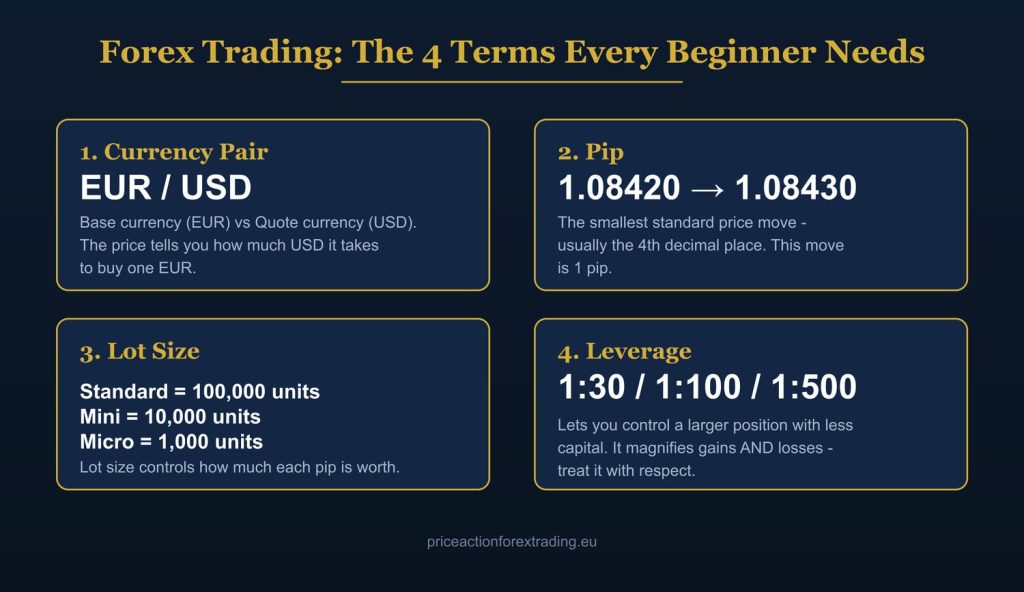
Leverage is the piece that gets new traders into trouble fastest. Used carefully, it’s a tool. Used carelessly, it’s how a small, manageable loss turns into an account-wiping one. Get comfortable with these four concepts before you risk a single euro – they’re the price of entry, but not the skill itself.
The Beginner Trap: Why Most New Traders Lose Money
Almost every beginner loses money in their first year. That’s not pessimism, it’s just what happens when you combine inexperience with real capital and real emotions. A few patterns show up again and again.
New traders over-leverage, risking far more of their account on a single trade than they should. They trade without a plan, entering positions because a chart “looks like” it might move rather than because a defined setup occurred. They chase losses, doubling position size after a loss to “win it back” instead of stepping away. They skip education entirely, jumping straight from a YouTube video to a funded live account. Or, what’s even worse, they respect education and they do buy a nice looking trading course, only to be fed worthless retail bullshit – in other words, paying to be taught how to lose.
I made every one of these mistakes myself. What changed things for me wasn’t a new indicator – it was finding a proper mentor who’d actually traded professionally and could show me, in real time, why my process was broken. If you’re evaluating who to learn from, it’s worth understanding the real difference between a genuine mentor and someone simply selling a course or signals, because that distinction shapes everything about how quickly – and how safely – you progress.
Building Your Foundation: Why I Trade Price Action
There’s no shortage of indicators promising to simplify forex trading – moving averages, oscillators, custom scripts stacked five deep on a single chart. I tried most of them early on. What actually turned things around for me was stripping all of that away and learning to read price action itself: the raw behaviour of candles, how and why the market actually moves.
Price action doesn’t lag behind the market the way indicators do, because it is the market. It also forces you to actually understand what’s happening on the chart rather than outsourcing that judgment to a formula. That’s not to say indicators are useless – some traders blend both effectively – but for a beginner, I’d rather you understand the “why” behind a move before you start layering on tools that can mask that understanding.
This is the approach my entire teaching method is built around. Once you’ve got the basics down, the real work is turning price action reading into a repeatable, profitable process – which is exactly what I focus on with students inside my Forex Training Course. It’s not just a beginner primer; it’s built to take both new and experienced traders and develop them into consistent, professional traders. And for the record, I do use indicators in my trading to avoid having to be glued to charts all day, but I use those indicators differently compared to the retail crowd.
Professional Understanding vs. the Retail Illusion of Knowledge
Here’s something nobody told me early on: knowing what a pin bar is, or being able to name five chart patterns, is not the same as understanding the market. Most retail traders mistake vocabulary for knowledge. They can label a “double top” or an “engulfing candle,” and that labelling gives them a false sense of competence – right up until the market does something their pattern book never covered.
Real, professional understanding of the market comes from studying participant behaviour, not memorising shapes on a chart. Why did price accelerate through that level instead of respecting it? Who was trapped on the wrong side of that move, and what does their forced exit do to the next hour of price action? That’s a completely different question from “does this candle match a picture in a course PDF,” and it’s the question that actually separates traders who survive from traders who are still guessing after five years.
This gap is exactly why so many retail traders plateau. They accumulate more indicators, more patterns, more “confirmations” – and none of it closes the gap, because the gap was never about tools in the first place. It’s about understanding the market as a market: a place where real participants with real motivations are moving real size, not a static image waiting to be pattern-matched. Ask most of the retail traders “who are the participants of the market YOU’re trading in”, and most of them will have no clue or they’ll think they know the answer when in fact they don’t.
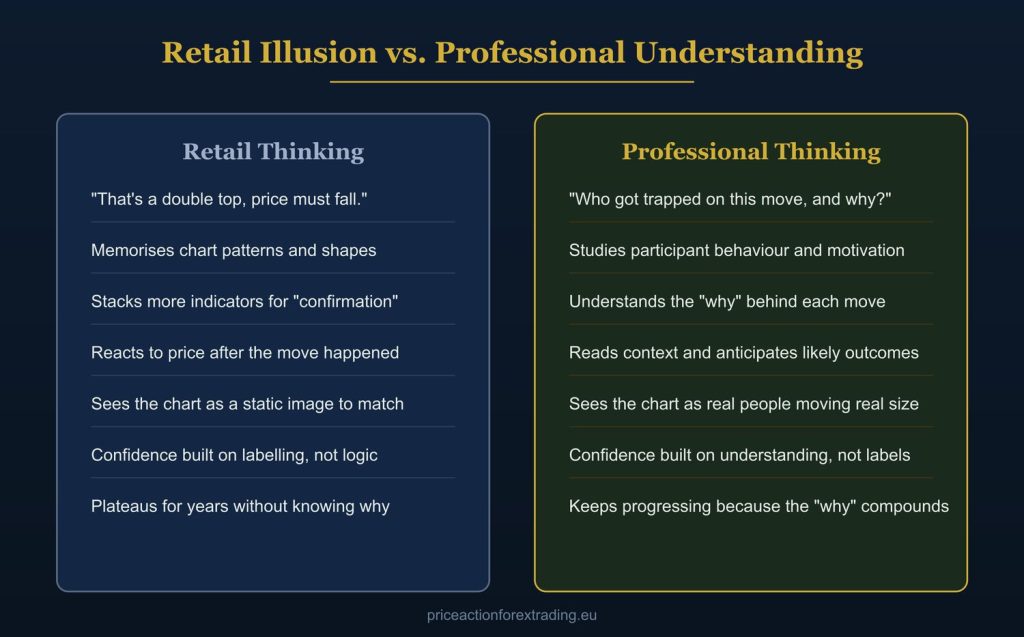
I built these habits the hard way, through years of studying that participant behaviour rather than chasing new indicators. It’s a lot cheaper to learn to see the market this way from someone who’s already done that work than to stumble onto it yourself after a decade of trial and error.
Demo Trading: Useful, But Don’t Stay There Forever
A demo account is genuinely useful for beginners – it lets you get comfortable with a trading platform, practice reading charts, and test a strategy without financial risk. I use demo accounts myself too – when I want to test a new idea on how to improve my trading. But it has a ceiling. Because there’s no real money on the line, demo trading doesn’t teach you the psychological side of this business: the fear of pulling the trigger, the urge to move your stop, the temptation to revenge-trade after a loss, the destructive obsession with outcomes over process. Those only show up once real money is involved.
My advice: use a demo account to confirm your process is sound and your platform mechanics are second nature, but don’t spend a year there under the illusion that you’re “practicing trading.” At some point you need small, controlled real-money exposure to build the actual skill that matters – emotional control under pressure. And also, keep in mind that sometimes the size of your live account will be too small instead of being too large. If you find yourself repeatedly making some weird mistakes on a live account, increasing your trading capital might actually help. There are cases when you’re simply not taking yourself seriously enough when your account size is too small. But I know it’s a very fine balance line in between. I don’t want to say “start big and risk blowing it all”. You do need to find the balance yourself.
Setting Realistic Expectations
I want to be direct about something most beginner guides gloss over: forex trading is not a fast path to income. It can absolutely become a serious, profitable skill – I’ve built my career around it – but it takes months to years of deliberate practice, not days. Anyone promising you consistent five-figure months within weeks of starting is selling you a story, not a skill.
A more realistic first-year goal looks like this: learn the mechanics properly, develop and stick to a defined trading plan, keep a detailed journal of every trade you take, and aim for consistency rather than home-run wins. If you can finish your first year with your account intact and a clear understanding of your own strengths and weaknesses as a trader, that’s a genuine win – even if the profit and loss statement isn’t dramatic yet. The traders who last are the ones who protected their capital long enough to get good, not the ones who tried to get rich in month one.
It also helps to track your progress honestly. Reviewing real trading statements (or even publishing them to a blog) – wins and losses both – keeps you accountable in a way that cherry-picked screenshots never will. That habit alone will teach you more about your own trading than most courses do.
Picking a Broker and Account Type
Your broker is the platform through which every trade you place is executed, so this isn’t a decision to rush. Look for regulation from a recognised financial authority in your region, transparent spreads and commissions, and a platform you actually find intuitive to use. I still use MetaTrader 4 and found it to be much better than cTrader or TradingView. Most people would probably disagree with me, as the MT4 feels old and clumsy, but not everything that shines nicely is actually the best.
Beginners are often tempted by brokers advertising extremely high leverage, sometimes 1:500 or more. Leverage offered is neither good nor bad. When you gain professional understanding, you’ll understand where to use more or less of it. That 500:1 represents the maximum you can use on your account, but the ultimate decision maker is you. I usually choose the highest available (usually 500:1) but on any given trade I use just a small fraction of that. However, by choosing the largest max leverage option I feel safer because it protects me from certain tricks the brokers can use against me, but these are advanced topics that I cover in my training course.
Choosing How You Want to Learn to Trade
Not every beginner wants the same path, and that’s fine. Some people want to become independent, confident traders who understand every decision they make. Others want to move faster with a highly structured, short-term programme. And some simply don’t have the time to learn to trade themselves and would rather have it managed professionally. All three are legitimate, provided you’re honest with yourself about which one you actually are.
If you want a genuine grounding in how I trade, from the fundamentals through to a complete price action method, that’s what the Forex Training Course is built for. If you’d rather get hands-on fast and see how the process works in a condensed format, my Learn to Trade in 5 Days programme is designed exactly for that. Traders who are specifically drawn to shorter-term, faster-paced setups often prefer Learn to Scalp in 5 Days, which focuses on that style specifically. And if, after all this, you decide trading isn’t something you want to do hands-on yourself, my Managed Forex Trading service is worth a look.
There’s no single “correct” route into this market. There is, however, a wrong way to start – which is jumping into a live account with real money before you understand any of what we’ve covered above.
Final Thoughts
Forex trading rewards patience, discipline and a willingness to actually learn the mechanics before risking your capital – and it punishes shortcuts ruthlessly. I say that as someone who took most of the shortcuts myself before figuring out the long way was actually the fast way. Learn the vocabulary. Understand risk before you understand reward. Find a real education source, not just a signal feed or an AI-written PDF/video course. And give yourself permission to become a real professional trader instead of safely calling yourself a “beginner” for a decade.
If you’ve made it this far, you’re already ahead of most people who jump straight to trading without reading anything first. That’s a good sign. Take the next step deliberately.
Thanks for stopping by and wish you all the best.