
A managed forex account is an arrangement where a professional trader makes trading decisions on your behalf, inside an account that stays in your own name at your own broker. That’s the whole concept. Everything else, the different account structures, the fee models, the ways this gets abused, is detail worth understanding before you commit any capital to one.
This article covers how managed accounts are actually structured, where they differ from copy trading and signal services, how guaranteed-return products actually work versus performance-fee managed accounts, and what to check before you sign anything.
The Core Mechanism: Limited Power of Attorney
A managed account works through a Limited Power of Attorney (LPOA), sometimes called trading authority. This is a legal document granting a named third party permission to open and close trades on it. It does not grant permission to withdraw funds. Withdrawal rights stay with the account owner (you) – unless you separately and explicitly authorize otherwise, which you shouldn’t.
This distinction is the entire basis of a legitimate managed account. The moment money leaves your own named account at a regulated broker and moves into someone else’s wallet, company account, or an unregulated pooled structure, you’re no longer dealing with LPOA-based management.
PAMM, MAM, and Privately Managed Accounts: The Real Differences
These three terms get used interchangeably in marketing material, and that’s part of the problem, because they carry meaningfully different risk profiles.
PAMM (Percentage Allocation Management Module) pools investor capital into a single master account. Your deposit becomes a percentage share of that pool, and trades are executed once at the master level, then allocated proportionally across every investor. You don’t own individual positions; you own a fractional claim on the pool’s overall equity. This is efficient for the manager and the broker, but it means your outcome is tied to everyone else’s capital movements in and out of the same pool, not just to the trading itself.
MAM (Multi-Account Manager) is closer in spirit to individual account management than it is to PAMM, despite the similar name. A manager trades from a master interface, but each investor’s account remains separately held, with its own lot sizing, its own leverage, and often its own risk multiplier relative to the master strategy. You can typically see your own account’s individual trade history, not just a pooled statement. It’s a middle ground: more operationally efficient for a manager running many clients, while keeping your capital and your trade record separated from other investors’.
Privately managed accounts go furthest in the other direction. The manager trades your account directly, one account at a time, under LPOA. There’s no pooling and no master allocation logic sitting between the decision and your account. It’s the most transparent structure, and also the least scalable for a manager, which is worth knowing, because it shapes how many clients a manager can realistically take on without their attention getting diluted.
None of the three is automatically dishonest. But if a manager can’t clearly explain which structure you’d be in and why, that’s worth pausing on before you go further.
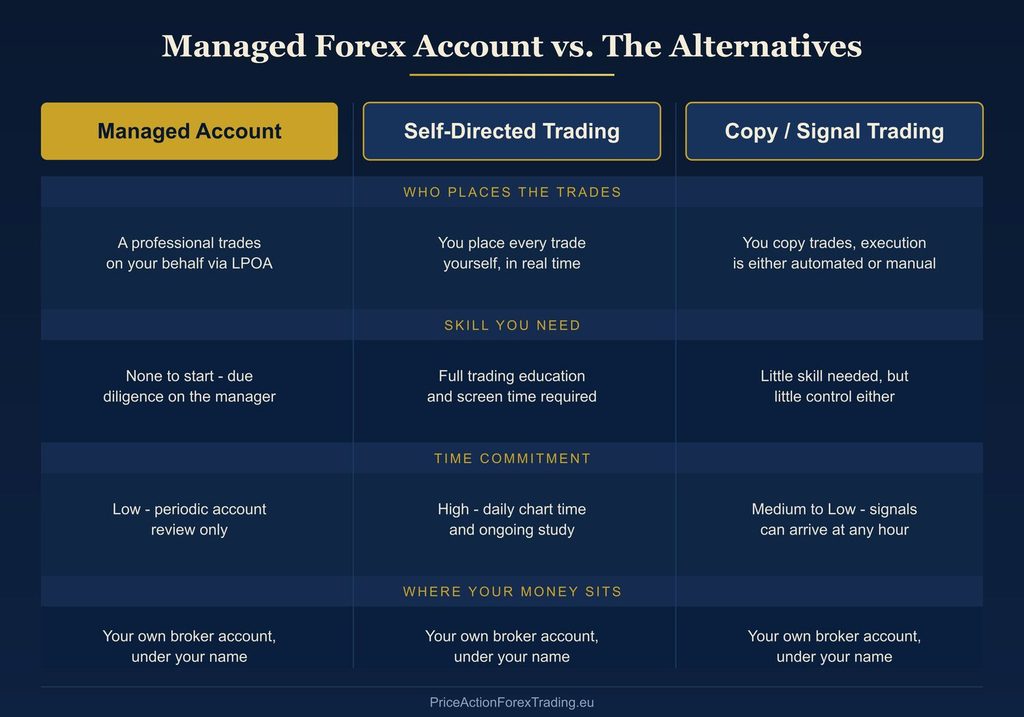
Managed Accounts vs. Learning to Trade Yourself
These solve different problems. A managed account gives you market exposure without you having to develop the skill yourself. Learning to trade gives you the skill itself, at the cost of the time it takes to build it properly.
If the goal is capability you own indefinitely, that only comes from structured, deliberate practice, not from watching someone else’s results. My Forex Training Course exists for people taking that route.
If the goal is simply return on capital without becoming a trader, a properly structured managed account is a more direct answer than either of those courses, and you should evaluate it on its own terms rather than as a substitute for learning.
Managed Accounts vs. Copy Trading: The Real Problem
Copy trading platforms let you automatically mirror another trader’s positions into your own account. The pitch is simple: find a trader with good results, connect your account, and their trades replicate into yours in real time.
Trading without a fixed stop-loss order isn’t inherently reckless. Plenty of experienced traders run strategies without one, managing risk instead through position sizing, exposure limits, or structural invalidation levels that don’t sit as a mechanical order on the platform. That’s a legitimate professional approach, and it looks nothing like what usually dominates copy trading leaderboards.
The actual problem on most copy platforms is what sits behind the missing stop, not the absence of the stop itself. The traders who climb highest on public leaderboards typically get there by taking oversized positions relative to their account size, often adding to losing trades (martingale or grid-style) without any coherent framework for how much exposure that can absorb before it becomes unrecoverable. There’s no professional risk management happening, and no stop, because there’s no plan for what happens if the trade keeps moving the wrong way. It just keeps getting bigger until the account can’t hold it.
That combination produces a smooth, high-win-rate equity curve for months or even years, because almost every trade eventually turns around given enough added size and enough time. It looks exceptional on a leaderboard sorted by return. It isn’t. It’s an account carrying steadily increasing, undefined risk, and undefined risk doesn’t fail gradually. It fails once, entirely, when a large enough adverse move arrives (a surprise rate decision, a geopolitical shock, a broker gap over a weekend) that the position size can no longer absorb. The curve that looked flawless for eighteen months can be wiped out in a single session.
This is a structural feature of that specific style of copy-trade leaderboard trading, not just bad luck. The longer it runs without failing, the more followers it attracts, and the larger the eventual damage when it does. If you’re evaluating a trader to copy, the relevant question isn’t simply “do they use a stop.” It’s whether their position sizing has a defined ceiling regardless of how a losing trade develops, and whether they can explain that ceiling in specific terms rather than pointing at a smooth equity curve as proof enough.
Guaranteed Returns vs. Performance-Fee Managed Accounts
Guaranteed returns aren’t automatically a scam, but they’re a completely different product from a standard managed account, and the two get confused constantly.
A legitimate guaranteed-return product works because the provider, not the investor, is absorbing the downside risk. In exchange for that certainty, the return offered is deliberately conservative, well below what the actual trading typically produces, because the investor is paying a premium for security rather than for maximum upside. This is closer to a fixed-income or structured product than to a typical trading arrangement. I offer this myself as one option, alongside my managed account service: a lower, fixed rate, because I’m the one carrying the risk if trading conditions turn against the position.
A standard managed account works on the opposite principle. There’s no guarantee, because the risk is shared between you and the manager rather than carried entirely by one side. If the account draws down, you feel that directly, not the manager. In exchange, the upside is shared too, and the manager is typically compensated only through a performance fee on profit generated, meaning they earn nothing if you don’t. That alignment, only getting paid when you get paid, is the actual safeguard in this structure, not a promised number.
What separates a real guaranteed product from a Ponzi structure isn’t the presence of a guarantee. It’s whether the provider can explain, specifically, how the guarantee is backed: what capital reserve, hedge, or conservative allocation makes it possible for them to absorb a loss and still pay you the promised return. If a guarantee is offered with no explanation of what stands behind it, and the return is high rather than conservative, that combination is the actual warning sign, because the only way to fund a high fixed return without a real backing structure is to pay it from new investor deposits. That’s a Ponzi mechanic regardless of how it’s marketed.
Fees: What You’re Actually Paying For
Managed account fee structures generally combine two components: a management fee, a flat percentage charged on the capital under management regardless of performance, and a performance fee, a share of the profits generated, usually calculated against a high-water mark so the manager only gets paid on new profit, not on regaining ground after a loss.
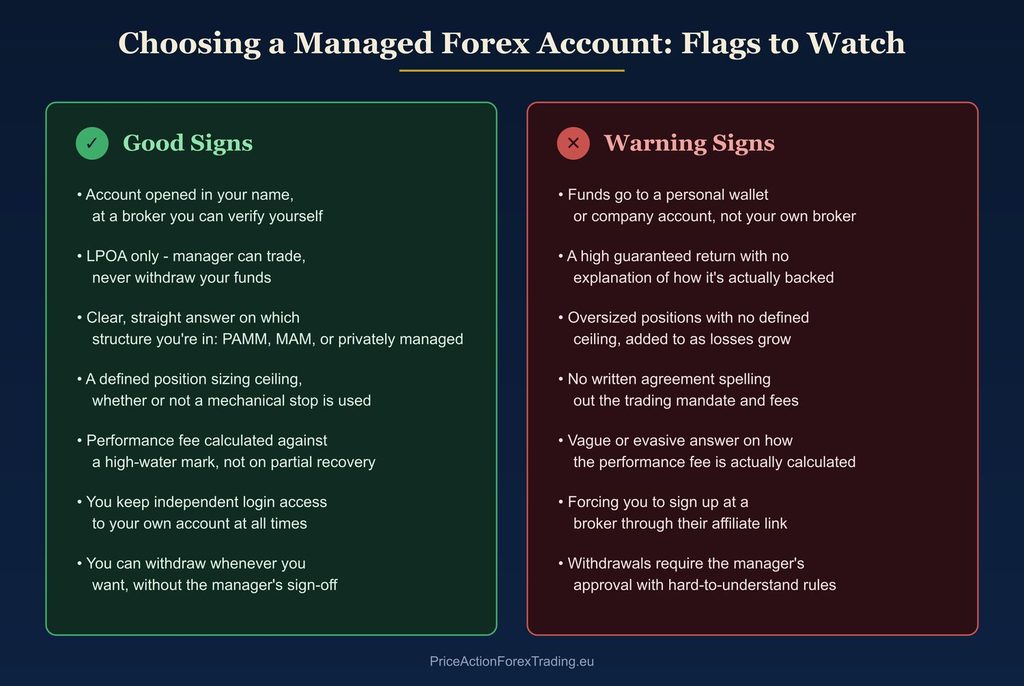
Watch for structures that skip the high-water mark. Without one, a manager can lose money one month, recover part of it the next, and still collect a performance fee on that partial recovery, effectively getting paid twice for the same ground. Ask directly how the performance fee is calculated and whether losses carry forward before new profit is counted.
Fund Custody and Regulation
Before anything else, confirm where your money actually sits. In a properly structured managed account, funds remain with a regulated broker, in an account opened in your own name, using your own identification documents. You should retain full login access to that account independently of the manager’s LPOA access at all times.
Look up the broker’s regulatory status yourself rather than taking a manager’s word for it. Regulation doesn’t guarantee the manager is competent, that’s a separate question entirely, but it does mean client funds are legally required to be held separately from the broker’s own operating capital, and there’s a recognized authority to escalate to if something goes wrong. If a manager insists you open your account exclusively through their own referral link and discourages you from verifying the broker independently, that’s reason enough to slow down.
Keep in mind that I often direct clients to offshore entities of worldwide-known brokers for higher flexibility. However, I only do it with brokers who have multiple licences in Tier 1 countries (e.g. EU, UK, Australia) and who have good reputation. I don’t deal with brokers who are licensed only in offshore jurisdictions as it means they are not well capitalised and there’s too much financial incentive for them to simply run away with your capital.
A Managed Forex Account Option
I run a Managed Forex Trading service structured as an individual account under LPOA, compensated on a performance-fee basis, for people who’ve weighed this against the alternatives above and decided it fits what they’re looking for. The page covers the structure and terms directly.
Frequently Asked Questions
Is a managed forex account safe? No form of market exposure is risk-free. What a properly structured managed account gets right is custody: your funds stay in your own name, at your own regulated broker, and the manager never holds withdrawal rights.
What’s the difference between PAMM, MAM, and a privately managed account? PAMM pools your capital with other investors’ into a single fund and allocates trades proportionally. MAM keeps your account operationally separate with its own lot sizing while trading from a shared master strategy. A privately managed account has a manager trading your account directly, with no pooling or shared allocation involved.
Can I lose money in a managed forex account? Yes. Any process exposed to market movement can produce losses. The relevant question isn’t whether losses are possible, they always are, but how positions are sized and what’s the underlying logic behind the trading decisions.
What’s the difference between a managed account and a hedge fund? A managed forex account usually keeps your capital in an individually held broker account under LPOA. A hedge fund pools investor capital into a single legal fund structure, typically with less visibility into individual trade decisions and a different regulatory framework.
Can I withdraw my money whenever I want? In an individual managed account, yes, because the account is opened in your name and you retain independent access to it. If withdrawals require the manager’s sign-off or route through a portal separate from your own broker login, clarify that before depositing anything.
Can a managed forex account offer guaranteed returns? A standard performance-fee managed account, no, because risk is shared between you and the manager rather than carried by one side. Guaranteed-return products exist as a separate offering, where the provider absorbs the downside risk directly and prices that certainty into a deliberately conservative, fixed rate.
Final Thoughts
A managed forex account is a straightforward arrangement in principle: your money, your named account, someone else making the trading decisions under a legal authority that stops well short of letting them touch your funds. Where it goes wrong is almost always in the gap between that principle and the structure actually being used, whether that’s a pooled account presented as individual, a copy-trade leaderboard built on undisciplined position sizing, or a guaranteed return with no explanation of what’s actually backing it.
Check the structure, check custody, check how position sizing, fees, and any guarantee are actually backed, and treat any of those questions being dodged as your answer.