
Brokers love to tell you a nice, soothing story about the forex market. They’ll say its daily turnover is $9.6 trillion. They’ll let that number sit in your mind until it starts to feel like an ocean of untouched treasure – money and businesses quietly swapping currencies all day long, with no idea that traders like you could dip in and scoop some of it out.
Then comes the pitch: “Imagine if you could extract just 0.000001% of that turnover. That’s $96,000 in a single day. Anyone can do it, right?”
Wrong. And once you understand why, you’ll see the forex market in a completely different light – which is exactly what this article is here to do.
Where the $9.6 Trillion Number Actually Comes From
Before we go further, you need to separate two things that brokers love to blur together: what happens in your trading account, and what happens “out there” in the real world of foreign exchange. They are not the same thing, and they barely touch each other.
Let’s look at two everyday examples of real foreign exchange happening.
Example one. A tourist from Europe lands at an airport in Australia. He walks up to the currency exchange booth, hands over 500 euros, and receives 820 Australian dollars in return.
Example two. A company in the United States receives an invoice from a European supplier for 1,000,000 euros. Someone in the finance department logs into the company’s bank account and sends an international transfer. The bank deducts 1,090,000 US dollars to cover it.
Both of these are genuine foreign exchange transactions. Both get counted inside that famous $9.6 trillion daily figure. Multiply these two simple examples by millions of similar transactions happening every day – tourists, importers, exporters, central banks, pension funds – and you arrive at the total turnover number brokers love to quote.
Now ask yourself an honest question: what makes anyone think that clicking “buy” or “sell” on a trading platform somehow lets them dip into those transactions? Even if it were possible, it would be theft. Picture that European supplier receiving only 900,000 euros instead of the agreed 1,000,000, for no explainable reason – say, because your trade somehow “took a cut” from their transfer. That kind of shortfall would never go unnoticed. Banks reconcile these amounts to the cent. The deal would break, lawyers would get involved, and someone would go to prison.
Here’s the part that should stop you cold: none of those transactions ever pass through your broker. So how exactly is your broker supposed to pay you out of a $9.6 trillion pool it was never connected to in the first place? It can’t. Something doesn’t add up – and that’s because the whole premise is built on a myth.
There’s No Such Thing as “The” Forex Market
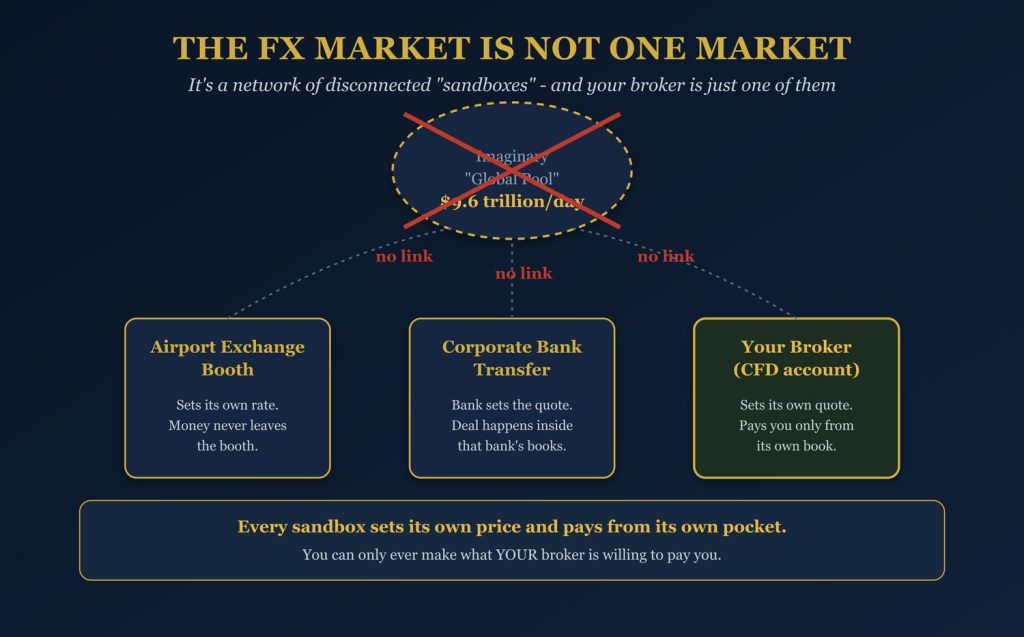
The truth is simpler and, frankly, a little less exciting than the brochure version: there is no single, centralised forex market that your trades plug into. The $9.6 trillion figure is nothing more than a sum – a statistical total of countless individual, unrelated transactions. It is not a market’s turnover in the sense of one shared pot of liquidity that participants draw from.
Every one of those FX transactions happens inside its own closed environment. Think of them as separate sandboxes. You’ve probably heard forex described as a “decentralised, over-the-counter market” – this is exactly what that phrase means. There is no exchange floor, no single order book, no central authority matching every buyer with every seller the way a stock exchange does.
The tourist exchanging euros for Australian dollars is transacting inside the sandbox of that particular exchange booth. The money he hands over doesn’t get released into some mythical global market – it stays with the booth. And critically, it’s the booth that decides what exchange rate to offer him, not “the market.”
The same logic applies to the company paying its European supplier. That transaction happens entirely inside the sandbox of their bank. The bank sets its own quote for the euro-to-dollar conversion, and the transaction is settled within the bank’s own books.
Your trades work exactly the same way. Whatever you buy or sell at your broker stays inside the sandbox of that broker. Your broker is the one quoting you prices. Which means the uncomfortable truth is this: you can only ever make as much money as your broker is willing to pay you. You are not siphoning value out of some bottomless global reserve – you’re negotiating, trade by trade, with one specific counterparty.
What You’re Really Buying When You Click “Buy”
There’s another layer to this that most retail traders never stop to think about. When you click “buy” on your trading platform, you are almost never buying an actual currency. In the vast majority of retail setups, you’re buying a CFD – a contract for difference.
A CFD is an agreement between you and your broker about the price movement of an asset. No physical or even electronic transfer of currency takes place between you and “the market.” Your trade doesn’t get bundled into that $9.6 trillion global turnover figure at all – unless your broker decides it needs to hedge its own exposure to you by going out and buying the real currency in the wholesale market. That only tends to happen once a trader becomes large enough, or consistently profitable enough, that the broker doesn’t want to carry the risk of paying you out of pocket.
For the overwhelming majority of retail accounts, none of that happens. Your profit or loss is simply a number that moves between your account and your broker’s balance sheet. That’s the entire transaction. There’s no invisible thread connecting your MT4 terminal to a European invoice or an airport currency booth.
Sandboxes Aren’t Completely Isolated – But There’s Still No Central Pool
None of this means every sandbox is a sealed island with zero connection to the rest of the world. Banks talk to other banks. Large institutions hedge with each other across borders. Liquidity providers connect brokers to bigger liquidity pools upstream. These connections are real, and they’re what makes forex a genuinely global, interconnected system rather than a collection of totally isolated shops.
But interconnected is not the same as centralised. There is still no single marketplace where all $9.6 trillion physically flows through one pipe that you, as a retail trader, are plugged into. Your broker sits at the end of a long chain of sandboxes, and what happens upstream of that chain has very little to do with whether your account grows or shrinks today.
Why This Matters for How You Actually Trade
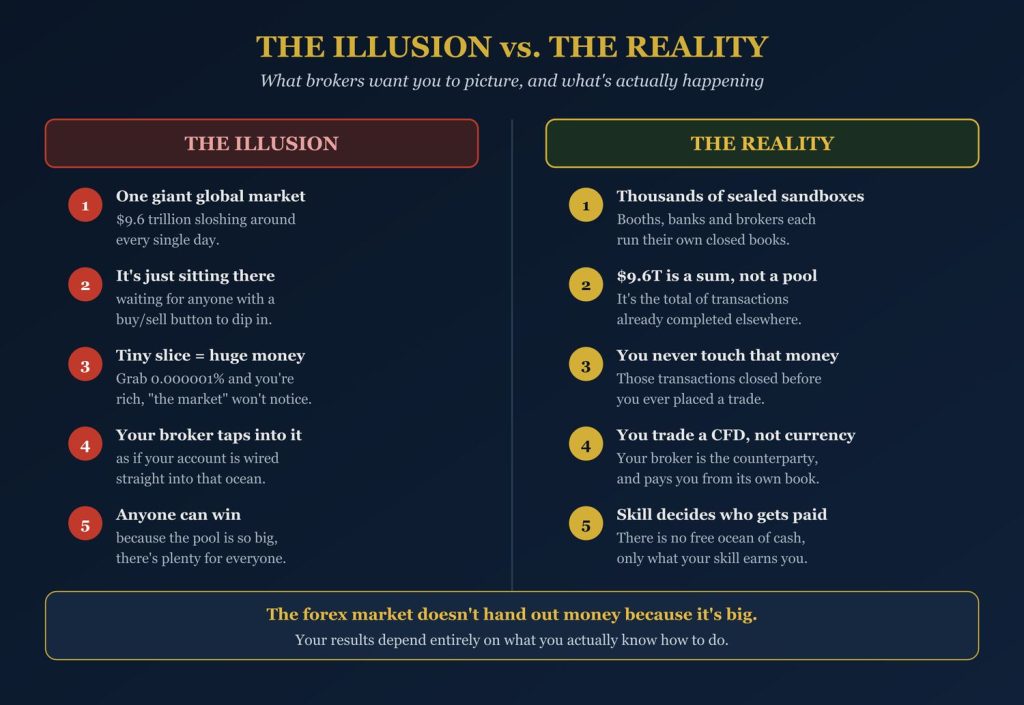
Understanding this changes the entire way you should think about “making money in forex.” You’re not competing against a $9.6 trillion ocean. You’re not trying to grab an invisible sliver of somebody else’s international wire transfer. You are trying to consistently win against a very specific, very real counterparty: your broker, and the other traders inside that same sandbox.
That reframing matters because it kills two dangerous myths at once.
Myth one: the market is so big that anyone can profit from it effortlessly. Size has nothing to do with whether you personally make money. A trillion-dollar backdrop doesn’t make a losing strategy profitable, any more than a huge stock market makes every stock picker rich. If you don’t understand price action – the actual mechanics of why price moves where it moves – the size of the number on a brochure is irrelevant to your account balance. I wrote about this exact misunderstanding in why news announcements don’t move the market the way the textbooks claim – the forex market runs on real cause and effect, not on the comforting stories retail traders are told to keep them clicking buttons.
Myth two: retail education that ignores this structure is harmless. It isn’t. Most retail content treats forex as if it were one giant casino floor where the house edge barely matters because the pot is infinite. That framing keeps people trading recklessly, chasing signals, and blaming “the market” instead of learning how price actually behaves inside their own broker’s environment. Once you understand you’re trading inside a sandbox with a real, finite counterparty, you start taking your edge far more seriously – because now you know exactly who you’re up against.
What Actually Determines Whether You Get Paid
If size and access to some mythical global pool aren’t what decide your results, what does? Three things, and none of them are exotic:
- Whether you genuinely understand price behaviour inside the environment you’re trading, rather than relying on lagging indicators or recycled “strategies” copied from forums.
- Whether your risk management is strict enough that a string of losing trades doesn’t wipe you out before your edge has a chance to play out.
- Whether you can execute your plan without emotional interference – because your broker doesn’t care how you feel about a trade, only what you actually clicked.
None of these three things has anything to do with the size of the daily FX turnover figure. You could trade in a market with $96 billion of daily turnover or $96 trillion, and it wouldn’t change a single one of these requirements. This is precisely why proper training matters so much more than the marketing brochures suggest – you’re not trying to out-muscle a giant market, you’re trying to out-think one specific counterparty using skills that can genuinely be learned. That’s the whole premise behind my forex training and mentoring course – teaching you to read price the way it actually behaves, not the way brokers pretend it behaves.
If You Want to See This in Practice Quickly
If you’d rather see the mechanics for yourself before committing to a longer course, I run a condensed programme called Learn to Trade in 5 Days, where I walk you through exactly how price moves inside your broker’s sandbox and how to read it without relying on lagging indicators or recycled retail strategies.
For traders who are drawn to fast, short-term setups rather than swing positions, Learn to Scalp in 5 Days covers the same core principles applied to a much tighter timeframe – useful once you understand that you’re trading against a specific counterparty and need precision, not just volume of trades.
And if trading isn’t something you want to do yourself but you still want exposure to the market, my managed forex trading service lets you put your capital to work while I handle the execution, using the same understanding of market structure covered in this article.
The Bottom Line
The $9.6 trillion figure is real, but it’s not what brokers imply it is. It’s a sum of finished transactions, not a shared pool waiting for you to dip into. Every foreign exchange transaction – from an airport currency booth to a multinational wire transfer to your own CFD trade – happens inside its own closed sandbox, with its own quotes, set by whoever runs that sandbox.
Your broker is your counterparty. Your results depend on what happens between you and them, trade by trade, not on the size of some imaginary global reservoir. Once that illusion falls away, you stop chasing the fantasy of an infinite market and start focusing on the only thing that was ever actually going to make you money: understanding how price genuinely behaves, and trading that understanding with discipline.
That shift in perspective alone puts you ahead of most of the retail crowd, who are still out there believing they’re one lucky trade away from scooping up a slice of $9.6 trillion that was never theirs to take.