
Most traders treat range trading like a consolation prize. If the market isn’t trending, the thinking goes, you’re stuck buying the bottom and selling the top of a boring box until something more exciting happens. That framing is exactly why most range trades lose money. A range isn’t a boring pause between the “real” moves – it’s one of the clearest windows you’ll ever get into how the three groups of market participants are actually behaving, and reading it correctly is a skill in its own right.
I trade ranges often, and I trade them very differently from the way they’re taught on YouTube or in most forums. In this article I’ll walk through what a forex range actually represents, why the retail approach to it fails so consistently, and how I structure a range trade using the same principles I use everywhere else in my trading.
What a Forex Range Actually Is
A range forms when price oscillates between a ceiling and a floor without making sustained progress in either direction. Retail material describes this as “support and resistance” holding the price in place, as if there were two static lines and the job is simply to buy near one and sell near the other. I’ve written before about why that entire framework is incomplete, and a range is where the gap between the retail version and the professional version shows up most clearly.
What’s really happening during a range isn’t something I can lay out in a public article – the actual reason a range holds where it holds is part of what I train mentees on directly. What I can say is that a range is not empty or directionless just because price isn’t making sustained progress. There’s constant activity inside that box, and every candle inside it is telling part of the story to someone who knows how to read it. Retail material tends to fill that gap with guesses about what “must” be happening, and most of those guesses are wrong.
This is also why I don’t treat a range as a special category that needs its own separate rulebook. It’s still built from key reversal levels, the same proprietary concept I use to read every other kind of price behaviour, whether that’s a pullback, a breakout, or a full trend. A range simply means price is currently oscillating between two key reversal levels instead of pushing through them.
Why Most Retail Range Trading Fails
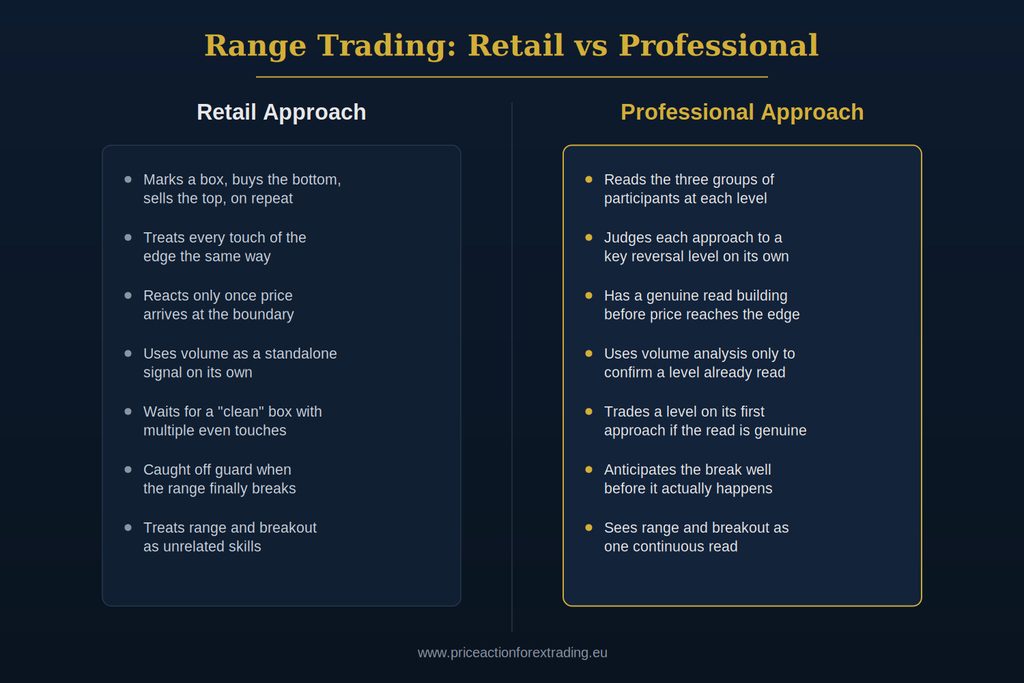
The standard retail approach is mechanical: mark the top and bottom of the range, buy near the bottom, sell near the top, and repeat until the range breaks. It sounds simple enough to work, and occasionally it does – which is exactly the problem, because it works often enough to convince traders it’s a real edge before it eventually stops working and gives back everything they made.
The reason it fails is that the retail trader is reacting to price location alone. They see price near the bottom of a visible box and assume it will bounce, with no genuine read on what’s actually happening at that zone – just an assumption based on where the price happens to be sitting. A range doesn’t hold forever. At some point the same zone that produced three clean bounces won’t produce a fourth, and the mechanical trader has no way of knowing in advance which visit to the edge is the one that breaks. They find out with their stop loss.
I see this constantly in how retail traders talk about ranges: bounce off the bottom, bounce off the top, treat every touch of the level the same way. But not every touch of the same price level is created equal. What matters is what’s happening at that level each time price returns to it, not simply that price has arrived there again.
How I Read a Range
My approach starts from the same place every other setup starts from: understanding where price is actually going to based on the behaviour of the three groups of market participants, not just the boundaries of the box on the chart. A range gets interesting to me the moment I have a genuine read on what’s building at one side of it, even while price is still technically inside the box.
That’s the distinction I want to be clear about. A mechanical range trader waits for price to arrive at the edge and then acts. I’m reading what’s building toward that edge before price ever gets there, which tells me whether the eventual touch is likely to hold or fail. This is the same professional thinking I apply to trend structure and to every other part of my process – the specifics of what I’m reading in a given range are part of what I train mentees on directly, because writing out every detail publicly would hand away the exact edge that makes this worth trading.
What I can say is that volume analysis plays a confirming role here, never a standalone one. I don’t look at volume in isolation and decide a range edge will hold or break based on that number alone. Volume only means something to me once price is already at a key reversal level – it either supports what the level is already telling me or it doesn’t. Used any other way, volume becomes just another lagging indicator dressed up to look more sophisticated than it is.
The Structure of a Professional Range Trade
When I do take a trade inside a range, it’s built on Professional Alignment – multiple pieces of the picture agreeing with each other before I commit. That includes the key reversal level itself, the way price is behaving as it approaches that level, and the confirming read from volume analysis once price arrives. None of these on their own is enough. It’s the alignment between them that turns a range edge from a guess into a trade I’m willing to take with real size.
This is also where professional thinking replaces mechanical discipline. Retail material tends to frame range trading execution around position sizing rules and “stick to your plan” platitudes, as if the hard part is emotional control once the trade is already identified. In my experience the hard part happens earlier – it’s whether you correctly read the level in the first place. Get that right, and the execution stage is simply applying what you already know with the confidence that comes from actually understanding what’s in front of you.
I’d also point out that a range trade isn’t restricted to a particular session. I don’t treat London differently from New York or Tokyo when I’m reading a range – the same principles apply regardless of when the range happens to be forming. The clock isn’t part of what determines whether a level holds.
When a Range Is About to Break
Every range eventually ends, and the way it ends tells you almost as much as the range itself. I’ve written in detail about how I read a breakout, and what actually causes a range to break is, again, part of what stays confidential to mentees rather than something I can lay out publicly.
The retail crowd tends to treat every approach to the edge of a range the same way, right up until the one that breaks – and then they’re caught leaning the wrong way, either still trying to fade a level that’s no longer holding or chasing a move that’s already left them behind. Because I already have a genuine read building before the break happens, rather than reacting to the break itself, I’m not relying on the breakout candle to tell me something has changed. By the time most traders notice the range has broken, I’ve usually already had a read on it building for several candles.
This is also why I don’t separate “range trading” and “breakout trading” into two unrelated skill sets that need to be learned independently. They’re two views of the exact same underlying behaviour – what the three groups of participants are doing at a key reversal level – just observed at different points in time.
Common Mistakes Traders Make With Range Trading
A few patterns come up repeatedly with traders who struggle with ranges. The first is treating the range as a fixed, unchanging box the moment it’s drawn, rather than reassessing the boundaries as new information comes in. A range is a live read, not a static rectangle you mark once and trade against for the next two weeks.
The second is trading every single touch of the range boundary with equal conviction. Some approaches to a key reversal level are backed by genuine strength behind them, and some aren’t. Treating them identically is how a trader ends up with a string of small wins followed by one loss that erases all of them.
The third is ignoring how a range sits within the bigger picture. A range that forms after a strong prior move is being read by a different group of participants than a range that forms after a long period of indecision, even if the two boxes look identical on a chart. Context matters, and it’s part of what separates a read built on real understanding from one built on pattern matching a shape.
The fourth mistake, and one of the most common, is assuming a range needs to display a particular structure before it can be traded at all. I regularly see traders wait for a certain number of touches on each side, or insist a range must be perfectly flat and symmetrical before they’ll consider it valid. That’s another checklist dressed up as analysis. What actually qualifies a range edge to be traded is genuine understanding of what the three groups of participants are doing at that key reversal level, not how many times price has previously visited it or how tidy the box looks on the chart. A range can be tradable on its very first approach to a level if the read behind that level is genuine, and it can remain untradable after a dozen touches if the read isn’t there.
How a Range Compares to a Trending Market
It’s worth being clear that a range isn’t a separate discipline from trend trading. The tools I use don’t change between the two – only the outcome of what I’m reading changes.
This is part of why I don’t think of “range trading” as a niche skill that sits apart from everything else I do. A trader who genuinely understands how to read a key reversal level can apply that understanding whether price is trending, ranging, or transitioning between the two. A trader who only knows mechanical rules for one specific market condition will always be caught off guard the moment conditions shift, because their approach was never built on understanding in the first place – it was built on a pattern that happened to work until it didn’t.
Where This Fits Into Learning to Trade Properly
None of this comes from public sources, and that’s not a knock on the people producing that content – it’s simply that this level of market reading isn’t something that gets taught for free, or in most paid courses either. It’s the kind of understanding that gets built under direct mentorship, and it can be built a lot faster than most traders assume. I don’t believe you need years of screen time to get here. I believe you need the right training.
If you want to build this understanding from the ground up, my Forex Training Course covers exactly this kind of market reading, and it’s built for traders at any stage, not just beginners or only advanced traders. If you’d rather get a complete, standalone strategy you can start applying immediately, my Learn to Trade in 5 Days programme teaches professional market understanding through one strategy in full, and traders have gone on to be profitable from that course alone.
Ranges aren’t the boring part of the market. They’re one of the clearest places to see who’s actually in control, if you know what you’re looking at.
Thanks for reading and have a beautiful day!